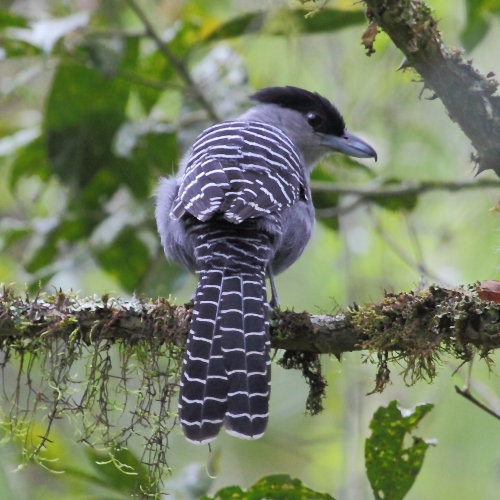
Dot-backed Antbird
Hylophylax punctulatus
Order: Passeriformes / Family: Thamnophilidae

Wikimedia Commons
About the Dot-backed Antbird
The Dot-backed Antbird, scientifically known as Hylophylax punctulatus, thrives in the dense, humid undergrowth of tropical lowland rainforests, primarily in the Amazon Basin. This bird plays a vital ecological role as a part of the intricate food web of these biodiverse regions. Its presence is indicative of healthy forest ecosystems, as it predominantly occupies undisturbed habitats. In terms of geographic distribution, the Dot-backed Antbird can be found in countries such as Brazil, Peru, Colombia, and Ecuador, where it is often seen flitting through the shadows of the forest floor. The bird is non-migratory, maintaining its territories year-round, which it defends vigorously against intruders. Seasonal behaviors of the Dot-backed Antbird include heightened vocal activity during the breeding season, which typically corresponds with the rainy season in its habitat. Its ecological significance is further underscored by its role in controlling insect populations, as it feeds primarily on ants and other small arthropods. Moreover, the bird's foraging habits contribute to the natural pest control within its environment. The Dot-backed Antbird is also an important subject for studies on avian behavior and ecology, as its interactions with the environment and other species provide insights into the complexities of tropical rainforest ecosystems. Despite its relatively stable population, the species faces threats from deforestation and habitat fragmentation, which could potentially impact its numbers in the future. Conservation efforts are crucial to ensure the preservation of its natural habitat, which is vital for the survival of this and countless other forest-dependent species.
The Dot-backed Antbird belongs to the family Thamnophilidae, within the order Passeriformes. These birds typically live estimated average 3-5 years, with limited data on maximum lifespan..
How to Identify a Dot-backed Antbird
Adult Dot-backed Antbirds exhibit a striking plumage with a predominantly black body adorned with white spots on the back, giving them their common name. Males and females are similar in appearance, though females may have slightly less contrast in their plumage. Juveniles differ from adults, displaying a more muted coloration that lacks the distinct spotting of mature birds. The bird's small size, approximately 12-13 centimeters in length, aids in its camouflage within the dense forest understory. In terms of flight silhouette, the Dot-backed Antbird is compact with a short tail, which is typical for birds adapted to maneuvering through thick vegetation. When perched, it often adopts a horizontal posture, which helps it stay concealed from predators. This species can be confused with other antbirds in the same habitat, but its unique spotted back serves as a distinguishing feature. Observers should note the bird's quick, darting movements and its preference for staying low to the ground, often hopping rather than flying.
Having trouble telling birds apart? Upload a photo to our bird identification tool for an instant species match.
Dot-backed Antbird Habitat and Range
Preferred Habitat
The Dot-backed Antbird inhabits the lowland tropical rainforests of the Amazon Basin, thriving in areas with dense understory and abundant leaf litter. It prefers elevations ranging from sea level to about 500 meters, where the humidity and foliage provide ample cover and foraging opportunities. This species shows a marked preference for pristine forest environments over degraded or secondary growth areas. Unlike some of its relatives, the Dot-backed Antbird is not commonly found in urban or suburban settings. It remains largely within forest interiors, avoiding open areas and edges. Seasonal shifts in habitat are minimal, as the bird is non-migratory and remains within its established territories throughout the year.
Geographic Range
The Dot-backed Antbird's range is centered within the Amazon Basin, covering parts of Brazil, Peru, Colombia, and Ecuador. It occupies a relatively narrow band of habitats, with the highest population densities found in areas of undisturbed forest. Unlike migratory species, the Dot-backed Antbird maintains stable territories year-round, exhibiting little to no seasonal movement. This sedentary lifestyle is typical for many species within the Thamnophilidae family, which tend to be highly territorial. The bird's distribution is influenced by the availability of dense, humid forest environments, which provide the cover and food resources necessary for its survival. While it is not considered widespread beyond its core range, within suitable habitats, it can be quite common, contributing to the rich avian diversity of the region.
Want to know which birds visit your area? Browse our backyard birds by location guides for region-specific species lists.
What Does the Dot-backed Antbird Eat?
The Dot-backed Antbird's diet primarily consists of ants and other small arthropods, which it captures through a methodical foraging technique. Utilizing its keen eyesight, the bird scans the leaf litter and forest floor, often following army ant swarms to take advantage of disturbed prey. This behavior is typical of many antbirds, earning them their group name. In addition to ants, the Dot-backed Antbird also consumes beetles, spiders, and occasionally small fruits. Seasonal changes in diet are minimal, as the bird relies on the consistent availability of its primary prey within the rainforest. The Dot-backed Antbird exhibits diurnal feeding patterns, actively foraging during the daylight hours, with peak activity occurring during the early morning and late afternoon when insect activity is highest.
Dot-backed Antbird Behavior and Social Structure
The Dot-backed Antbird is known for its solitary or pair-based social structure, rarely forming large groups. It is highly territorial, with individuals or pairs vigorously defending their chosen areas from conspecifics. Courtship displays are subtle and involve mutual preening and low vocalizations. The Dot-backed Antbird shows a strong preference for remaining close to the ground, where it engages in its characteristic foraging behavior. Though generally quiet, it becomes more vocal during the breeding season, using a series of soft calls to communicate with its mate and defend its territory. In response to predators, the Dot-backed Antbird employs a strategy of stealth and stillness, relying on its cryptic plumage to avoid detection rather than fleeing. Daily activity patterns show that the bird is most active during cooler parts of the day, with a notable decrease in movement and vocalizations during the hottest midday periods.
Dot-backed Antbird Nesting and Reproduction
Dot-backed Antbirds construct cup-shaped nests using materials such as leaves, twigs, and vines, which they skillfully weave together to provide stability and camouflage. These nests are typically located low to the ground, often hidden within dense vegetation to protect against predators. The typical clutch size ranges from two to three eggs, which both parents incubate. The incubation period lasts approximately 14 to 16 days, after which the chicks hatch and are cared for by both parents. Fledging occurs about 12 to 14 days post-hatching, with the young remaining under parental supervision for several weeks before becoming independent. The Dot-backed Antbird generally produces one to two broods per year, with breeding activity closely tied to the rainy season, which provides the necessary conditions for raising young.
Dot-backed Antbird Sounds and Vocalizations
The primary song of the Dot-backed Antbird is a series of soft, rhythmic whistles, often described as a musical 'tew-tew-tew.' These calls are delivered in a deliberate manner, with each note distinct and clear. In addition to its song, the Dot-backed Antbird produces a variety of call notes, including soft chirps and trills used for communication between mates and signaling territory. Alarm calls are sharper and more abrupt, serving to alert others of potential threats. During the dawn chorus, the Dot-backed Antbird's song is more prominent, contributing to the symphony of sounds that define the rainforest morning. Its vocalizations, while not as loud or varied as some other species, play a crucial role in its social interactions.
Interesting Facts About the Dot-backed Antbird
- 1The Dot-backed Antbird is part of the Thamnophilidae family, which includes over 200 species of antbirds, each with unique adaptations.
- 2Despite their small size, Dot-backed Antbirds are highly territorial and will defend areas as large as 1,500 square meters from intruders.
- 3These birds are often seen accompanying army ant swarms, capitalizing on the insects flushed out by the ants' movements.
- 4The Dot-backed Antbird's distinctive spotted plumage provides effective camouflage, mimicking the dappled light of the forest floor.
- 5Both male and female Dot-backed Antbirds participate equally in nesting duties, from building the nest to feeding the chicks.
- 6The Dot-backed Antbird's habitat, the Amazon Basin, is one of the most biodiverse regions on Earth, hosting thousands of bird species.
- 7Unlike many other bird species, Dot-backed Antbirds do not migrate, maintaining territories year-round in the same forested areas.
Dot-backed Antbird Conservation Status
The Dot-backed Antbird is currently listed as Least Concern by the IUCN, reflecting its relatively stable population across its range. However, ongoing threats such as deforestation and habitat fragmentation could pose significant challenges in the future. The primary threat to the Dot-backed Antbird is the loss of its rainforest habitat due to logging, agriculture, and infrastructure development. Conservation efforts are focused on preserving large tracts of contiguous forest, which are essential for maintaining the ecological integrity required by this species. Historical population changes have been minimal, but continuous monitoring is necessary to ensure that future impacts do not lead to declines. Efforts to protect the Amazon Basin as a whole are critical for the long-term survival of the Dot-backed Antbird and the myriad other species that call this region home.