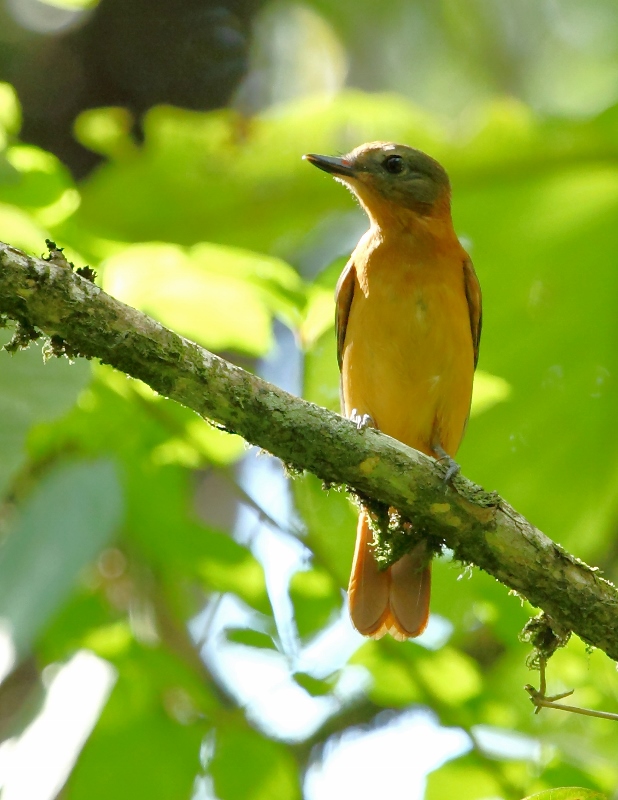
Dull-capped Attila
Attila bolivianus
Order: Passeriformes / Family: Tyrannidae

Wikimedia Commons
About the Dull-capped Attila
The Dull-capped Attila (Attila bolivianus) is a captivating bird species belonging to the Tyrannidae family, renowned for its distinct vocalizations and vibrant presence in lowland forests across South America. This species plays a pivotal role in its ecosystem, acting as both predator and prey within the intricate food web of tropical forests. Found primarily in the Amazon Basin, the Dull-capped Attila is a key indicator of forest health, contributing to the control of insect populations through its feeding habits. Its distribution spans several countries, including Brazil, Bolivia, and Peru, where it inhabits a variety of forested environments, from pristine rainforests to secondary growth areas. The ecological significance of the Dull-capped Attila is underscored by its interactions with other species, particularly during the breeding season, when it becomes a target for nest predators, thus enhancing the biodiversity of its habitat. This bird exhibits intriguing seasonal behaviors, with some populations undertaking short-distance migrations to exploit seasonal food resources. Despite its name, the Dull-capped Attila is anything but dull; its presence in the forest is marked by its vibrant calls and distinctive foraging techniques, making it a favorite among birdwatchers and researchers alike. As a testament to its adaptability, the Dull-capped Attila can thrive in a range of forest types and elevations, although it shows a strong preference for humid, lowland areas where insect abundance supports its dietary needs. The Dull-capped Attila's role in seed dispersal, though less pronounced than its insectivorous habits, further highlights its importance in maintaining the ecological balance of its native regions. Seasonal changes in rainfall and temperature influence its behavior and distribution, prompting shifts in foraging patterns and vocal activity. During the wet season, when insect populations peak, the Dull-capped Attila becomes particularly active, taking advantage of the abundant food supply to rear its young successfully. This adaptability to environmental changes ensures the continued survival and success of the species in the face of shifting climate patterns. The Dull-capped Attila is a testament to the resilience and complexity of tropical forest ecosystems, providing invaluable insights into the dynamics of biodiversity and habitat conservation. Its ability to coexist with human-altered landscapes highlights the potential for sustainable coexistence between wildlife and human development. As researchers continue to study the Dull-capped Attila, they uncover new aspects of its behavior and ecology, contributing to our understanding of avian biodiversity in one of the world's most biologically diverse regions.
The Dull-capped Attila belongs to the family Tyrannidae, within the order Passeriformes. These birds typically live average 5 years, with a maximum recorded of 9 years..
How to Identify a Dull-capped Attila
The Dull-capped Attila is a medium-sized bird measuring around 17-20 cm in length, with a distinctive olive-brown plumage that sets it apart from similar species. Adults display a uniform coloration on the upperparts, with a paler, buffy belly and a subtle grayish crown that gives the bird its 'dull-capped' appearance. Juvenile Dull-capped Attilas resemble adults but may have slightly more mottled plumage and a less distinct cap. Both male and female Dull-capped Attilas exhibit similar plumage, making it challenging to differentiate between the sexes in the field. A keen eye is needed to separate the Dull-capped Attila from other attilas and flycatchers in the region, particularly the Bright-rumped Attila (Attila spadiceus), which has a more vivid rump and overall brighter coloration. In flight, the Dull-capped Attila presents a robust silhouette with strong, rounded wings and a moderately long tail, characteristics typical of the Tyrannidae family. When perching, it maintains an upright posture, often in the mid-canopy, where it can be spotted scanning for prey or vocalizing prominently. Observers can identify this bird by its unique combination of coloration, posture, and vocalizations, differentiating it from other passerines in its habitat.
Having trouble telling birds apart? Upload a photo to our bird identification tool for an instant species match.
Dull-capped Attila Habitat and Range
Preferred Habitat
The Dull-capped Attila inhabits a variety of forested environments, with a strong preference for lowland tropical forests. It thrives in pristine rainforests, secondary growth areas, and forest edges, demonstrating a remarkable adaptability to different forest types. This species is typically found at elevations ranging from sea level to around 1000 meters, although it favors the humid, insect-rich environments of the Amazon Basin. Seasonal shifts see the Dull-capped Attila adjusting its habitat preferences slightly, moving to areas with higher insect activity during peak breeding and feeding times. While not commonly found in urban areas, the Dull-capped Attila can occasionally be spotted in rural settings where forest cover remains intact. Its presence in these diverse habitats underscores the importance of forest conservation efforts in maintaining the ecological balance of these regions.
Geographic Range
The Dull-capped Attila's range primarily encompasses the northern and central regions of South America, with significant populations found in countries such as Brazil, Bolivia, Peru, and Ecuador. This bird inhabits the vast expanse of the Amazon Basin, where it occupies a mosaic of tropical forest types. While the Dull-capped Attila is considered a resident species, some populations exhibit altitudinal migrations, moving to lower elevations during cooler months in search of food. These movements are generally localized, as the species does not undertake long-distance migrations typical of other passerines. Within its range, the Dull-capped Attila appears more densely populated in areas with extensive forest cover and minimal human disturbance, underscoring the importance of large, contiguous habitats for its survival. As a non-migratory bird, its presence in specific regions remains relatively stable throughout the year, although local weather patterns and food availability can influence its distribution at a finer scale.
Want to know which birds visit your area? Browse our backyard birds by location guides for region-specific species lists.
What Does the Dull-capped Attila Eat?
The Dull-capped Attila is primarily insectivorous, feeding on a diverse array of arthropods that populate its forest habitat. Its diet includes beetles, caterpillars, spiders, and other insects, which it captures using a combination of sit-and-wait tactics and active foraging. During the wet season, when insects are abundant, the Dull-capped Attila becomes particularly active, often seen gleaning insects from foliage or catching prey mid-flight. In addition to insects, this bird occasionally consumes small fruits and berries, supplementing its diet with plant matter, particularly when insect prey becomes scarce. The Dull-capped Attila's feeding schedule aligns with the diurnal activity of its prey, with peak foraging occurring during the early morning and late afternoon hours. The bird's robust bill and agile movements enable it to exploit a wide range of food sources, ensuring its survival in the dynamic environment of tropical forests.
Dull-capped Attila Behavior and Social Structure
The Dull-capped Attila exhibits a range of behaviors that reflect its adaptability and ecological role in tropical forests. Primarily a solitary bird, it maintains well-defined territories during the breeding season, vigorously defending these areas from intruders through vocalizations and physical displays. Its courtship behavior involves elaborate singing and displays of plumage to attract mates, with successful pairs forming monogamous bonds for the duration of the breeding season. Outside of breeding, the Dull-capped Attila may join mixed-species foraging flocks, benefiting from the increased vigilance and foraging efficiency of group living. In response to predators, this bird employs a combination of alarm calls and evasive maneuvers to protect itself and its nest. The Dull-capped Attila's daily activity pattern is largely diurnal, with peak activity during the cooler parts of the day, reflecting the typical behavior of many tropical passerines.
Dull-capped Attila Nesting and Reproduction
The Dull-capped Attila constructs its nest in the dense understory of tropical forests, often selecting well-concealed sites to protect against predators. Its nests are typically cup-shaped structures made from twigs, leaves, and fibers, lined with softer materials such as moss or feathers. Clutch size usually ranges from 2 to 3 eggs, which the female incubates for approximately 14-16 days. During this period, the male plays a crucial role in providing food for the female and guarding the nest site. Once hatched, the chicks are altricial and require intensive parental care, with both parents contributing to feeding and protection. Fledging occurs around 18-21 days after hatching, after which the young birds continue to rely on their parents for support. The Dull-capped Attila typically raises one brood per year, although favorable conditions may allow for an additional brood in some cases.
Dull-capped Attila Sounds and Vocalizations
The Dull-capped Attila is known for its distinctive vocalizations, which are a key component of its territorial and courtship behaviors. Its primary song consists of a series of melodious, flute-like whistles that vary in pitch and rhythm, often delivered from a high perch within its territory. These songs serve to establish territory boundaries and attract potential mates. In addition to its primary song, the Dull-capped Attila produces a variety of call notes, including sharp 'chip' sounds used for communication between mates or signaling alarm. During the dawn chorus, this bird's vocalizations can be heard throughout the forest, adding to the rich auditory tapestry typical of tropical habitats. The clarity and repetition of its song make it a familiar sound to those accustomed to the rainforest's acoustic environment.
Interesting Facts About the Dull-capped Attila
- 1The Dull-capped Attila is known for its impressive vocal range, with songs that can be heard over 100 meters away in dense forest.
- 2Despite its name, the Dull-capped Attila exhibits a striking variety of calls, making it a standout performer in the dawn chorus.
- 3The species' name 'Attila' is derived from the Hunnic ruler Attila the Hun, reflecting the bird's bold and assertive nature.
- 4The Dull-capped Attila's diet includes over 50 different insect species, showcasing its adaptability and foraging skill.
- 5This bird's nest is often so well camouflaged that even experienced birders can struggle to locate it in the understory.
- 6Dull-capped Attilas are monogamous, with pairs often returning to the same nesting territory year after year.
- 7Their ability to thrive in secondary growth forests highlights the importance of forest regeneration for biodiversity.
Dull-capped Attila Conservation Status
The Dull-capped Attila is currently listed as a species of Least Concern by the IUCN, reflecting its relatively stable population across much of its range. Despite this status, habitat loss due to deforestation and land-use change poses ongoing threats to its long-term survival. Conservation efforts focused on preserving large tracts of tropical forest are critical to maintaining the species' habitat and ecological role. Historically, the Dull-capped Attila's population has remained stable, benefiting from its adaptable nature and wide distribution. However, continued monitoring and habitat protection are essential to ensure that this species does not experience the declines seen in other forest-dependent birds.
Other Tyrannidae Species


Birds Similar to the Dull-capped Attila
These species are often confused with the Dull-capped Attila due to similar appearance or overlapping range.