
Dull-mantled Antbird
Sipia laemosticta
Order: Passeriformes / Family: Thamnophilidae

Wikimedia Commons
About the Dull-mantled Antbird
The Dull-mantled Antbird (Sipia laemosticta) is a noteworthy member of the family Thamnophilidae, renowned for its role in the complex ecological web of Central America's tropical forests. This bird primarily inhabits the humid lowland and foothill forests stretching from Honduras through Nicaragua, Costa Rica, and into western Panama. It thrives in the understory, an often shadowy realm rich in leaf litter and decaying vegetation, crucial for its survival.
Throughout its range, the Dull-mantled Antbird plays a significant role as both predator and prey. By specializing in a diet of insects and small arthropods, it contributes to the control of insect populations, which might otherwise grow unchecked. Its presence indicates a healthy, functioning forest ecosystem, as it relies on the abundance of invertebrate prey that dense, undisturbed forests provide. These birds are also part of mixed-species flocks, a common strategy among understory birds to enhance foraging efficiency and reduce predation risks.
Seasonally, the Dull-mantled Antbird's behavior remains relatively consistent, although breeding activities peak during the wet season when food is abundant. During this time, males become particularly vocal, using their calls to establish and defend territories. The species is primarily sedentary, showing little evidence of long-distance migration, although it may make short, elevation-related movements in response to seasonal availability of forest resources. This species, with its distinctive vocalizations and ecological role, represents the intricate balance of tropical forest ecosystems.
The Dull-mantled Antbird belongs to the family Thamnophilidae, within the order Passeriformes. These birds typically live average 3-5 years with a maximum recorded of 8 years..
How to Identify a Dull-mantled Antbird
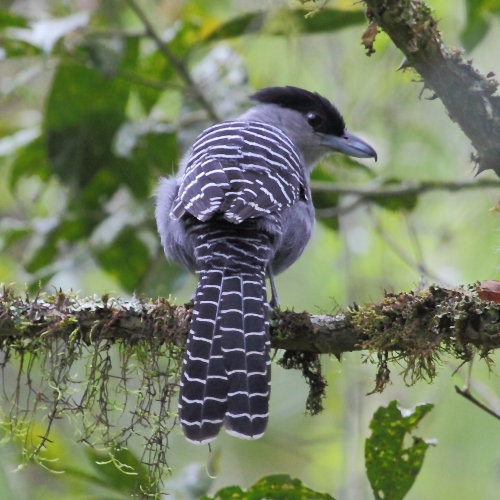
The Dull-mantled Antbird is a small, striking bird with a distinctive plumage that aids in its identification. Adult males feature a predominantly dark slate-gray body with a black throat and upper chest, contrasting with a deep rufous belly and flanks. Their eyes are a bright red, a striking feature that stands out in the dimly lit understory.
Females, while similar in size and overall shape, differ in coloration. They exhibit a more muted overall gray, lacking the deep black throat of the males. Their underparts are also slightly paler, though the rufous belly remains a defining characteristic. Juveniles resemble females but are even less distinctly marked, often appearing more uniformly gray until they mature.
In terms of behavior, the Dull-mantled Antbird often perches low in dense vegetation, making use of its cryptic coloration to remain hidden from predators. Its flight is typically short and direct, characterized by rapid wingbeats as it moves between perches within the thick understory. When seen in profile, its silhouette is compact, with a short, stout bill perfectly adapted for snapping up insect prey.
Having trouble telling birds apart? Upload a photo to our bird identification tool for an instant species match.
Dull-mantled Antbird Habitat and Range
Preferred Habitat
The Dull-mantled Antbird thrives in the dense, humid lowland and foothill forests of Central America. It prefers areas with thick understory vegetation, often near streams or other bodies of water that support a rich diversity of insect life. Elevation-wise, it can be found from sea level up to around 1,200 meters, although it is most commonly observed at mid-elevations.
Unlike species that adapt well to urban or heavily altered landscapes, the Dull-mantled Antbird requires undisturbed forest habitats. It does not typically venture into open areas or secondary growth, preferring the continuous cover of mature forests. Seasonal habitat shifts are minimal, as this bird is largely sedentary, though it may move slightly in elevation in response to local rainfall patterns that influence prey availability.
During the wet season, when insect populations peak, the Dull-mantled Antbird's need for dense, rich understory becomes even more pronounced, as it relies on the abundance of invertebrates for feeding and breeding success.
Geographic Range
The geographic range of the Dull-mantled Antbird spans several Central American countries. It occupies a narrow corridor from eastern Honduras and Nicaragua through Costa Rica, reaching into western Panama. Within this range, the bird is typically found in the Caribbean foothills and adjacent lowlands, areas characterized by lush, humid forests.
Unlike migratory species, the Dull-mantled Antbird is largely resident, exhibiting no significant seasonal migrations. However, it may undertake local movements within its range, particularly in response to environmental conditions that affect food availability, such as variations in rainfall. Population density is generally higher in regions where extensive tracts of undisturbed forest remain, with hotspots noted in Costa Rica's lowland rainforests.
Despite its relatively restricted range, the Dull-mantled Antbird's presence across multiple countries highlights the importance of transnational conservation efforts to protect the contiguous forest habitats this species depends upon.
Want to know which birds visit your area? Browse our backyard birds by location guides for region-specific species lists.
What Does the Dull-mantled Antbird Eat?
The diet of the Dull-mantled Antbird primarily consists of insects and other small arthropods, making it an important insectivore within its ecosystem. It often feeds on ants, beetles, and spiders, which it gleans from the leaf litter and low foliage, employing a methodical foraging technique.
During the wet season, when insect populations surge, the Dull-mantled Antbird can be seen actively hopping through dense vegetation, probing crevices and overturning leaves to uncover hidden prey. Its stout bill is well-suited for capturing and consuming a wide range of invertebrates, from small ants to larger beetles.
The bird's feeding schedule is largely diurnal, with peak activity occurring early in the morning and again in the late afternoon when temperatures are cooler and insect activity is high. Seasonal diet variations are minimal, though the abundance of certain prey types may influence its foraging patterns at different times of the year.
Dull-mantled Antbird Behavior and Social Structure
The Dull-mantled Antbird exhibits intriguing behaviors that are vital for its survival in the forest understory. This species is generally monogamous, forming long-term pair bonds that facilitate cooperative breeding efforts. Territoriality plays a significant role in its behavior, with males vigorously defending their territories through distinctive vocalizations and occasional physical confrontations with rivals.
During breeding periods, males engage in elaborate courtship displays, which include singing and presenting food items to females as part of the pair bond strengthening process. These displays are crucial for maintaining the pair's territory and ensuring reproductive success.
The Dull-mantled Antbird is typically solitary or found in pairs, rarely forming large flocks. However, it often associates with mixed-species flocks, a strategy that increases foraging efficiency and reduces predation risk. In response to predators, this bird relies on its cryptic plumage and rapid flight to escape threats, retreating into dense vegetation when alarmed.
Its daily activity patterns are strongly diurnal, with peaks in activity occurring during the cooler parts of the day. This bird's ability to adapt its behavior to the challenges of its environment highlights its evolutionary success as a forest understory specialist.
Dull-mantled Antbird Nesting and Reproduction
Nesting habits of the Dull-mantled Antbird reflect its adaptation to dense forest environments. It constructs a cup-shaped nest, carefully woven from plant fibers, leaves, and twigs, which it typically situates in low shrubs or among vines, less than a meter above the ground. This strategic placement provides camouflage and protection from predators.
The female lays a clutch of approximately two eggs, which she incubates for about 14-16 days. Both parents share incubation duties, taking turns to ensure the eggs remain at a constant, suitable temperature. Once hatched, the altricial chicks are nurtured by both parents, who provide regular feedings of small insects and care until fledging.
Fledging occurs roughly 12-14 days after hatching, during which time the young birds develop the necessary skills for independent survival. Parental care continues for a short period post-fledging, ensuring the juvenile birds are well-prepared to thrive on their own. Typically, the Dull-mantled Antbird raises one brood per year, although favorable conditions may occasionally allow for a second.
Dull-mantled Antbird Sounds and Vocalizations
The vocalizations of the Dull-mantled Antbird are distinctive and play a critical role in its behavioral ecology. The primary song is a series of clear, melodious whistles that rise and fall in pitch, often described as 'whee-whee-whee, chuu-chuu.' This song is frequently heard at dawn and dusk, serving both to establish territory and to maintain pair bonds.
In addition to its song, the Dull-mantled Antbird emits a variety of call notes, including sharp 'pik' sounds and complex chatter used in communication between mates and within mixed-species flocks. Alarm calls are more abrupt and harsh, designed to alert other birds to the presence of predators.
The bird's dawn chorus is particularly notable, with males engaging in a vocal duel to assert dominance and territorial rights. These sounds, while melodious, serve as a critical tool for survival in the dense forests where visual signals might otherwise be obscured.
Interesting Facts About the Dull-mantled Antbird
- 1The Dull-mantled Antbird is often found in mixed-species flocks, benefiting from increased foraging efficiency and safety in numbers.
- 2Despite its name, the Dull-mantled Antbird's intricate plumage provides excellent camouflage against the forest floor and leaf litter.
- 3This bird's red eyes are a striking adaptation, aiding in communication and mate recognition in the dimly lit forest understory.
- 4The Dull-mantled Antbird's song has been likened to the rhythmic pattern of a flute, a quality that makes it easily distinguishable.
- 5These birds are particularly vocal during the wet season, when they engage in intense territorial disputes with neighboring pairs.
- 6The Dull-mantled Antbird's preference for dense forest understory highlights its role as an indicator species for forest health.
- 7In areas where forests are intact, the Dull-mantled Antbird serves as an effective control agent for insect populations, preserving ecosystem balance.
Dull-mantled Antbird Conservation Status
According to the IUCN Red List, the Dull-mantled Antbird is currently classified as a species of Least Concern. However, its population trend is believed to be decreasing due to ongoing habitat loss and fragmentation, primarily from deforestation for agriculture and urban development. Conservation efforts focus on preserving large tracts of intact forest habitats, essential for maintaining viable populations of this and other forest-dependent species. Protected areas and reserves in countries such as Costa Rica and Panama play a critical role in safeguarding the habitats this bird relies upon. While the Dull-mantled Antbird is not immediately threatened, continued monitoring and habitat conservation are necessary to ensure its long-term survival. Historical data indicates stable populations in undisturbed areas, underscoring the importance of habitat protection in conservation strategies.
Other Thamnophilidae Species



Birds Similar to the Dull-mantled Antbird
These species are often confused with the Dull-mantled Antbird due to similar appearance or overlapping range.

