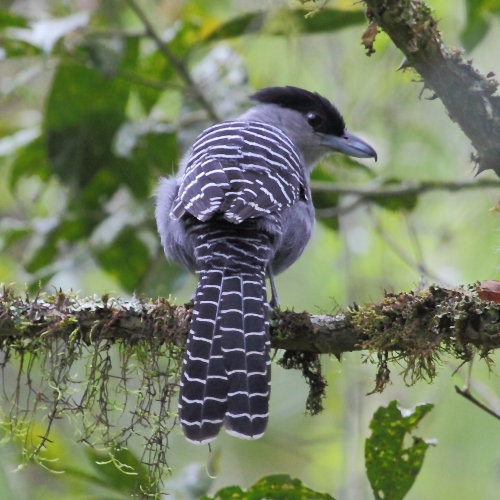
Dusky Antbird
Cercomacra tyrannina
Order: Passeriformes / Family: Thamnophilidae

Wikimedia Commons
About the Dusky Antbird
The Dusky Antbird (Cercomacra tyrannina) is a small passerine bird belonging to the Thamnophilidae family, renowned for its affinity for dense forest understories. This bird is predominantly found throughout the tropical regions of Central and South America, including countries like Costa Rica, Panama, Colombia, and Ecuador. Its presence in these biodiverse areas underscores its ecological role as a participant in the complex web of forest life. The Dusky Antbird primarily occupies lowland and foothill forests, often residing at altitudes ranging from sea level to 1,200 meters. Its preference for dense, tangled vegetation makes it an integral part of the ecosystem, contributing to insect population control as a skilled forager.
The Dusky Antbird is significant not only for its ecological role but also for its contribution to the biodiversity of the regions it inhabits. Its presence is often indicative of a healthy forest environment, as it relies on undisturbed habitats with rich understory growth. The bird’s subtle coloration and elusive behavior make it an intriguing subject for birdwatchers and ornithologists alike. The Dusky Antbird is known for its distinctive calls, which play a crucial role in communication and territory defense. As a non-migratory species, it remains within its range throughout the year, adapting to seasonal changes in food availability and habitat structure.
In terms of ecological interactions, the Dusky Antbird often participates in mixed-species foraging flocks, where it benefits from the collective vigilance and varied foraging techniques of multiple bird species. This behavior not only enhances its foraging efficiency but also reduces the risk of predation. The bird's presence in such flocks highlights its adaptability and cooperative nature. During the breeding season, which typically coincides with the onset of the rainy season, the Dusky Antbird becomes more territorial, with pairs defending their nesting sites aggressively. Its reproductive success relies on the availability of suitable nesting sites and abundant food resources, making habitat conservation essential for its long-term survival.
The Dusky Antbird belongs to the family Thamnophilidae, within the order Passeriformes. These birds typically live average 5 years, with the maximum recorded age being 7 years..
How to Identify a Dusky Antbird
The Dusky Antbird is a small bird, measuring about 13 centimeters in length. Its plumage is predominantly gray and brown, allowing it to blend seamlessly into the forest understory. Adult males and females display subtle differences in coloration, with males typically exhibiting a slightly darker, more uniform gray than females. Females often have a browner hue on their upperparts, providing a slight sexual dimorphism that can aid in field identification.
Juvenile Dusky Antbirds resemble females but tend to have a more mottled appearance, with the brown tones more pronounced. These subtle differences are crucial for birders attempting to distinguish between age classes and sexes in the field. Despite its name, the Dusky Antbird lacks the bold patterns often associated with other antbird species, instead opting for a more subdued appearance that suits its secretive lifestyle.
In flight, the Dusky Antbird displays a short, rounded silhouette, with its wings appearing relatively broad compared to its body size. This compact form complements its behavior as it maneuvers through dense vegetation. On the perch, the Dusky Antbird adopts a somewhat horizontal posture, often remaining motionless for extended periods as it scans for prey. This behavior, combined with its muted colors, can make it challenging to spot despite its vocal presence in the forest.
Having trouble telling birds apart? Upload a photo to our bird identification tool for an instant species match.
Dusky Antbird Habitat and Range
Preferred Habitat
The Dusky Antbird thrives in the dense understory of tropical forests, primarily occupying lowland and foothill regions. It is commonly found in primary and secondary growth forests, as well as forest edges that offer abundant cover and food resources. It favors regions with high humidity and dense foliage, which provide both protection from predators and ample foraging opportunities.
Elevation plays a role in its habitat preference, with the Dusky Antbird typically occurring from sea level up to about 1,200 meters. While it is less common in urban areas, it can sometimes be found in rural gardens and plantations adjacent to forested areas, indicating some level of adaptability to human presence. Seasonal habitat shifts are minimal, as the Dusky Antbird is non-migratory and tends to remain within its established territory throughout the year.
The presence of this bird in a particular area often signals a well-preserved forest environment, as it relies on thick, tangled vegetation for nesting and foraging. Its preference for such habitats underscores the importance of conserving these ecosystems to maintain healthy bird populations and the overall ecological balance.
Geographic Range
The Dusky Antbird has a distribution that spans the Neotropics, with its range extending from southern Mexico through Central America to the northern parts of South America. It is commonly found in countries such as Costa Rica, Panama, Colombia, Venezuela, Ecuador, and parts of Peru. This extensive range covers a variety of forested regions, highlighting the bird's adaptability to different environmental conditions within the tropical zone.
While the Dusky Antbird is considered a resident species with a stable range, local movements within this range may occur in response to changes in food availability or habitat conditions. However, it does not undergo long-distance migrations like some other bird species. Population density tends to be higher in areas with well-preserved forest habitats, where it benefits from the rich biodiversity and abundant insect prey.
In terms of distribution hotspots, regions such as the Darien Gap in Panama and the Chocó biogeographic region in Colombia and Ecuador are known for their high biodiversity and provide critical habitats for the Dusky Antbird. These areas are key to the bird's conservation, requiring ongoing protection to ensure the survival of its populations amid increasing habitat pressures.
Want to know which birds visit your area? Browse our backyard birds by location guides for region-specific species lists.
What Does the Dusky Antbird Eat?
The Dusky Antbird primarily feeds on insects and other small arthropods, making it an effective insectivore within its forest habitat. Its diet consists mainly of ants, beetles, spiders, and caterpillars, which it skillfully captures by gleaning from leaves and branches. The bird's keen eyesight and quick reflexes enable it to spot and capture prey with precision.
Seasonal changes in diet are minimal, as the Dusky Antbird can find a variety of prey throughout the year due to the relatively stable climate of its tropical environment. However, during the rainy season, it may benefit from an increase in insect abundance, which provides ample feeding opportunities.
Foraging behavior involves moving methodically through the understory, often pausing to inspect potential feeding sites. The Dusky Antbird occasionally joins mixed-species foraging flocks, where it benefits from the collective efforts of different birds to disturb and capture prey. This cooperative behavior enhances its foraging success and reduces competition for food resources. Despite its small size, the Dusky Antbird is a proficient hunter, capable of capturing prey items up to 10 millimeters in length.
Dusky Antbird Behavior and Social Structure
The Dusky Antbird exhibits interesting social and territorial behaviors, forming monogamous pairs that remain together throughout the year. These pairs establish and defend territories within the dense forest understory, often using vocalizations to communicate and deter intruders. The bird's distinctive calls serve a dual purpose: maintaining pair bonds and asserting territorial boundaries.
During the breeding season, which typically coincides with the rainy season, the Dusky Antbird becomes more vocal and aggressive in territory defense. Courtship displays are subtle, often involving coordinated movements and vocal exchanges between the male and female. The pair works together to select a suitable nesting site and build the nest, demonstrating a cooperative approach to reproduction.
Despite its territorial nature, the Dusky Antbird also participates in mixed-species foraging flocks, showcasing its adaptability and cooperative behavior. These flocks provide increased foraging efficiency and protection from predators, as multiple eyes watch for threats. Daily activity patterns involve foraging during the cooler morning and late afternoon hours, with periods of rest during the heat of the day. In response to predators, the Dusky Antbird relies on its cryptic coloration and the protection of dense vegetation to avoid detection.
Dusky Antbird Nesting and Reproduction
The Dusky Antbird constructs its nest in the dense understory, typically choosing a site well-concealed by foliage. The nest itself is a small cup, intricately woven from fibers, leaves, and spider silk, providing both strength and camouflage. Nest placement is usually low to the ground, often less than two meters above the forest floor, where it blends seamlessly with the surrounding vegetation.
Clutch size for the Dusky Antbird is generally two eggs, which both parents incubate over a period of about 14 days. This shared responsibility continues after hatching, with both male and female involved in feeding and caring for the chicks. The nestlings grow rapidly, fledging approximately 12 to 15 days after hatching.
The Dusky Antbird typically raises one or two broods per year, depending on environmental conditions and food availability. Parental roles are well-defined, with both adults taking turns foraging and guarding the nest. This cooperative breeding strategy ensures that the young receive adequate care and protection during the critical early stages of development.
Dusky Antbird Sounds and Vocalizations
The primary song of the Dusky Antbird consists of a series of clear, whistled notes that rise and fall in pitch. The rhythm is steady and deliberate, creating a distinctive sound that easily cuts through the dense forest understory. This song is often used to establish territory and maintain contact between mates.
In addition to its primary song, the Dusky Antbird produces various call notes that serve as alarm signals or communication between flock members. These calls are typically shorter and sharper, with a more urgent quality when alerting to potential threats. During the dawn chorus, the Dusky Antbird's song adds to the rich tapestry of forest sounds, contributing to the early morning symphony.
The bird's vocalizations are comparable to those of other antbird species, though its song is less complex and more repetitive. This simplicity allows it to be easily recognized by birders and researchers, even in the midst of the bustling forest environment.
Interesting Facts About the Dusky Antbird
- 1The Dusky Antbird belongs to the Thamnophilidae family, which includes over 200 species known for their association with ant swarms.
- 2Unlike some antbird species, the Dusky Antbird does not rely solely on ant swarms for foraging, showcasing its adaptable diet.
- 3The Dusky Antbird's song is often described as a 'musical whistle,' making it a favorite among birders for its pleasant sound.
- 4Despite its small size, the Dusky Antbird can hold its own in mixed-species flocks, demonstrating its social adaptability.
- 5The species was first described by the renowned naturalist Louis Jean Pierre Vieillot in the early 19th century.
- 6Dusky Antbirds are often heard before they are seen, thanks to their distinctive calls and preference for dense cover.
- 7The species' ability to adapt to secondary forests highlights its resilience in the face of habitat change.
Dusky Antbird Conservation Status
The Dusky Antbird is currently listed as a species of Least Concern by the IUCN, indicating a relatively stable population across its range. However, ongoing habitat destruction and fragmentation pose significant threats to its long-term survival. Deforestation for agriculture and urban development continues to reduce the availability of suitable habitats, particularly in regions with high human population densities. Conservation efforts focus on preserving critical forest habitats and promoting sustainable land use practices. Protected areas and national parks in countries like Costa Rica and Panama play a vital role in safeguarding the Dusky Antbird's habitat. These efforts are crucial, as historical population declines in some areas have been linked to habitat loss and degradation. Despite these challenges, the Dusky Antbird's adaptability to secondary growth and edge habitats provides some resilience against habitat changes. Ongoing research and monitoring of population trends are essential to ensure that conservation measures remain effective and responsive to emerging threats.