Dusky-tailed Antbird
Drymophila malura
Order: Passeriformes / Family: Thamnophilidae

Wikimedia Commons
About the Dusky-tailed Antbird
The Dusky-tailed Antbird, scientifically known as Drymophila malura, is a captivating bird within the Thamnophilidae family, commonly found in the dense forests of South America. Predominantly residing in the subtropical and tropical moist lowland forests, this species is most prevalent in countries like Brazil, Argentina, and Paraguay. It thrives in the undergrowth, often within the tangled mass of vines and shrubs where it forages for insects. The bird's adaptation to such environments underscores its ecological role as a significant predator of insects, helping to maintain the balance in its ecosystem. Seasonal behaviors include subtle movements within its range as it adjusts to the availability of food resources, although it does not undertake long migrations. The Dusky-tailed Antbird plays a crucial role in the ecosystem by controlling insect populations, thus preventing potential outbreaks that could harm plant life and agriculture. Its presence in these habitats indicates a healthy, unfragmented forest, and it serves as a bioindicator for conservationists monitoring forest health. The bird's activity tends to peak during the dawn and dusk hours, aligning with the cooler parts of the day in tropical climates. Its significance extends beyond its ecological role, as it is also a subject of interest for birdwatchers and researchers who seek to understand the complexities of avian life in South America's diverse landscapes.
The Dusky-tailed Antbird belongs to the family Thamnophilidae, within the order Passeriformes. These birds typically live average 4-5 years, with some reaching 6-7 years..
How to Identify a Dusky-tailed Antbird
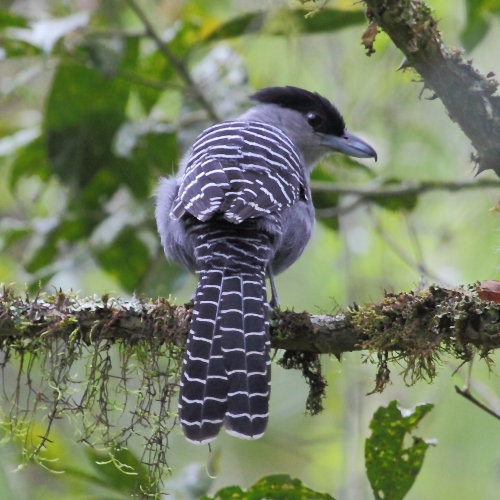
The Dusky-tailed Antbird exhibits a distinctive plumage that assists birders in identifying it amidst the forest understory. Adult males possess a predominantly gray body with subtle streaks of white running along the chest and throat. Their namesake tail is a deep, dusky brown, providing a stark contrast to their otherwise muted coloration. Females, in contrast, display more brownish hues on their backs and wings, with a slightly paler belly. Juveniles often resemble females but with a more muted color palette and less pronounced streaking. The species' identification is further aided by its behavior, as it tends to flit and hop through dense foliage, often with its tail cocked upwards. This posture, along with its distinctive vocalizations, helps distinguish it from similar species like the Plain Antvireo, which lacks the dusky tail and has a more uniform plumage. The Dusky-tailed Antbird's flight is typically short and direct, as it prefers to remain close to cover.
Having trouble telling birds apart? Upload a photo to our bird identification tool for an instant species match.
Dusky-tailed Antbird Habitat and Range
Preferred Habitat
The Dusky-tailed Antbird predominantly inhabits subtropical and tropical moist lowland forests. It favors secondary growth and forest edges where dense understory vegetation provides ample cover and foraging opportunities. This bird is often found at elevations ranging from sea level to about 1,500 meters, though it is most abundant in lower elevations where the forest canopy is dense. Unlike some other avian species, the Dusky-tailed Antbird does not usually venture into urban areas, preferring the seclusion of forested environments. Seasonal habitat shifts are minimal, as the bird tends to reside within the same general area year-round, only moving slightly to find food as availability changes.
Geographic Range
The Dusky-tailed Antbird's range is primarily concentrated in the eastern part of South America, extending through Brazil, northeastern Argentina, and into eastern Paraguay. It is a resident species, meaning it does not engage in long-distance migrations. Instead, it occupies specific territories within these countries, with population density hotspots often occurring in the Atlantic Forest, a region known for its rich biodiversity. This bird's presence in these areas is a strong indicator of its preference for humid, densely vegetated environments. Given its limited range, conservation of its habitat is essential to ensure the species' continued survival.
Want to know which birds visit your area? Browse our backyard birds by location guides for region-specific species lists.
What Does the Dusky-tailed Antbird Eat?
The Dusky-tailed Antbird's diet is predominantly insectivorous, with ants, beetles, and caterpillars forming the bulk of its intake. It forages by meticulously searching through leaf litter and probing into crevices in tree bark. This bird also employs a technique known as 'gleaning,' where it picks off insects from foliage as it moves through the understory. Seasonal variations in diet are minimal, but the bird may shift its focus to different insect prey depending on availability. Prey size typically ranges from small to medium, with the bird adept at handling various invertebrates. Feeding primarily occurs during the early morning and late afternoon, aligning with periods of increased prey activity.
Dusky-tailed Antbird Behavior and Social Structure
The Dusky-tailed Antbird is primarily solitary or found in pairs, rarely forming large flocks. Its social structure revolves around monogamous pairs that maintain territories through vocalizations and occasional displays. Territorial behavior is pronounced, with males often singing and displaying to deter intruders. Courtship involves mutual preening and subtle displays, reinforcing pair bonds. The bird is generally diurnal, with peak activity occurring during the cooler hours of dawn and dusk. Its response to predators includes alarm calls and rapid retreats into dense foliage, leveraging its habitat for cover. While not known for long-distance flight, it is agile in navigating the forest undergrowth.
Dusky-tailed Antbird Nesting and Reproduction
Nesting for the Dusky-tailed Antbird occurs in dense thickets, where the bird constructs a cup-shaped nest primarily from leaves, twigs, and sometimes spider silk. Nests are typically located low in shrubs or small trees, providing both concealment and support. Clutch size generally consists of two to three eggs, which both parents incubate over approximately two weeks. After hatching, the chicks remain in the nest for another two weeks before fledging. Both parents share feeding duties, and the pair may raise one or two broods per year, depending on environmental conditions. Nesting success is closely tied to habitat quality, with dense vegetation offering the best protection against predators.
Dusky-tailed Antbird Sounds and Vocalizations
The primary song of the Dusky-tailed Antbird comprises a series of rapid, high-pitched notes delivered in a consistent rhythm. These vocalizations are often described as a 'trilled' sound, which serves both to attract mates and establish territory. Call notes are shorter, more abrupt sounds used for communication between mates or signaling alarm. During the dawn chorus, the bird's song is most prominent, cutting through the ambient sounds of the forest. Alarm calls are sharper and more urgent, often eliciting responses from both mates and neighboring birds, alerting them to potential threats.
Interesting Facts About the Dusky-tailed Antbird
- 1The Dusky-tailed Antbird can be quite elusive, often heard before it is seen due to its dense habitat preferences.
- 2Despite its name, the Dusky-tailed Antbird does not feed exclusively on ants, showing dietary flexibility.
- 3This species can recognize the alarm calls of other birds, allowing it to respond to potential threats quickly.
- 4The Dusky-tailed Antbird's vocalizations can carry over long distances, despite the dense forest environment.
- 5It is a member of the diverse Thamnophilidae family, which includes over 200 species of antbirds.
- 6Unlike some antbirds, the Dusky-tailed Antbird does not typically follow army ant swarms.
- 7Its presence in an area often indicates a healthy, biodiverse forest ecosystem.
Dusky-tailed Antbird Conservation Status
The Dusky-tailed Antbird is currently listed as Least Concern by the IUCN, but its population trend is decreasing due to ongoing habitat destruction. Deforestation in the Atlantic Forest poses the most significant threat, with logging and land conversion reducing its natural habitat. Conservation efforts focus on protecting and restoring forest areas, with some success in designated reserves. Historical data indicate that while the species was once more widespread, habitat fragmentation has led to localized declines. Continued conservation action is necessary to safeguard its future.