Eastern Russet Antshrike
Thamnistes aequatorialis
Order: Passeriformes / Family: Thamnophilidae
About the Eastern Russet Antshrike
The Eastern Russet Antshrike (Thamnistes aequatorialis) is a small passerine bird endemic to the subtropical and tropical forests of the Andes. This species occupies a crucial niche within its habitat, primarily found in the dense understory of montane forests. Its preference for such environments underscores its role in the ecological dynamics of these biodiverse regions, where it contributes to insect population control. As a member of the family Thamnophilidae, the Eastern Russet Antshrike is closely related to other antbirds, although it exhibits unique characteristics that set it apart. The bird's russet coloration is not only a defining feature but also serves as effective camouflage amidst the forest's intricate foliage. This adaptation is vital for its survival, allowing it to evade predators and effectively hunt for prey. Geographic distribution of the Eastern Russet Antshrike spans several countries along the Andes, including Colombia, Ecuador, Peru, and Bolivia. Within these regions, its presence is most noted in cloud forests and areas rich in epiphytes and mosses. The bird's affinity for elevations ranging from 500 to 2,500 meters further defines its habitat preference. Seasonal behaviors of the Eastern Russet Antshrike include subtle shifts in foraging strategies, often correlated with changes in insect availability. Despite its relatively small range, the Eastern Russet Antshrike is an indicator species, reflecting the health of its habitat. Conservation of these montane forests is paramount not only for the antshrike but for the myriad species that share its environment. As these forests face threats from deforestation and climate change, the Eastern Russet Antshrike continues to be a subject of interest for conservationists and ornithologists alike.
The Eastern Russet Antshrike belongs to the family Thamnophilidae, within the order Passeriformes. These birds typically live average 5-7 years, with a maximum of 8 years recorded..
How to Identify a Eastern Russet Antshrike
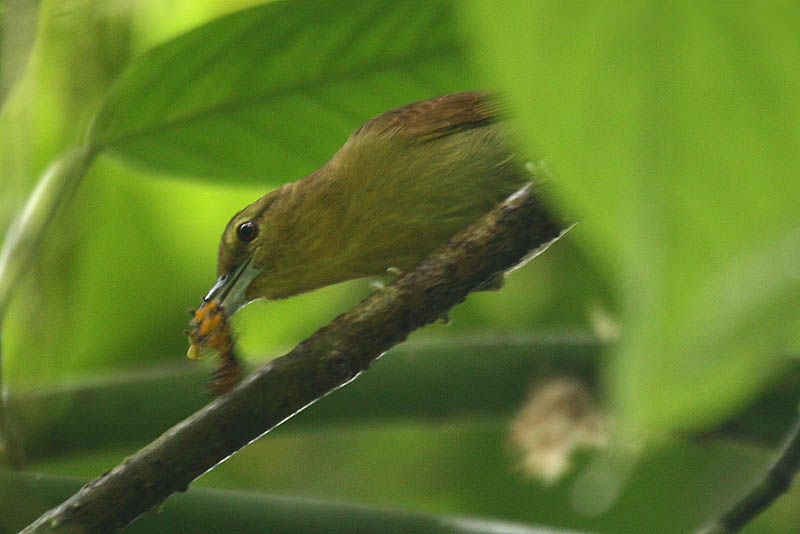
The Eastern Russet Antshrike is best identified by its rich russet plumage that covers most of its body, contrasted by darker wings and tail. Adult birds display a subtle sexual dimorphism, with males often showing slightly brighter tones than females. Both sexes possess a relatively short, curved bill, suited for their insectivorous diet. Juveniles resemble adults but exhibit a more muted coloration, which gradually intensifies as they mature. In terms of size, the Eastern Russet Antshrike is small, typically measuring between 12 to 14 centimeters in length, with a compact and robust build. When observing this bird in the field, note its perching posture, often hunched slightly forward with wings held close to the body. Its flight is generally brief, characterized by quick, direct movements between branches. Distinguishing the Eastern Russet Antshrike from similar species can be challenging, particularly in dense forest habitats. However, its distinctive coloration and call can aid in identification. Unlike some sympatric antbird species, the Eastern Russet Antshrike lacks prominent streaks or spots, relying instead on its overall color tone for identification.
Having trouble telling birds apart? Upload a photo to our bird identification tool for an instant species match.
Eastern Russet Antshrike Habitat and Range
Preferred Habitat
The Eastern Russet Antshrike thrives in the montane forests of the Andes, favoring cloud forests with abundant epiphytes and dense understory layers. These habitats, often situated at elevations between 500 and 2,500 meters, provide the dense vegetation necessary for the antshrike's foraging and nesting activities. Within these environments, the bird can commonly be found in areas with thick moss growth and ample leaf litter, which support a rich insect fauna. Seasonal habitat shifts are minimal, as the Eastern Russet Antshrike tends to remain in its preferred elevation range year-round. While it primarily inhabits rural and untouched forest areas, it may occasionally be observed in secondary forests if such environments maintain sufficient undergrowth. The species' dependence on forested habitats makes it particularly vulnerable to deforestation, highlighting the importance of preserving these ecosystems.
Geographic Range
The Eastern Russet Antshrike's range is confined to the western slopes of the Andes, where it inhabits parts of Colombia, Ecuador, Peru, and Bolivia. Within this range, the bird is non-migratory, maintaining a relatively stable presence throughout the year. The species' distribution is closely linked to the availability of suitable forest habitats, particularly cloud forests with rich understory vegetation. While the antshrike does not engage in long-distance migrations, it may undertake local movements in response to resource availability. Population density is highest in undisturbed forest areas where insect prey is abundant. Despite its limited range, the Eastern Russet Antshrike is considered relatively widespread within suitable habitat zones, although specific population hotspots can vary depending on local environmental conditions.
Want to know which birds visit your area? Browse our backyard birds by location guides for region-specific species lists.
What Does the Eastern Russet Antshrike Eat?
The Eastern Russet Antshrike primarily feeds on insects, with a particular preference for ants, beetles, and caterpillars. This insectivorous diet is supplemented by occasional small arthropods such as spiders. The bird employs a gleaning foraging technique, meticulously picking prey from leaves and branches. During the breeding season, its diet may expand to include a greater variety of insects, reflecting seasonal changes in prey availability. The Eastern Russet Antshrike forages throughout the day, often in mixed-species flocks which provide increased foraging efficiency and predator vigilance. Prey size typically ranges from small to medium insects, allowing the bird to exploit a wide range of food resources within its habitat.
Eastern Russet Antshrike Behavior and Social Structure
The Eastern Russet Antshrike is known for its relatively solitary nature, although it occasionally participates in mixed-species flocks. This social structure provides benefits such as increased feeding opportunities and predator protection. The bird exhibits territorial behavior, with pairs or individuals maintaining defined territories through vocalizations and displays. Courtship displays are subtle, often involving singing and mutual preening between pairs. The Eastern Russet Antshrike maintains a consistent daily activity pattern, predominantly active during dawn and dusk when insect activity is highest. The bird's response to predators involves both cryptic behavior, relying on its plumage for camouflage, and mobbing, particularly when facing avian threats. Despite its small size, the Eastern Russet Antshrike demonstrates a remarkable adaptability to the complex social dynamics of its forest habitat.
Eastern Russet Antshrike Nesting and Reproduction
The Eastern Russet Antshrike constructs cup-shaped nests from twigs, leaves, and moss, typically located in the fork of a tree branch. Nest placement tends to be low, often less than 5 meters above the ground, which provides protection from aerial predators. Clutch size generally consists of two to three eggs, which both parents incubate over a period of approximately 14 to 16 days. After hatching, chicks remain in the nest for about 12 to 15 days before fledging. Both parents participate in feeding and caring for the young, ensuring their growth and survival. The Eastern Russet Antshrike usually raises one brood per year, although in favorable conditions, a second brood may occur.
Eastern Russet Antshrike Sounds and Vocalizations
The Eastern Russet Antshrike's vocalizations include a primary song characterized by a series of short, sharp notes delivered in rapid succession. This song serves both as a territorial call and a method to attract mates. Call notes are typically soft and metallic, utilized in communication between mates or to alert others of potential threats. Alarm calls are more abrupt and higher-pitched, signaling the presence of predators. During the dawn chorus, the Eastern Russet Antshrike's song blends with those of other forest birds, creating a complex soundscape that is characteristic of its montane habitat.
Interesting Facts About the Eastern Russet Antshrike
- 1The Eastern Russet Antshrike's russet plumage provides excellent camouflage in the dense montane forests it inhabits.
- 2Unlike many birds, the Eastern Russet Antshrike often forages in mixed-species flocks, benefiting from increased vigilance.
- 3This antshrike is a non-migratory species, remaining in its Andean habitat throughout the year across its range.
- 4The Eastern Russet Antshrike plays a vital role in controlling insect populations within its forest ecosystem.
- 5Despite its small size, the Eastern Russet Antshrike exhibits territorial behavior, defending its area with vocalizations.
Eastern Russet Antshrike Conservation Status
The Eastern Russet Antshrike is currently listed as Least Concern by the IUCN, although its population is affected by habitat loss due to deforestation and land conversion. The species' reliance on intact forest environments makes it vulnerable to these threats, with ongoing conservation efforts focused on habitat preservation. Population trends suggest a gradual decline in some areas, prompting increased attention from conservationists. Historical population changes have been linked to land use changes in the Andean region, emphasizing the need for sustainable forest management to ensure the long-term survival of the Eastern Russet Antshrike.
Other Thamnophilidae Species



Birds Similar to the Eastern Russet Antshrike
These species are often confused with the Eastern Russet Antshrike due to similar appearance or overlapping range.