
Elegant Quail
Callipepla douglasii
Order: Galliformes / Family: Odontophoridae

Wikimedia Commons
About the Elegant Quail
The Elegant Quail, Callipepla douglasii, stands out among the quail species due to its striking appearance and unique ecological role within its habitat. Found predominantly in the northwestern regions of Mexico, this bird thrives in the subtropical and tropical dry forests that characterize the states of Sonora and Sinaloa. These regions provide an ideal environment where the Elegant Quail can forage under the protective canopy, benefiting from the mix of arid and semi-arid climates. Unlike many other quail species that might wander in search of resources, the Elegant Quail has a relatively restricted range, which highlights its specialized adaptations to this particular ecological niche. This bird plays a significant role in the ecosystem, primarily through its diet, which consists of a variety of seeds and small insects. By foraging, it aids in seed dispersal and insect population control, contributing to the overall health of its habitat. As the seasons change, the Elegant Quail exhibits a range of behaviors that reflect its adaptability to environmental shifts. During the breeding season, which aligns with the onset of the rainy period in these regions, Elegant Quails become more vocal and active in establishing territories. This period is crucial for the species as they engage in courtship displays and nest-building activities. Outside the breeding season, they may form small coveys consisting of family groups, which provide them with increased protection against predators. The Elegant Quail's significance extends beyond its ecological contributions, as it is also a species of interest for ornithologists and bird enthusiasts alike. Its presence is often used as an indicator of ecosystem health, given its reliance on undisturbed habitats. Conservation efforts in the region focus on preserving these critical areas to ensure the continuing survival of the Elegant Quail and the myriad other species that share its territory.
The Elegant Quail belongs to the family Odontophoridae, within the order Galliformes. These birds typically live average 3-5 years, with some individuals reaching 7 years in the wild..
How to Identify a Elegant Quail
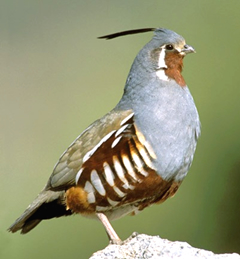
The Elegant Quail is distinguished by its striking plumage and unique field marks, making it relatively easy to identify in its natural habitat. Adult males boast a distinctive black and white speckled pattern on their chest and a bold rufous crest that sets them apart from other quail species. The females, while more subdued in coloration, feature a similar pattern with slightly muted tones and a less pronounced crest. Juveniles resemble the females but with even duller plumage, which provides them with added camouflage against predators. In flight, the Elegant Quail shows a compact silhouette with rapid wingbeats typical of quail, but it is more often seen scuttling on the ground. One might confuse the Elegant Quail with the Gambel’s Quail due to their similar size and shape, but the distinctive chest pattern and crest color are reliable differentiators. When perching, the Elegant Quail maintains a low profile, often blending in with the underbrush, where its intricate pattern provides excellent camouflage.
Having trouble telling birds apart? Upload a photo to our bird identification tool for an instant species match.
Elegant Quail Habitat and Range
Preferred Habitat
The Elegant Quail predominantly inhabits subtropical and tropical dry forests in northwestern Mexico. These environments, found in Sonora and Sinaloa, offer a mix of open areas and dense thickets that are ideal for foraging and nesting. The elevation range for these quails typically spans from sea level to about 1,500 meters, although they are most abundant in lowland areas. During the dry season, they may venture into more open spaces searching for food, but they tend to remain close to cover. Unlike some quail species that adapt well to urban environments, the Elegant Quail prefers rural, undisturbed habitats, making its presence in such areas a sign of relatively intact ecosystems.
Geographic Range
The range of the Elegant Quail is primarily restricted to the northwestern regions of Mexico, specifically in the states of Sonora and Sinaloa. This range encompasses both their breeding and non-breeding habitats, as the species is non-migratory and remains in these regions year-round. Within this range, populations are densest in areas that offer a mix of cover and open space, which are crucial for their foraging and nesting activities. Unlike some quail species that may expand their range during different seasons, the Elegant Quail remains loyal to its homeland, relying on the stability of its preferred environment.
Want to know which birds visit your area? Browse our backyard birds by location guides for region-specific species lists.
What Does the Elegant Quail Eat?
The Elegant Quail's diet primarily consists of seeds, which it forages from the ground in the dense underbrush of its habitat. These may include seeds from native grasses and shrubs, which are abundant in the dry forests of northwestern Mexico. In addition to seeds, the Elegant Quail consumes a variety of small insects and invertebrates, particularly during the breeding season when protein demands increase. This insect diet plays a critical role in their reproductive success, providing essential nutrients for egg production and chick development. The quail forages mainly during the cooler parts of the day, such as early morning and late afternoon, when they move methodically across the forest floor, scratching at the ground with their feet to uncover hidden food sources. This foraging behavior not only sustains the quail but also contributes to soil turnover, aiding in the dispersal of seeds and the aeration of the soil.
Elegant Quail Behavior and Social Structure
The Elegant Quail exhibits a range of intriguing behaviors that underscore its adaptability to the subtropical and tropical dry forests of northwestern Mexico. Socially, these quails are known to form small coveys outside the breeding season, consisting of family groups that provide mutual protection against predators. During the breeding season, which coincides with the onset of the rainy period, males become more vocal and establish territories through a series of displays and calls. Courtship involves elaborate displays where males puff up their chests and spread their tails to impress females. Flocking behavior becomes more pronounced outside the breeding season, with quails often feeding and moving together in small groups. In response to predators, the Elegant Quail relies on its excellent camouflage and quick, low flight to escape, often diving into dense cover at the first sign of danger. Daily activity patterns are largely diurnal, with most foraging and social activities occurring during daylight hours, particularly in the cooler parts of the day.
Elegant Quail Nesting and Reproduction
The nesting habits of the Elegant Quail reflect its adaptation to the dry forest habitats of northwestern Mexico. Nests are typically constructed on the ground, well-concealed by surrounding vegetation. The female primarily builds the nest, which consists of a shallow scrape lined with grasses and leaves. Clutch sizes range from 8 to 12 eggs, which are incubated primarily by the female for about 21 to 23 days. After hatching, the chicks are precocial and leave the nest within hours, following their parents to forage. Both parents participate in caring for the young, guiding them to food sources and protecting them from predators. The quail typically raises one brood per year, although in years with favorable conditions, a second brood may occur. The period from hatching to fledging is relatively short, with chicks becoming independent after about three weeks, although they may remain with the family group until the next breeding season.
Elegant Quail Sounds and Vocalizations
The vocalizations of the Elegant Quail are distinctive, with the primary song consisting of a series of clear, melodious whistles repeated in succession. These whistles are often heard during the breeding season as males establish territories. The call notes are softer, used for communication within coveys and during foraging. Alarm calls are sharp and quick, serving to alert the covey of potential danger. During the dawn chorus, these quails contribute a rhythmic and soothing background to the forest soundscape, reminiscent of the clear notes of a flute. These vocalizations play a crucial role in maintaining social bonds and ensuring the safety of the group.
Interesting Facts About the Elegant Quail
- 1The Elegant Quail is one of the few quail species that do not migrate, remaining in northwestern Mexico year-round.
- 2Males have a distinctive courtship display where they puff out their chests and spread their tail feathers to attract females.
- 3Elegant Quails form family groups, or coveys, which provide safety in numbers and enhanced foraging efficiency.
- 4These quails use their feet to scratch the ground, uncovering seeds and insects, which are their primary food sources.
- 5The Elegant Quail's plumage provides excellent camouflage in its natural habitat, making it difficult for predators to spot.
Elegant Quail Conservation Status
The International Union for Conservation of Nature (IUCN) currently lists the Elegant Quail as a species of Least Concern. However, the population trend is declining, primarily due to habitat degradation and fragmentation. Agricultural expansion and urban development in northwestern Mexico threaten the subtropical and tropical dry forests that are crucial for their survival. Conservation efforts focus on habitat preservation and the establishment of protected areas to ensure the continuity of these ecosystems. Historical population data suggests that while the Elegant Quail has been relatively stable, continued habitat loss could pose significant challenges in the future.
Other Odontophoridae Species


Birds Similar to the Elegant Quail
These species are often confused with the Elegant Quail due to similar appearance or overlapping range.