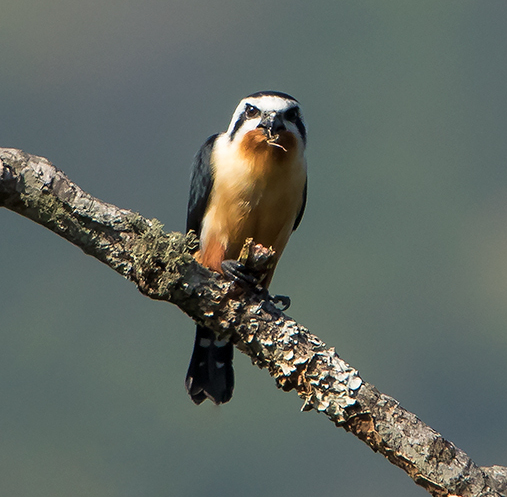
Falco sufflator
Falco sufflator
Order: Falconiformes / Family: Falconidae
About the Falco sufflator
The Falco sufflator, commonly referred to as the Puff-throated Falcon, is a striking bird of prey that commands attention with its distinctive vocalizations. This raptor belongs to the family Falconidae and inhabits specific regions across the African continent. Its ecological role is significant as it occupies the middle to upper trophic levels in its ecosystem, helping regulate populations of small mammals and birds. The Puff-throated Falcon is adapted to a variety of habitats but shows a preference for savannas and open woodlands, where it can easily spot and pursue its prey. In the dry seasons of Africa, the Falco sufflator exhibits seasonal movements, often shifting to areas where prey availability is higher. This adaptability is crucial for its survival, especially in regions prone to seasonal droughts. The Puff-throated Falcon is not just a predator but also a key bioindicator, revealing much about the health of its environment. Its presence in an area often suggests a robust ecosystem, as these raptors require abundant prey and suitable nesting sites to thrive. As a top predator, the falcon influences the structure of its community, indirectly supporting plant growth by controlling herbivore numbers. This bird's significance extends beyond its immediate ecological impact, as it also holds cultural value in some African societies, symbolizing freedom and agility. Observers can often spot the Falco sufflator perched high on trees or poles, scanning its surroundings with penetrating eyes. This species is predominantly solitary, though it may occasionally be observed in pairs during the breeding season. The Puff-throated Falcon's population dynamics reflect broader environmental changes, as shifts in its numbers often correlate with habitat loss or degradation due to agricultural expansion and urbanization. Conservation efforts for the Falco sufflator focus on habitat preservation and restoration, ensuring that these magnificent birds continue to thrive in their natural environments.
The Falco sufflator belongs to the family Falconidae, within the order Falconiformes. These birds typically live estimated average of 8-12 years, with little data on maximum age..
How to Identify a Falco sufflator
Identifying the Falco sufflator in the field involves noting several key characteristics. Adult birds display a striking plumage with a mix of dark brown and pale cream, which provides excellent camouflage in their natural habitats. Typically, the upper body is a rich, earthy brown, while the underparts are lighter, featuring subtle streaking. This pattern helps in differentiating the Puff-throated Falcon from other similar raptors. Juvenile falcons appear similar to adults but possess a slightly duller coloration, which brightens as they mature. Both sexes share this plumage, though females are generally larger, a common trait among raptors. The Falco sufflator is unique in its throat region, which can appear puffed when the bird is agitated or vocalizing, a feature that contributes to its common name. In flight, this species demonstrates agility and speed, attributes that are vital for hunting. Its wings are long and tapered, characteristic of other falcons, enabling swift and direct flight. Observers might confuse this species with other falcons, but the combination of size, vocalization, and habitat preference helps in accurate identification. Perched, the Falco sufflator maintains an upright stance, often with a keen gaze fixed on its surroundings, a posture that reflects its predatory nature.
Having trouble telling birds apart? Upload a photo to our bird identification tool for an instant species match.
Falco sufflator Habitat and Range
Preferred Habitat
The Puff-throated Falcon exhibits a preference for open, semi-arid environments such as savannas and woodlands. It thrives in regions where tree cover is sparse enough to allow easy aerial maneuvers but sufficient to provide perching and nesting opportunities. This falcon is commonly found at elevations ranging from sea level up to 2000 meters, adapting well to the varied topography of its range. Seasonal habitat shifts occur, particularly during dry periods when the falcon may venture into more humid areas or closer to water sources in search of prey. Urban sightings are rare, as this species prefers more expansive, natural landscapes. The presence of this falcon in an ecosystem often indicates a complex, well-balanced environment, as it requires specific conditions to sustain its dietary and nesting needs.
Geographic Range
The Falco sufflator's range is primarily within central and southern Africa, with notable populations in countries such as Angola, Zambia, and Zimbabwe. During the breeding season, these falcons are more concentrated in areas like the Miombo woodlands, where prey abundance supports chick rearing. In contrast, the non-breeding season sees some dispersal into peripheral areas, including parts of Namibia and Mozambique. Migration patterns are minimal, as the species exhibits partial residency, with movements influenced more by prey availability than by climatic changes. Population density is typically higher in protected areas and national parks, where human disturbance is minimal, and prey species are abundant. These regions serve as critical strongholds for sustaining falcon populations.
Want to know which birds visit your area? Browse our backyard birds by location guides for region-specific species lists.
What Does the Falco sufflator Eat?
The diet of the Falco sufflator primarily consists of small mammals, such as rodents, and various bird species. Insects form a secondary food source, particularly during the rainy season when they are more abundant. The falcon employs a hunting technique characterized by swift, low-level flights to surprise prey or by perching silently before executing a rapid dive. Prey size typically ranges from small songbirds to medium-sized rodents, reflecting the falcon's adaptability in its hunting strategies. Feeding generally occurs during the early morning and late afternoon, times when prey is most active and visibility is optimal. Seasonal changes in diet are observed, with a higher reliance on insects and birds during wetter months when these food sources are plentiful. This dietary flexibility is crucial for survival across varied environments and changing seasons.
Falco sufflator Behavior and Social Structure
The Puff-throated Falcon exhibits a range of fascinating behaviors, from its territorial displays to its solitary hunting methods. Socially, these falcons are primarily solitary, coming together only during the breeding season to form monogamous pairs. Territories are fiercely defended against intruders, especially during nesting periods, with vocalizations and aerial displays used to ward off rivals. Courtship involves elaborate displays, including aerial acrobatics and food offerings from the male to the female as part of pair bonding. The falcons are diurnal, with peak activity occurring during the early morning and late afternoon, corresponding with prey activity levels. Their response to predators includes alarm calls and evasive flight, showcasing their agility and speed. While generally solitary, these falcons may occasionally be observed in loose groups when migrating or in areas of abundant food. The Puff-throated Falcon's behavior is a testament to its adaptability and resourcefulness in the face of environmental challenges.
Falco sufflator Nesting and Reproduction
Nesting for the Falco sufflator involves choosing sites that provide safety from predators and proximity to abundant food sources. Nests are often located in tall trees or on cliff ledges, constructed from a variety of materials such as twigs, grass, and feathers. The typical clutch size ranges from two to four eggs, with incubation lasting approximately 28 to 32 days. Both parents share responsibilities during incubation, though the female primarily attends to the eggs while the male forages. Once hatched, chicks are altricial, requiring intensive care and feeding. Fledging occurs after 35 to 45 days, but young falcons remain dependent on their parents for several weeks post-fledging, learning essential survival skills. The Falco sufflator typically raises one brood per year, with breeding success closely tied to environmental conditions and prey availability.
Falco sufflator Sounds and Vocalizations
The primary vocalization of the Falco sufflator is a piercing call that can be described as a series of sharp, high-pitched notes, often repeated in rapid succession. This call serves multiple purposes, from territory defense to mating communication. Alarm calls are shorter and more abrupt, used to alert conspecifics of potential threats. During the dawn chorus, these falcons are particularly vocal, asserting their presence and dominance in their territory. The vocalizations carry a distinctive quality, somewhat akin to the rapid notes of a whistle, setting them apart from other raptors in their range.
Interesting Facts About the Falco sufflator
- 1The Puff-throated Falcon can reach speeds of over 60 mph when diving for prey, showcasing its incredible aerial agility.
- 2Unlike many raptors, the Falco sufflator often uses its keen eyesight to hunt from a perch rather than exclusively from flight.
- 3The falcon's throat can expand significantly during vocalizations, a trait that helps project its calls over long distances.
- 4This species exhibits a unique foraging behavior where it sometimes follows brush fires to catch small animals fleeing the flames.
- 5The Puff-throated Falcon shows remarkable adaptability, thriving in both dry savannas and semi-humid woodlands across Africa.
- 6Its diet shifts seasonally, relying more on insects during wet months and small mammals in drier periods.
- 7Falco sufflator's nesting success is closely linked to the abundance of small mammals, its primary prey during breeding season.
Falco sufflator Conservation Status
The IUCN currently classifies the Falco sufflator as Least Concern, although localized population pressures exist. While overall populations remain stable, threats from habitat destruction, particularly due to agricultural expansion and deforestation, pose significant challenges. Conservation efforts focus on habitat protection and restoration, with some regions implementing monitoring programs to track population trends. Historically, the falcon's adaptability has allowed it to withstand moderate environmental changes, but ongoing habitat degradation could alter this trajectory.
Other Falconidae Species


Birds Similar to the Falco sufflator
These species are often confused with the Falco sufflator due to similar appearance or overlapping range.