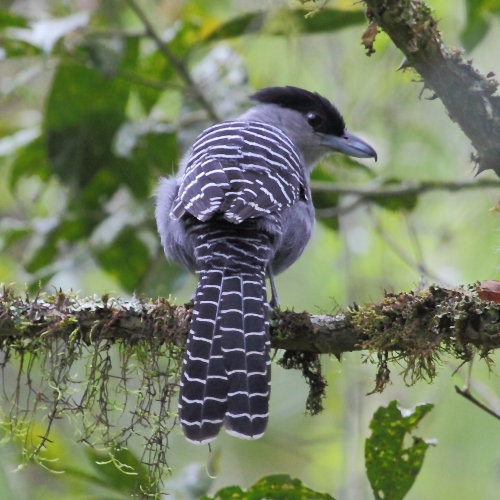
Ferruginous-backed Antbird
Myrmeciza ferruginea
Order: Passeriformes / Family: Thamnophilidae

Wikimedia Commons
About the Ferruginous-backed Antbird
The Ferruginous-backed Antbird (Myrmeciza ferruginea) is a captivating bird species that plays a significant role in the ecosystems of South America's rainforests. This bird belongs to the family Thamnophilidae, a group known for their close association with ants, particularly army ants. Found primarily in the Amazon Basin, its range spans countries like Brazil, Peru, and Colombia. These regions provide the perfect backdrop for its preferred habitat: dense, humid lowland forests with thick understory.
This bird's ecological significance is closely tied to its unique feeding behavior. The Ferruginous-backed Antbird often follows swarms of army ants to capture insects and other prey displaced by the ants. This symbiotic relationship not only benefits the antbird by providing a steady food source but also controls insect populations within its habitat. Such interactions highlight the bird's role in maintaining the delicate balance of tropical forest ecosystems.
Seasonal behaviors of the Ferruginous-backed Antbird are subtle, as the species is non-migratory and remains in its tropical environment year-round. However, breeding activities do influence its behavior. During the breeding season, males become more vocal and actively defend territories against rivals. These territories are not only breeding grounds but also ensure access to food resources. The bird's presence in these forests also contributes to local biodiversity, making it an essential component of these complex ecosystems.
The Ferruginous-backed Antbird belongs to the family Thamnophilidae, within the order Passeriformes. These birds typically live average 5-7 years, with a maximum recorded of 10 years..
How to Identify a Ferruginous-backed Antbird
The Ferruginous-backed Antbird is immediately recognizable by its rich, rust-colored back, which contrasts with its otherwise dark plumage. Adult males and females share similar coloration with minor differences. Males typically have a slightly more vibrant rust hue compared to females. The bird's underparts are generally a dark gray, providing a striking contrast to its ferruginous upperparts.
Juveniles may display duller plumage than adults, with less distinct rust coloration and more uniform gray tones. In the field, pay close attention to the bird's perching posture, which is often horizontal with the tail slightly cocked, a typical stance for antbirds.
Confusion with similar species can occur, particularly with other members of the genus Myrmeciza. However, the Ferruginous-backed Antbird's unique combination of rust and dark gray, along with its habitat preference for dense rainforest understory, aids in its identification. When in flight, its silhouette is compact, with short rounded wings and a stout body.
Having trouble telling birds apart? Upload a photo to our bird identification tool for an instant species match.
Ferruginous-backed Antbird Habitat and Range
Preferred Habitat
The Ferruginous-backed Antbird inhabits the lowland tropical forests of the Amazon Basin, particularly favoring regions with dense understory. These forests provide not only shelter but also a bounty of feeding opportunities. The bird is commonly found at elevations ranging from sea level to about 1,200 meters.
The species shows a strong preference for primary forests but can occasionally be observed in secondary growth areas. Seasonal habitat shifts are minimal due to its non-migratory nature. Unlike some forest birds, it rarely ventures into open or urban areas, maintaining its presence in the lush, secluded parts of the rainforest.
Geographic Range
The Ferruginous-backed Antbird's range is focused within the broad expanse of the Amazon Basin. It breeds and resides year-round in countries such as Brazil, Peru, Colombia, and parts of Bolivia. Within these regions, the bird is most abundant in the undisturbed lowland forests of the Amazon and its tributaries.
It does not migrate, so its distribution remains relatively stable throughout the year. Population density is highest in regions where primary forests are intact, underscoring the importance of preserving these habitats for the species' continued survival. Unlike some species, it does not utilize migration corridors, relying instead on the permanent resources of its tropical environs.
Want to know which birds visit your area? Browse our backyard birds by location guides for region-specific species lists.
What Does the Ferruginous-backed Antbird Eat?
The diet of the Ferruginous-backed Antbird consists primarily of insects and other arthropods. This bird is an adept forager, often found following swarms of army ants. As the ants move through the forest, they flush out insects from the leaf litter, which the antbird eagerly captures.
The bird's foraging technique involves quick, darting movements to snatch prey disturbed by the ants. Seasonal diet changes are minimal due to the consistent availability of its prey in tropical climates. The Ferruginous-backed Antbird typically feeds during daylight hours, taking advantage of the peak activity periods of army ants. Its diet may occasionally include small vertebrates or fruit, though these are secondary to its primary insectivorous habits.
Ferruginous-backed Antbird Behavior and Social Structure
The Ferruginous-backed Antbird displays a complex array of behaviors that reflect its adaptation to life in dense tropical forests. Socially, the bird exhibits territorial behavior, with males aggressively defending their chosen areas during the breeding season. These territories ensure sufficient access to food and nesting sites.
Courtship displays involve vocalizations and subtle physical movements designed to attract mates. Unlike many bird species, the Ferruginous-backed Antbird does not form large flocks, often maintaining solitary or paired interactions. When confronted by predators, it relies on its cryptic plumage and stealthy movements to avoid detection.
Daily activity patterns include active foraging sessions during the morning and late afternoon, with quieter periods during the midday heat when it retreats into the forest understory for rest and preening.
Ferruginous-backed Antbird Nesting and Reproduction
The nesting habits of the Ferruginous-backed Antbird reflect its preference for dense forest environments. It typically constructs its nest in low shrubs or small trees within the forest understory. The nest itself is a delicate cup made from leaves, twigs, and plant fibers, often positioned less than two meters above the ground.
Clutch size generally consists of two to three eggs, which both parents incubate. The incubation period lasts approximately 14 to 16 days. Once hatched, chicks remain in the nest for about two weeks, during which time both parents share feeding and protective duties. The species usually raises one brood per year, though favorable conditions may allow for a second.
Ferruginous-backed Antbird Sounds and Vocalizations
The primary song of the Ferruginous-backed Antbird is a series of clear, melodious whistles that rise and fall in pitch. These whistles serve as territorial calls and are most frequently heard during the early morning hours. Call notes are short and sharp, often used for communication between mates or to signal alarm.
Alarm calls are distinct, high-pitched series of notes that increase in tempo when predators are near. During the dawn chorus, the Ferruginous-backed Antbird's song blends with the symphony of other rainforest birds, adding to the rich acoustic landscape of its habitat.
Interesting Facts About the Ferruginous-backed Antbird
- 1The Ferruginous-backed Antbird's rust-colored plumage provides excellent camouflage in its rainforest environment, blending with the forest floor's leaf litter.
- 2Despite its small size, the Ferruginous-backed Antbird can be quite aggressive when defending its territory, often chasing away larger bird species.
- 3The bird's name, 'ferruginous,' comes from the Latin word for iron, a nod to its rust-like coloration.
- 4Myrmeciza ferruginea's association with army ants is so strong that its presence often indicates nearby ant swarms, benefiting birdwatchers seeking to observe this behavior.
- 5The Ferruginous-backed Antbird does not overwinter in a different location, a behavior contrasting with many migratory bird species.
- 6Its feeding strategy exemplifies commensalism, as it benefits from the ant swarms without affecting the ants, showcasing intricate ecological relationships.
- 7Despite its specific habitat requirements, the Ferruginous-backed Antbird is considered one of the more adaptable antbird species.
Ferruginous-backed Antbird Conservation Status
The Ferruginous-backed Antbird is currently listed as Least Concern by the IUCN, but its population faces threats from deforestation and habitat fragmentation. The bird's reliance on pristine forest environments makes it vulnerable to land conversion for agriculture and logging. Conservation efforts focus on preserving large tracts of primary forest and establishing protected areas within its range. Historically, the species has maintained stable populations, but ongoing habitat loss poses a significant risk to its future stability.