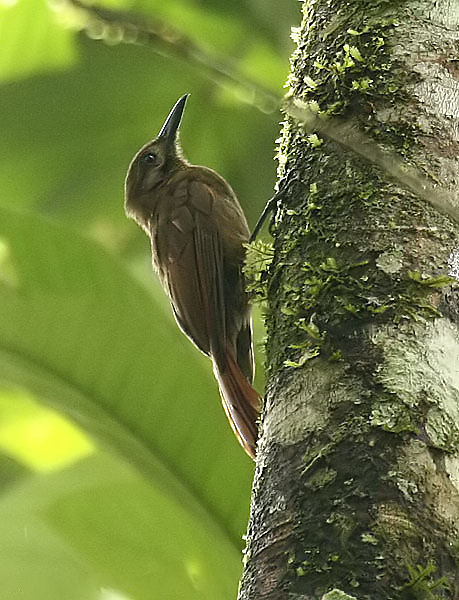
Fulvous-dotted Treerunner
Margarornis stellatus
Order: Passeriformes / Family: Furnariidae

Wikimedia Commons
About the Fulvous-dotted Treerunner
The Fulvous-dotted Treerunner, scientifically known as Margarornis stellatus, is a small passerine bird belonging to the family Furnariidae. This bird is primarily found in the cloud forests of the Andes, a habitat characterized by high humidity and consistent cloud cover, which provides an ideal environment for its insectivorous diet. The species is especially prevalent in countries such as Colombia, Ecuador, and Peru, where it plays a significant ecological role in controlling insect populations. This bird's presence contributes to the rich biodiversity of these regions, as it participates in the complex web of forest life. During the breeding season, typically between March and June, the Fulvous-dotted Treerunner exhibits increased activity as it searches for nesting materials and suitable sites. Its ecological significance extends beyond pest control; it also serves as a prey species for larger predators, thus maintaining the balance of the ecosystem. The bird is a vital indicator of forest health, with its population trends reflecting changes in forest cover and climate conditions. The Fulvous-dotted Treerunner is a fascinating subject for ornithologists and birdwatchers alike, offering insights into the intricate dynamics of Andean cloud forests.
The Fulvous-dotted Treerunner belongs to the family Furnariidae, within the order Passeriformes. These birds typically live 5 years with a maximum recorded of 8 years..
How to Identify a Fulvous-dotted Treerunner
The Fulvous-dotted Treerunner is a medium-sized bird with a length of approximately 16 cm. Its plumage is predominantly olive-brown with distinctive fulvous spots scattered across its upperparts, making it easily recognizable. The bird's underparts are paler, with a slight buff wash on the chest and belly. Juveniles resemble adults but often display a duller coloration and less distinct spotting. Males and females are similar in appearance, which can make sexing in the field challenging. When perched, the Fulvous-dotted Treerunner exhibits a characteristic upright posture, often clinging to vertical surfaces or tree trunks. In flight, its silhouette is streamlined, with pointed wings and a relatively long tail, adapted for maneuvering through dense foliage. It can be confused with the similar-looking Streaked Tuftedcheek, but the latter lacks the distinctive fulvous spotting and has a more pronounced facial pattern. Observers should note the bird’s agile movements, as it climbs and forages, which are key identification markers.
Having trouble telling birds apart? Upload a photo to our bird identification tool for an instant species match.
Fulvous-dotted Treerunner Habitat and Range
Preferred Habitat
The Fulvous-dotted Treerunner thrives in humid montane forests, particularly cloud forests, at elevations ranging from 1,200 to 3,000 meters. These forests, found along the Andes, offer a unique combination of high humidity and thick vegetation, ideal for the bird's foraging habits. While it predominantly inhabits primary forests, it can occasionally be found in secondary growth areas, provided there is sufficient tree cover. Unlike some species that adapt to urban environments, the Fulvous-dotted Treerunner remains closely tied to forested habitats, rarely venturing into rural or urban areas. Seasonal shifts in habitat are minimal, as the bird tends to remain within its preferred altitude throughout the year. However, slight altitudinal movements may occur in response to food availability and climatic conditions.
Geographic Range
The breeding range of the Fulvous-dotted Treerunner primarily encompasses the Andean regions of Colombia, Ecuador, and northern Peru. It is a resident species, with no significant migratory movements observed, although minor altitudinal migrations may occur. The bird's range is largely confined to mountainous areas, where it occupies suitable forest habitats. Population density is highest in regions where cloud forests are well-preserved, such as the eastern slopes of the Andes. While the bird is generally uncommon, certain local hotspots, particularly in protected areas like national parks, host more substantial populations. Ongoing habitat destruction poses a threat to its range, underscoring the importance of conservation efforts in these biologically rich regions.
Want to know which birds visit your area? Browse our backyard birds by location guides for region-specific species lists.
What Does the Fulvous-dotted Treerunner Eat?
The diet of the Fulvous-dotted Treerunner consists primarily of insects and arthropods, which it skillfully extracts from tree bark and foliage. This bird employs a methodical foraging technique, using its bill to probe crevices and under loose bark for hidden prey. During the wet season, when insect abundance peaks, it may expand its diet to include small fruits and berries, providing a crucial source of energy. Prey size ranges from tiny ants and beetles to larger caterpillars, which the bird deftly handles. The Fulvous-dotted Treerunner typically feeds throughout the day, with peaks in activity during the early morning and late afternoon when insects are most active. Its role as an insect predator helps control pest populations, benefiting the forest ecosystem.
Fulvous-dotted Treerunner Behavior and Social Structure
The Fulvous-dotted Treerunner exhibits a solitary or pair-based social structure, often seen foraging alone or in pairs. During the breeding season, it becomes more territorial, defending its nesting area from intruders. Courtship displays are subtle but involve mutual feeding and soft vocalizations between mates. The bird's response to predators includes rapid, agile movements to escape and occasional mobbing behavior if the threat persists. Daily activity peaks in the early morning and late afternoon, aligning with prey availability. While generally quiet, the bird becomes more vocal during the breeding season, using its calls to communicate with its mate and establish territory boundaries.
Fulvous-dotted Treerunner Nesting and Reproduction
The nesting habits of the Fulvous-dotted Treerunner involve constructing a well-hidden nest in tree cavities or under dense vegetation. The nest is crafted from a variety of materials, including moss, leaves, and twigs, providing insulation and camouflage. Clutch size typically ranges from two to three eggs, with both parents sharing incubation duties over a period of approximately 18 days. Once hatched, the chicks fledge in about 20 to 25 days, during which both parents actively participate in feeding and protecting them. The species may attempt two broods per year, depending on environmental conditions and food availability. The choice of nesting site and materials reflects the bird's adaptation to its montane forest environment.
Fulvous-dotted Treerunner Sounds and Vocalizations
The primary song of the Fulvous-dotted Treerunner is a series of soft, melodious whistles that rise and fall in pitch. These vocalizations often serve as communication between mates and are most prominent during the breeding season. The bird's call notes are sharp and distinct, used to signal alarm or maintain contact with its partner. Alarm calls are louder and more abrupt, indicating the presence of a predator. During the dawn chorus, the Fulvous-dotted Treerunner's song blends with the symphony of other forest species, creating a rich acoustic tapestry. Its song is reminiscent of a gentle breeze rustling through leaves, providing a serene backdrop to the Andean cloud forests.
Interesting Facts About the Fulvous-dotted Treerunner
- 1The Fulvous-dotted Treerunner can climb trees vertically with remarkable agility, akin to a woodpecker.
- 2Despite its small size, the Fulvous-dotted Treerunner plays a crucial role in pest control by consuming vast quantities of insects.
- 3The bird's distinctive fulvous spots provide excellent camouflage against the bark of Andean trees.
- 4Fulvous-dotted Treerunners often form mixed-species flocks, enhancing their foraging efficiency.
- 5This bird's song is a delightful series of whistles, often described as one of the more melodious forest sounds.
- 6The species is a non-migratory resident, spending its entire life within the Andean cloud forests.
- 7The Fulvous-dotted Treerunner's preference for high-altitude habitats helps it avoid many lowland predators.
Fulvous-dotted Treerunner Conservation Status
Currently, the Fulvous-dotted Treerunner is classified as 'Least Concern' by the IUCN, but its population trend is decreasing due to habitat loss and fragmentation. Primary threats include deforestation for agriculture and logging, which reduce the availability of suitable forest habitats. Conservation efforts focus on preserving the cloud forests of the Andes, with several protected areas established to safeguard critical habitats. Historical population changes reflect the ongoing impact of human activities, although localized conservation initiatives have shown promise in stabilizing populations within protected regions.
Other Furnariidae Species


Birds Similar to the Fulvous-dotted Treerunner
These species are often confused with the Fulvous-dotted Treerunner due to similar appearance or overlapping range.