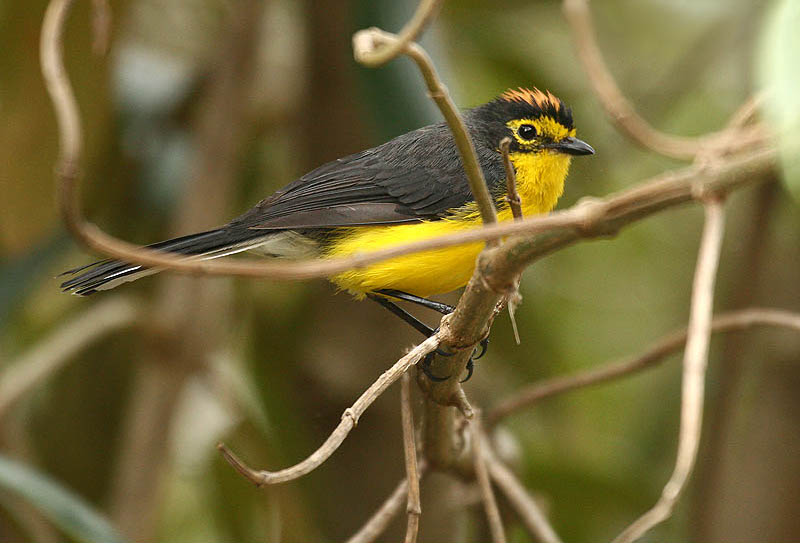
Golden-fronted Redstart
Myioborus ornatus
Order: Passeriformes / Family: Parulidae

Wikimedia Commons
About the Golden-fronted Redstart
The Golden-fronted Redstart (Myioborus ornatus) is a captivating avian species belonging to the Parulidae family, renowned for its vivid coloration and dynamic behavior. This small passerine is primarily found in the montane forests of the Andes, stretching through countries such as Venezuela, Colombia, Ecuador, and Peru. Its presence is significant in these regions due to its role in controlling insect populations and its contribution to the vibrant soundscape of Andean forests. The Golden-fronted Redstart exhibits a preference for elevations ranging from 1,500 to 3,500 meters, showcasing its adaptability to high-altitude environments.
In terms of ecological significance, the Golden-fronted Redstart plays a crucial role in the ecosystems it inhabits. As an insectivorous bird, it helps regulate insect populations, thus maintaining ecological balance. Its diet primarily consists of small insects and arthropods, which it skillfully captures with its agile movements. During the breeding season, its presence becomes more pronounced as it actively participates in courtship displays and territorial defense. The bird's song, a series of melodious notes, echoes through the forests, marking its territory and attracting mates.
Seasonal behaviors of the Golden-fronted Redstart are closely tied to the climatic conditions of the Andes. Breeding typically occurs during the wet season, from March to June, when food resources are abundant. This period also witnesses heightened vocal activity, with males showcasing their singing prowess to attract females. As a resident species, the Golden-fronted Redstart does not undergo extensive migrations, although it may undertake altitudinal movements in response to food availability and weather conditions.
The Golden-fronted Redstart holds a special place in the hearts of bird enthusiasts and local communities alike. Its striking appearance and lively demeanor make it a sought-after species for birdwatchers visiting the Andean regions. Efforts to conserve its habitat are crucial, given the increasing threats of deforestation and habitat fragmentation in the Andes. Protecting the montane forests ensures the survival of this vibrant species and the myriad of other organisms that share its habitat.
The Golden-fronted Redstart belongs to the family Parulidae, within the order Passeriformes. These birds typically live average 3-5 years with a max recorded of 7 years.
How to Identify a Golden-fronted Redstart
Identifying the Golden-fronted Redstart involves observing its distinct field marks and behaviors. Adult plumage is characterized by a bright yellow forehead, which contrasts with its dark upperparts and striking white wing patches. The bird's underparts are primarily white, with a vibrant orange-yellow belly that creates a stunning visual contrast. The tail is black with white outer feathers, a feature that is especially noticeable during its fluttering flight.
Males and females of the species exhibit similar plumage, making gender differentiation challenging in the field. Juveniles, however, can be distinguished by their duller coloration and lack of the prominent yellow forehead seen in adults. As young birds mature, their plumage gradually adopts the vivid hues characteristic of the species.
The Golden-fronted Redstart may be confused with similar species, such as the Slate-throated Redstart, which shares its habitat. However, the Slate-throated Redstart lacks the distinctive yellow forehead, which serves as a key identifying trait for the Golden-fronted Redstart. In flight, the Golden-fronted Redstart displays a distinctive silhouette with its medium-sized, agile body and conspicuous tail pattern. When perched, the bird often fans its tail, revealing the contrasting black and white tail feathers, a behavior that aids in identification.
Having trouble telling birds apart? Upload a photo to our bird identification tool for an instant species match.
Golden-fronted Redstart Habitat and Range
Preferred Habitat
The Golden-fronted Redstart inhabits a range of montane forest types in the Andes, with a preference for cloud forests and elfin woodlands. These habitats are characterized by dense vegetation, high humidity, and a rich diversity of flora and fauna. The bird is most commonly found at elevations ranging from 1,500 to 3,500 meters, where it thrives in the cooler temperatures and abundant insect prey.
During the breeding season, the Golden-fronted Redstart frequents areas with dense foliage, which provides ample cover and nesting sites. Outside of the breeding season, it may occupy a wider range of habitats, including more open woodlands and forest edges. The bird's presence in both primary and secondary forests highlights its adaptability to different environmental conditions.
While the Golden-fronted Redstart predominantly inhabits rural and natural settings, it occasionally ventures into semi-urban areas where suitable habitat patches exist. However, significant urban development and habitat loss pose threats to its populations, underscoring the importance of conserving forested areas in its range.
Geographic Range
The Golden-fronted Redstart's range extends along the Andean mountains, primarily within Venezuela, Colombia, Ecuador, and Peru. This species is a year-round resident in these regions, where it occupies the montane forests that define the Andes. The bird's range is largely influenced by the availability of suitable habitats, which are concentrated in the high-altitude zones of the mountain range.
In Colombia, the Golden-fronted Redstart's presence is noted in regions such as the Sierra Nevada de Santa Marta and the Eastern Andes. In Ecuador, it inhabits areas like the cloud forests of the Andes and the slopes of the Pichincha volcano. Peru's northern regions, particularly the montane forests around the cities of Cajamarca and Amazonas, also host populations of this species.
Despite its relatively limited range, the Golden-fronted Redstart has adapted well to the Andean environment, exhibiting stable population densities in areas with suitable habitat. However, habitat fragmentation and deforestation pose ongoing challenges, making conservation efforts crucial to maintaining its populations and preserving its natural range.
Want to know which birds visit your area? Browse our backyard birds by location guides for region-specific species lists.
What Does the Golden-fronted Redstart Eat?
The Golden-fronted Redstart is primarily insectivorous, with its diet consisting mainly of small insects and arthropods. This bird demonstrates remarkable agility and precision in foraging, often engaging in aerial sallies to catch flying insects. Its foraging technique involves quick, darting flights from a perch to capture prey in mid-air, a behavior that showcases its adeptness as a hunter.
During the breeding season, the bird's diet becomes more varied to meet the nutritional needs of its offspring. In addition to insects, the Golden-fronted Redstart may consume small spiders and other arthropods, providing a rich protein source for growing chicks. Seasonal changes in food availability also influence its diet, with the bird adapting its foraging strategies to exploit different prey types throughout the year.
Prey size typically ranges from small flies and beetles to larger moths and caterpillars. The Golden-fronted Redstart exhibits peak feeding activity during the early morning and late afternoon, capitalizing on the increased insect activity during these times. Its role as an insect predator plays a vital part in controlling insect populations within its habitat, contributing to ecological balance.
Golden-fronted Redstart Behavior and Social Structure
The Golden-fronted Redstart exhibits a range of behaviors that reflect its social and territorial nature. It is generally observed in pairs or small family groups, particularly during the breeding season when territorial defense becomes a priority. Males engage in elaborate courtship displays, which involve singing and fluttering flights to attract potential mates.
Territorial behavior is pronounced, with both males and females actively defending their nesting area from intruders. The bird's melodious song, a series of clear, flute-like notes, serves as a territorial marker and a means of communication between mates. This vocal behavior is especially prominent during the dawn hours, when the bird participates in the dawn chorus, contributing to the acoustic landscape of the forest.
In response to predators, the Golden-fronted Redstart employs a variety of strategies, including alarm calls and distraction displays to draw attention away from nests. Its agility in flight and quick reflexes aid in evading threats, while its plumage provides some camouflage in the dappled light of the forest understory. Daily activity patterns reflect a diurnal lifestyle, with peak foraging and social interactions occurring during the cooler parts of the day.
Golden-fronted Redstart Nesting and Reproduction
The Golden-fronted Redstart constructs cup-shaped nests using a variety of natural materials, including grass, moss, and twigs. Nesting sites are typically located in dense vegetation, providing concealment and protection from predators. The bird exhibits a preference for building its nest at mid-level heights within shrubs or small trees, often in areas with ample foliage cover.
The typical clutch size for the Golden-fronted Redstart ranges from 2 to 4 eggs, which are pale with speckled markings. The female primarily undertakes incubation duties, with the incubation period lasting approximately 12 to 14 days. During this time, the male may assist by bringing food to the nesting female.
Once the chicks hatch, both parents share the responsibilities of feeding and caring for the young. The fledging period lasts around 14 to 16 days, after which the juveniles leave the nest but continue to receive parental care and feeding for several weeks. The Golden-fronted Redstart generally raises one brood per year, although favorable conditions may occasionally allow for a second brood.
Golden-fronted Redstart Sounds and Vocalizations
The Golden-fronted Redstart's primary song is a series of clear, melodious notes that vary in pitch and rhythm. The song typically consists of a sequence of flute-like whistles, each lasting a few seconds, and is often repeated multiple times. This vocalization serves both as a territorial declaration and a means of attracting mates during the breeding season.
The bird's call notes are short and sharp, serving as communication signals between individuals, especially during foraging and social interactions. Alarm calls are harsher and more urgent in tone, intended to alert others to the presence of predators or threats. The Golden-fronted Redstart participates actively in the dawn chorus, with males singing vigorously at first light to establish territory and communicate with mates.
The quality of the bird's song is often compared to that of other montane songbirds, although the Golden-fronted Redstart's distinct pitch and rhythm set it apart from similar species, adding to its identification in the field.
Interesting Facts About the Golden-fronted Redstart
- 1The Golden-fronted Redstart often flicks its tail while foraging, a behavior thought to flush out insects.
- 2This species' bright yellow forehead is a unique trait among redstarts, aiding in its identification.
- 3Golden-fronted Redstarts engage in aerial sallies to capture insects, showcasing their agility.
- 4The bird's song is a key component of the Andean dawn chorus, contributing to the region's soundscape.
- 5Golden-fronted Redstarts inhabit elevations up to 3,500 meters, adapting to high-altitude environments.
- 6The species is a year-round resident in the Andes, exhibiting minimal migration but altitudinal shifts.
- 7Juvenile Golden-fronted Redstarts gradually develop their distinctive adult plumage as they mature.
Golden-fronted Redstart Conservation Status
The Golden-fronted Redstart is currently listed as Least Concern on the IUCN Red List, indicating a relatively stable population trend. However, ongoing habitat destruction due to deforestation and land conversion for agriculture poses significant threats to its natural habitat. Conservation efforts aimed at protecting Andean montane forests are crucial for the long-term survival of the Golden-fronted Redstart. Protected areas and national parks within the bird's range play a vital role in preserving suitable habitats and ensuring the species' continued presence in the region. Historically, the Golden-fronted Redstart has maintained stable populations in areas with minimal human disturbance. Continued monitoring and conservation initiatives are essential to mitigate the impacts of habitat loss and ensure the preservation of its ecological niche within the Andean ecosystems.
Other Parulidae Species


Birds Similar to the Golden-fronted Redstart
These species are often confused with the Golden-fronted Redstart due to similar appearance or overlapping range.