
Gorgeted Wood-Quail
Odontophorus strophium
Order: Galliformes / Family: Odontophoridae

Wikimedia Commons
About the Gorgeted Wood-Quail
The Gorgeted Wood-Quail (Odontophorus strophium) is an exquisite bird endemic to the Andean region of Colombia, residing primarily in cloud forests. This medium-sized bird plays a crucial role in the ecosystem by aiding in seed dispersal through its foraging activities. The wood-quail is most often found in the subtropical and tropical moist montane forests, typically ranging from 1,600 to 2,100 meters in elevation. Due to its preference for dense understory vegetation, it remains an elusive species, difficult to spot even for the most experienced birders. The quail's ecological significance is notable, as it helps maintain the health of the forest floor through its feeding habits. Historically, the Gorgeted Wood-Quail faced severe population declines due to habitat loss and fragmentation caused by agricultural expansion and deforestation. Recent conservation efforts have been implemented to protect its dwindling habitats, and the species has become a symbol of avian conservation in Colombia. Seasonal behaviors of the Gorgeted Wood-Quail include slight elevations in activity during the breeding season, when they are more likely to be heard vocalizing in the early mornings and late afternoons. Outside of the breeding season, these birds are more secretive, often retreating to the densest parts of their habitat. The Gorgeted Wood-Quail's survival is closely linked to the preservation of Colombia's montane forests, making it a species of significant conservation concern. The bird's presence indicates a healthy, undisturbed ecosystem, and its decline serves as a stark reminder of the broader environmental issues facing the region.
The Gorgeted Wood-Quail belongs to the family Odontophoridae, within the order Galliformes. These birds typically live average 4-6 years, with the potential to live up to 8 years in the wild..
How to Identify a Gorgeted Wood-Quail
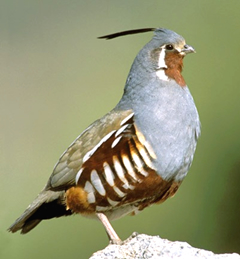
The Gorgeted Wood-Quail is identifiable by its distinct plumage, which features a rich chestnut body accented by a bold, black-and-white gorget on its throat. Adults exhibit a brownish-red coloration with intricate black barring on the sides and flanks. The head is adorned with a black crown and a white stripe running from the beak to the nape. Juvenile Gorgeted Wood-Quails often show duller plumage, lacking the pronounced gorget of the adults. Males and females appear quite similar, though males typically present slightly brighter and more defined coloration. In terms of size, the Gorgeted Wood-Quail is medium, measuring approximately 25-30 cm in length. Its flight silhouette is characterized by rounded wings and a short tail, typical of forest-dwelling quail species. The bird's posture when perched is often crouched, with the body held close to the ground, blending seamlessly with the forest floor. Similar species, such as the Rufous-fronted Wood-Quail, can cause some confusion, yet the distinctive throat gorget of Odontophorus strophium serves as a key differentiator.
Having trouble telling birds apart? Upload a photo to our bird identification tool for an instant species match.
Gorgeted Wood-Quail Habitat and Range
Preferred Habitat
The Gorgeted Wood-Quail inhabits the montane forests of the eastern Andes in Colombia, with a preference for subtropical and tropical moist environments. These forests, rich in biodiversity, provide the dense understory necessary for the bird's survival. Elevation typically ranges from 1,600 to 2,100 meters, where the climate is cool and the vegetation lush. The quail is rarely found in open areas, showing a strong preference for forest interiors where thick leaf litter and underbrush offer ample cover. Unlike some bird species, the Gorgeted Wood-Quail does not venture into urban or suburban areas, remaining strictly tied to undisturbed forest habitats. Seasonal habitat shifts are minimal, as the bird is largely sedentary, relying on the stability of its environment for foraging and nesting.
Geographic Range
The range of the Gorgeted Wood-Quail is limited to Colombia, specifically within the eastern Andes. Its distribution is highly localized to the department of Santander, with historical records also reported in the departments of Cundinamarca and Norte de Santander. The bird's range does not extend beyond these regions, making it one of the most range-restricted quail species in the world. The Gorgeted Wood-Quail is non-migratory, residing year-round within its limited geographic range. Population density is highest in protected areas such as the Santuario de Fauna y Flora Guanentá Alto Río Fonce, where conservation efforts have been focused. Outside these hotspots, sightings are rare due to habitat destruction and fragmentation.
Want to know which birds visit your area? Browse our backyard birds by location guides for region-specific species lists.
What Does the Gorgeted Wood-Quail Eat?
The diet of the Gorgeted Wood-Quail primarily consists of seeds, fruits, and small invertebrates. This diverse diet allows it to thrive in the nutrient-rich leaf litter of its montane forest habitat. During the wet season, the availability of fruits and seeds increases, and the quail adjusts its foraging behavior accordingly. Invertebrates, such as insects and small arthropods, provide essential protein, especially during the breeding season when nutritional demands are higher. Foraging typically occurs in small family groups, with the birds using their stout bills to sift through leaf litter and soil. The Gorgeted Wood-Quail is predominantly diurnal, with peak feeding activity occurring in the early morning and late afternoon. This schedule minimizes the risk of predation while taking advantage of the cooler temperatures and increased insect activity.
Gorgeted Wood-Quail Behavior and Social Structure
The Gorgeted Wood-Quail exhibits fascinating social and territorial behaviors. It is generally found in small coveys, consisting of a breeding pair and their offspring. This family structure is crucial for maintaining the group's cohesiveness and foraging efficiency. Territorial behavior is pronounced, with coveys defending their feeding and nesting areas from intruders through vocalizations and displays. Courtship involves males performing subtle displays, including soft calls and tail fanning, to attract females. During the breeding season, these displays become more frequent as pair bonds are reinforced. The Gorgeted Wood-Quail is known for its distinct daily activity patterns, being most active during dawn and dusk. This crepuscular activity pattern helps reduce exposure to predators. When threatened, the birds often freeze or dash into dense cover, using their cryptic plumage as camouflage. Predators include raptors and small carnivores, against which the quail's primary defense is remaining undetected.
Gorgeted Wood-Quail Nesting and Reproduction
The nesting habits of the Gorgeted Wood-Quail are adapted to its dense forest environment. Nests are typically shallow depressions on the forest floor, lined with leaves and twigs for insulation and camouflage. Preferred nest locations are under dense shrubbery or within thick leaf litter, providing natural concealment from predators. A typical clutch consists of 3 to 5 eggs, which are cream-colored and speckled with brown. Both parents share incubation duties, which last approximately 18 to 20 days. After hatching, the chicks are precocial, leaving the nest shortly after to follow their parents in search of food. Fledging occurs within a few weeks, although young quails remain with the family group for several months, learning essential survival skills. The Gorgeted Wood-Quail usually raises one brood per year, with breeding activity peaking during the wet season when food resources are abundant.
Gorgeted Wood-Quail Sounds and Vocalizations
The vocalizations of the Gorgeted Wood-Quail are notably distinctive and serve as a key identification feature. Its primary call is a series of clear, whistling notes that rise and fall in pitch, resembling the sound of a distant flute. These calls are often delivered in a rhythmic pattern, particularly during the early morning and late afternoon. Call notes are used to maintain contact between members of a covey and to establish territorial boundaries. Alarm calls are harsher and more rapid, employed when the birds perceive a threat. The dawn chorus of the Gorgeted Wood-Quail is a captivating experience for birders, as the forest resonates with their melodic calls. These vocalizations are crucial for communication within the dense forest habitat.
Interesting Facts About the Gorgeted Wood-Quail
- 1The Gorgeted Wood-Quail was first described in 1844 by the British ornithologist John Gould, who was renowned for his work on birds.
- 2This species is named for the striking gorget, or throat patch, which resembles a bib and is a key distinguishing feature.
- 3Despite its rarity, the Gorgeted Wood-Quail is one of the few quail species to be found exclusively in the humid montane forests of Colombia.
- 4The Gorgeted Wood-Quail is a sedentary bird, meaning it does not migrate and relies on stable habitats for survival.
- 5Although primarily ground-dwelling, the Gorgeted Wood-Quail can fly short distances, using its wings to escape predators quickly.
- 6The distinctive call of the Gorgeted Wood-Quail is often used by researchers to locate and study these elusive birds.
- 7Historically, the Gorgeted Wood-Quail's range has been restricted to a mere fraction of its original habitat, making conservation efforts crucial.
Gorgeted Wood-Quail Conservation Status
The Gorgeted Wood-Quail is currently classified as Endangered by the IUCN, with its population trend showing a concerning decline. Habitat loss due to agriculture and deforestation poses the greatest threat to its survival. Historical population changes highlight a drastic reduction in numbers over the past century, primarily due to human encroachment and land conversion. Conservation efforts have focused on protecting remaining forest habitats and establishing reserves such as the Santuario de Fauna y Flora Guanentá Alto Río Fonce. Captive breeding programs and community engagement are also part of conservation strategies to raise awareness and support for this rare bird. Continued habitat protection and restoration are essential to prevent further declines.
Other Odontophoridae Species


Birds Similar to the Gorgeted Wood-Quail
These species are often confused with the Gorgeted Wood-Quail due to similar appearance or overlapping range.

