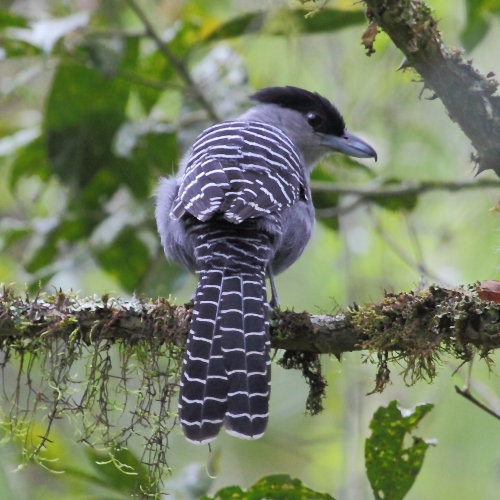
Gray Antbird
Cercomacra cinerascens
Order: Passeriformes / Family: Thamnophilidae

Wikimedia Commons
About the Gray Antbird
The Gray Antbird (Cercomacra cinerascens) is a member of the Thamnophilidae family, known for its strong association with the tropical forests of South America. This bird is typically found in the lowland rainforest regions, preferring dense underbrush where it can forage with ease. Its presence is most prominent in countries like Brazil, Peru, and Bolivia, extending into parts of Colombia and the Guianas. The Gray Antbird plays a significant ecological role as an insectivore, actively participating in the control of insect populations, which in turn helps maintain the health of its native forest ecosystems. Observers often note its tendency to follow army ant swarms, a behavior that allows it to capture insects flushed out by these marches. Seasonally, the Gray Antbird maintains a fairly consistent range, as it is not a migratory species. Instead, it adapts to the subtle changes in its environment, such as variations in insect abundance or shifts in forest composition due to weather patterns. The species is particularly significant as a bioindicator, reflecting the health of its habitat given its sensitivity to environmental changes and deforestation. With its understated beauty and vital ecological role, the Gray Antbird is a fascinating subject for ornithologists and birdwatchers alike.
The Gray Antbird belongs to the family Thamnophilidae, within the order Passeriformes. These birds typically live average 5 years with a maximum recorded of 8 years.
How to Identify a Gray Antbird
The Gray Antbird can be identified by its uniform slate-gray plumage, setting it apart in the dense understory it inhabits. Adult males and females share similar coloring, though males might appear slightly darker. The bird's eyes are a prominent red, contrasting with its plumage. Juveniles, on the other hand, exhibit a more muted gray-brown color, allowing them to blend into the shadows of their environment more effectively. In terms of size, the Gray Antbird is relatively small, averaging around 14 cm in length. When perching, it often adopts a low, horizontal posture, clinging to branches as it scans for prey. While its plumage might suggest confusion with other gray-bodied antbirds, its red eyes and lack of wing bars or distinctive markings aid in its identification. In flight, it exhibits a swift yet direct path, with rapid wingbeats that help it navigate through the forest's dense canopy.
Having trouble telling birds apart? Upload a photo to our bird identification tool for an instant species match.
Gray Antbird Habitat and Range
Preferred Habitat
The Gray Antbird primarily inhabits lowland tropical forests, thriving in the dense, humid understory. It favors areas with thick leaf litter and ample cover, vital for its ground-foraging behavior. Typically found at elevations up to 1000 meters, it prefers undisturbed forest regions but can also adapt to secondary growth forests if necessary. Throughout the year, it remains within these forested regions, showing little need for seasonal habitat shifts. While not commonly found in urban environments, the bird may occasionally venture into rural areas adjacent to large forest tracts, especially if these provide suitable cover and foraging opportunities.
Geographic Range
The breeding range of the Gray Antbird spans much of the northern half of South America. It is predominantly found in Brazil, with substantial populations in Peru, Bolivia, and the eastern parts of Colombia. The bird's range extends into the Guianas and parts of Venezuela. Unlike migratory species, the Gray Antbird remains within its range year-round, relying on the abundant food resources of its tropical habitat. Population density is highest in regions where large tracts of forest remain intact, such as the Amazon Basin. The bird's presence is less pronounced in fragmented or heavily degraded forest areas.
Want to know which birds visit your area? Browse our backyard birds by location guides for region-specific species lists.
What Does the Gray Antbird Eat?
The Gray Antbird's diet consists primarily of insects and arthropods, reflecting its role as a specialized insectivore. It actively forages by following army ant swarms, catching insects disturbed by these ants. This technique, known as ant-following, is a hallmark of its feeding strategy. The bird primarily consumes beetles, spiders, and caterpillars, with prey size varying from small insects to larger arthropods. Foraging generally occurs during the cooler morning and late afternoon hours, coinciding with peak ant activity. Seasonal changes in diet are minimal due to the relatively stable environment of its tropical habitat.
Gray Antbird Behavior and Social Structure
The Gray Antbird exhibits a largely solitary behavior, though pairs may be observed during the breeding season. Territorial by nature, it defends its feeding and nesting areas vigorously from conspecifics. Courtship displays are subtle, involving mutual preening and soft vocalizations. The bird demonstrates a strong fidelity to its territory, often returning to the same area each breeding season. In terms of flocking, the Gray Antbird seldom joins mixed-species flocks, preferring the company of a mate or foraging alone. Its response to predators includes remaining motionless or retreating into thick cover, relying on its cryptic plumage for protection.
Gray Antbird Nesting and Reproduction
The Gray Antbird constructs a cup-shaped nest using fine plant materials, often situated close to the ground within dense vegetation. Preferred locations include thick vines or low shrubs that provide excellent camouflage. The female typically lays a clutch of two eggs, which both parents incubate over a period of approximately 14 days. After hatching, the chicks remain in the nest for about 10-12 days before fledging. Both parents share the responsibility of feeding and guarding the young. The species usually raises one brood per year, although favorable conditions may occasionally allow for a second.
Gray Antbird Sounds and Vocalizations
The primary song of the Gray Antbird is a series of rapid, high-pitched notes that can be described as a 'chip-chip-chip' sequence. This song is often used for territory establishment and maintenance. The bird's call notes are sharp and distinctive, used for communication between mates and signaling alarm. During the dawn chorus, the Gray Antbird's song becomes more frequent and can dominate the soundscape of the forest understory. Its vocalizations are distinctive yet blend well into the ambient forest sounds, making them challenging to pinpoint without visual confirmation.
Interesting Facts About the Gray Antbird
- 1The Gray Antbird is often seen following army ant swarms, a behavior called 'ant-following'.
- 2Despite their elusive nature, Gray Antbirds are known for their loud, piercing calls.
- 3The Gray Antbird’s red eyes provide a striking contrast to its otherwise subdued plumage.
- 4This species is non-migratory, residing in its tropical habitat year-round.
- 5Gray Antbirds play a crucial role in controlling insect populations in their ecosystems.
- 6These birds have a unique niche, relying on army ants to flush out their insect prey.
- 7The Gray Antbird's preference for dense understory makes it an indicator of forest health.
Gray Antbird Conservation Status
Currently, the Gray Antbird holds a status of Least Concern on the IUCN Red List. Its population trend remains stable, although localized declines occur in regions facing severe deforestation. Primary threats include habitat loss due to logging and agricultural expansion. Conservation efforts focus on preserving large tracts of forest and promoting sustainable land-use practices. Historical data indicates that while the species is adaptable, it suffers in areas where forest fragmentation is severe. Continued protection of its habitat is crucial for maintaining its population.