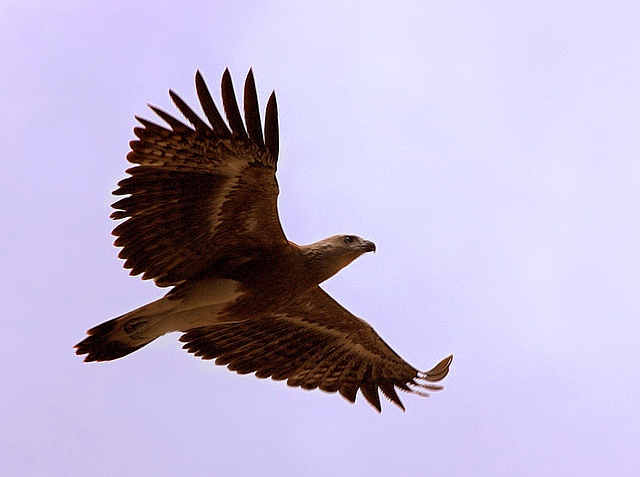
Gray-headed Fish-Eagle
Haliaeetus ichthyaetus
Order: Accipitriformes / Family: Accipitridae

Wikimedia Commons
About the Gray-headed Fish-Eagle
The Gray-headed Fish-Eagle, Haliaeetus ichthyaetus, is a striking raptor known for its robust build and striking plumage. This bird of prey inhabits tropical regions across South and Southeast Asia, including India, Sri Lanka, and the islands of Indonesia, often found near large bodies of water such as lakes, rivers, and coastal areas. Its presence signifies healthy aquatic ecosystems as it primarily feeds on fish, highlighting its ecological role as a top predator in these habitats. During the breeding season, which varies across its range but generally coincides with the monsoon, pairs are often seen performing aerial displays, showcasing their agility and strength. Outside the breeding season, these eagles are more solitary but occasionally roost communally. The Gray-headed Fish-Eagle's significance extends to cultural aspects as well, often featured in local folklore and considered a symbol of power and freedom. Its preference for undisturbed habitats makes it vulnerable to habitat degradation and pollution, which are significant threats to its population. Conservation efforts are thus crucial to ensure the survival of this majestic raptor, with initiatives focusing on habitat protection and pollution control. As climate change impacts water levels and fish populations, the conservation of the Gray-headed Fish-Eagle serves as an indicator of broader environmental health.
The Gray-headed Fish-Eagle belongs to the family Accipitridae, within the order Accipitriformes. These birds typically live typically lives 15-20 years, with some individuals reaching up to 25 years..
How to Identify a Gray-headed Fish-Eagle
Adults of the Gray-headed Fish-Eagle exhibit a striking gray head, contrasting with a mostly dark brown body and a white belly. Their legs are bare and yellow, while the tail is wedge-shaped with a broad white band. Juveniles lack the distinct gray head, featuring more mottled brown plumage and a less defined belly band. Males and females look similar, though females are typically larger, a common trait among raptors. This eagle can be confused with the Lesser Fish-Eagle, but the latter is smaller with a more uniformly colored tail. In flight, the Gray-headed Fish-Eagle displays broad, rounded wings and a slow, deliberate wingbeat, often soaring with wings held flat. When perched, it adopts an upright stance, often on a high vantage point near water, scanning for prey. Observers should note its distinctive call, a loud, cackling series of notes, which can aid in identification.
Having trouble telling birds apart? Upload a photo to our bird identification tool for an instant species match.
Gray-headed Fish-Eagle Habitat and Range
Preferred Habitat
The Gray-headed Fish-Eagle primarily inhabits large freshwater bodies like rivers, lakes, swamps, and estuaries. It can also be found in mangroves and coastal areas. This eagle prefers lowland regions but can be found up to 1,500 meters in elevation, particularly where large water bodies are present. While generally favoring rural over urban settings, it may occasionally be observed near human settlements, especially where fish resources are abundant. Seasonal habitat shifts are minimal; however, some local movements may occur in response to water levels and prey availability.
Geographic Range
The breeding range of the Gray-headed Fish-Eagle spans across the Indian subcontinent, Southeast Asia, and parts of China. It is resident in countries like India, Nepal, Bangladesh, Myanmar, Thailand, and Malaysia, with populations also present in the Philippines and Indonesia. Migration is limited, with most individuals being sedentary, although some altitudinal movements occur in response to seasonal changes in water levels. Population density is highest in regions with extensive wetland systems, such as the Sundarbans in India and Bangladesh, and the riverine areas of Southeast Asia.
Want to know which birds visit your area? Browse our backyard birds by location guides for region-specific species lists.
What Does the Gray-headed Fish-Eagle Eat?
The primary diet of the Gray-headed Fish-Eagle consists of fish, which it captures with remarkable skill. It hunts by soaring over water or perching nearby to watch for prey, swooping down with outstretched talons to snatch fish from the surface. Prey size varies but typically includes medium-sized fish up to 1 kg. When fish are scarce, it may consume small mammals, reptiles, and carrion. Its feeding schedule aligns with early morning and late afternoon, when fish are most active. Seasonal changes in diet occur based on prey availability, with some populations taking advantage of seasonal fish migrations.
Gray-headed Fish-Eagle Behavior and Social Structure
Gray-headed Fish-Eagles are generally solitary or found in pairs, particularly during the breeding season. They are territorial, often defending prime fishing areas aggressively against intruders. Courtship involves aerial displays, with pairs performing synchronized flights. Flocking behavior is uncommon, but some communal roosting has been observed. In response to predators or threats, these eagles emit loud, cackling calls and may engage in aggressive aerial maneuvers. Their daily activity pattern includes peak hunting periods during dawn and dusk, with midday often spent perching and preening.
Gray-headed Fish-Eagle Nesting and Reproduction
Nesting occurs in the dry season, with eagles building large stick nests high in trees near water. Nests are reused annually, with additional materials added each year. Clutch size typically ranges from one to two eggs, with an incubation period of about 45 days. Both parents share incubation duties, although the female primarily incubates while the male provides food. Fledging occurs around 70 days after hatching, with juveniles remaining dependent on parents for several months. Generally, they produce one brood per year, but under optimal conditions, a second brood may be attempted.
Gray-headed Fish-Eagle Sounds and Vocalizations
The primary call of the Gray-headed Fish-Eagle is a series of loud, cackling notes that carry over long distances. These calls often increase in intensity during territorial disputes or courtship. Alarm calls consist of sharp, rapid notes, signaling potential threats. Unlike many songbirds, the Gray-headed Fish-Eagle does not participate in a dawn chorus, but its vocalizations are most frequent during early morning and late afternoon, coinciding with heightened activity periods.
Interesting Facts About the Gray-headed Fish-Eagle
- 1The Gray-headed Fish-Eagle can spot a fish from over 100 meters away, showcasing its extraordinary vision.
- 2Despite their name, not all Gray-headed Fish-Eagle individuals have entirely gray heads; some juveniles display a mottled brown head.
- 3These eagles can live up to 20 years in the wild, a testament to their resilience in natural habitats.
- 4Their nests can reach up to 2 meters in diameter, providing a sturdy home for their young.
- 5Gray-headed Fish-Eagles are often indicators of healthy wetland ecosystems due to their reliance on fish populations.
- 6Their talons are specially adapted to grip slippery fish, with rough pads that improve their catch success rate.
- 7In some cultures, the Gray-headed Fish-Eagle is revered as a spiritual messenger, reflecting its majestic presence.
Gray-headed Fish-Eagle Conservation Status
The IUCN lists the Gray-headed Fish-Eagle as Near Threatened due to habitat loss and pollution. Its population trend is decreasing, primarily because of wetland degradation and pollution. Conservation efforts focus on habitat protection and law enforcement against poaching. Historical populations were more robust, but recent decades have seen declines. Conservationists emphasize the need for international cooperation to protect the transboundary habitats crucial for its survival.
Other Accipitridae Species


Birds Similar to the Gray-headed Fish-Eagle
These species are often confused with the Gray-headed Fish-Eagle due to similar appearance or overlapping range.