
Lesser Fish Eagle
Icthyophaga humilis
Order: Accipitriformes / Family: Accipitridae
Wikimedia Commons
About the Lesser Fish Eagle
The Lesser Fish Eagle (Icthyophaga humilis) is a medium-sized raptor predominantly found in tropical and subtropical riverine ecosystems across South and Southeast Asia. This bird is highly specialized for life along rivers and large water bodies, where it primarily preys on fish. It plays a crucial role in maintaining the ecological balance by keeping fish populations in check. The eagle's significance extends beyond its ecological role; it is a vital indicator of healthy riverine environments. Observing the presence or absence of this eagle gives researchers insight into habitat quality and ongoing environmental changes. Found in countries like India, Nepal, Bhutan, Bangladesh, and parts of Southeast Asia including Thailand and Myanmar, the Lesser Fish Eagle prefers regions with dense forest cover adjacent to water sources. Specifically, the bird thrives in areas where mature trees provide ample perching and nesting opportunities. Its presence is often noted in protected areas like national parks and wildlife sanctuaries, where conservation efforts focus on preserving its habitat from human encroachment and pollution. Seasonally, the Lesser Fish Eagle remains relatively sedentary, although some populations may exhibit minor local movements in response to water level changes and prey availability. In the dry season, these birds are more visible as they concentrate around shrinking water bodies, making it an ideal time for birdwatchers to observe their hunting prowess. During the wet season, when waters swell and fish become plentiful, the eagles may disperse over a wider range, though they continue to rely on riverine habitats. Understanding the Lesser Fish Eagle's ecological role highlights the importance of conserving its natural habitats, which are increasingly threatened by deforestation, water pollution, and unsustainable fishing practices.
The Lesser Fish Eagle belongs to the family Accipitridae, within the order Accipitriformes. These birds typically live average lifespan of 15-20 years in the wild..
How to Identify a Lesser Fish Eagle
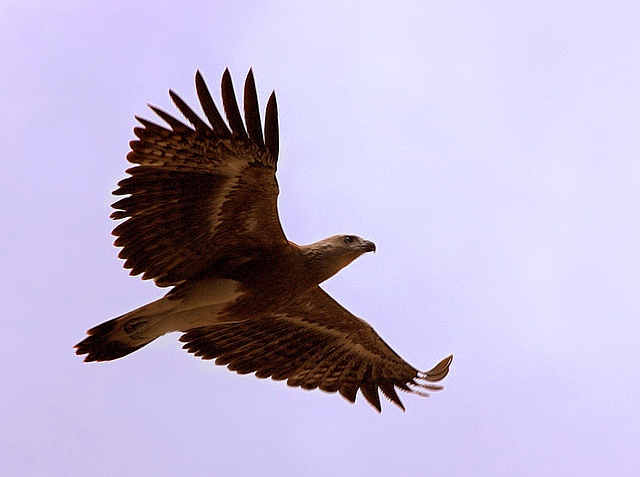
The Lesser Fish Eagle is easily identifiable by its distinctive plumage. Adults exhibit a striking white belly contrasted by a dark brown back and wings. Their head and neck appear a lighter brown, often with a slightly mottled appearance. The bird's yellow eyes and powerful grayish-black beak further distinguish it from other raptors. Juveniles, on the other hand, often present a more uniform brown coloration, lacking the clear demarcation of the adult plumage. As they mature, their plumage lightens and develops the characteristic adult pattern. Male and female Lesser Fish Eagles are similar in appearance, though females tend to be slightly larger, a common trait among raptors. When compared to similar species such as the larger Grey-headed Fish Eagle, the Lesser Fish Eagle's size and whiter belly are distinguishing features. In flight, the eagle's wings are broad and rounded, providing a distinctive silhouette against the sky. While perching, the bird maintains an upright stance, often choosing high vantage points near water to survey for prey. Its posture, combined with the contrasting plumage, makes it relatively easy to spot against the backdrop of lush green forests or blue water bodies.
Having trouble telling birds apart? Upload a photo to our bird identification tool for an instant species match.
Lesser Fish Eagle Habitat and Range
Preferred Habitat
The Lesser Fish Eagle thrives in riverine and wetland habitats, favoring areas with slow-moving or still waters such as rivers, lakes, and reservoirs. Found in dense forests adjacent to these water bodies, it relies on mature trees for nesting and perching. The eagle typically inhabits lowland areas, but it can also be found at elevations up to 1,500 meters, especially in the Himalayan foothills. Seasonal habitat shifts are minimal, but during periods of drought, the bird may move closer to remaining water sources. The Lesser Fish Eagle rarely ventures into urban environments, preferring the tranquility and resources of rural and protected areas. Conservation of its habitat is critical as deforestation and human encroachment pose significant threats to its survival.
Geographic Range
The Lesser Fish Eagle occupies a range that spans much of South and Southeast Asia. Its breeding range includes parts of India, Nepal, Bhutan, and Bangladesh, where it is a fairly common resident. In Southeast Asia, the bird is found in Myanmar, Thailand, Laos, Cambodia, and Vietnam. The species does not undertake long-distance migrations, but it may engage in local movements based on seasonal changes in water levels and prey availability. Population density is highest in regions with abundant water bodies and well-preserved forest habitats, such as the Assam region in India and the Chitwan National Park in Nepal. Unlike some migratory raptors, the Lesser Fish Eagle maintains relatively stable territories throughout the year.
Want to know which birds visit your area? Browse our backyard birds by location guides for region-specific species lists.
What Does the Lesser Fish Eagle Eat?
As its name suggests, the Lesser Fish Eagle specializes in catching fish, which forms the bulk of its diet. The eagle prefers medium-sized fish, typically ranging from 20 to 30 centimeters in length. Seasonal diet changes occur as fish availability fluctuates, with the bird occasionally supplementing its diet with small reptiles or amphibians. The Lesser Fish Eagle employs a sit-and-wait hunting strategy, perching silently near the water until it spots prey. It then swoops down with precision to snatch fish from the water using its sharp talons. This efficient hunting technique is typically observed during the early morning and late afternoon, when fish are most active near the surface.
Lesser Fish Eagle Behavior and Social Structure
The Lesser Fish Eagle is predominantly solitary, with each individual maintaining a distinct territory along a stretch of river or lake. Territorial disputes can occur, particularly during the breeding season, but these are generally limited to vocal displays and aerial chases rather than physical confrontations. Courtship involves elaborate displays, where the male performs aerial maneuvers to attract a mate and establish a pair bond. Unlike some raptors that form flocks, the Lesser Fish Eagle remains solitary or in pairs, even outside of the breeding season. When threatened by predators or human disturbance, the eagle employs loud, piercing calls as a deterrent. Its daily activities revolve around hunting and perching, with periods of rest during the hottest parts of the day.
Lesser Fish Eagle Nesting and Reproduction
The Lesser Fish Eagle constructs its nest in large trees near water bodies. The nest, a substantial platform of sticks and branches, is often reused and added to each year. Preferred nest sites include tall trees that provide a clear view of the surrounding area and proximity to fishing grounds. The eagle typically lays a clutch of two to three eggs, which are incubated by both parents for approximately 35 to 40 days. After hatching, eaglets remain in the nest for about two months before fledging. Both parents share in feeding and protecting the young, though the female often takes a more active role in incubation and brooding. The species usually raises one brood per year, with breeding timed to coincide with periods of fish abundance.
Lesser Fish Eagle Sounds and Vocalizations
The primary call of the Lesser Fish Eagle is a series of high-pitched whistles, often described as 'ki-ki-ki' or 'kee-kee-kee.' These calls vary in intensity and are most frequently heard during the breeding season as part of courtship displays and territorial defense. Alarm calls are sharper and more urgent, serving as a warning to intruders and potential threats. The Lesser Fish Eagle is generally not a vocal bird outside of these contexts, contributing to its elusive nature when not actively displaying.
Interesting Facts About the Lesser Fish Eagle
- 1The Lesser Fish Eagle's hunting technique is so efficient that it can catch a fish in mere seconds after spotting it from a perch.
- 2Despite its name, the Lesser Fish Eagle is only slightly smaller than its close relative, the Pallas's Fish Eagle.
- 3The eagle's talons are specially adapted to grip slippery fish, with rough surfaces that help prevent prey from escaping.
- 4Lesser Fish Eagles can spend hours perched silently, demonstrating extreme patience in their hunting strategy.
- 5This eagle's presence is often an indicator of a healthy aquatic ecosystem, as it requires clean waters to thrive.
- 6Lesser Fish Eagles tend to be more vocal during early morning hours, aligning with their peak hunting times.
- 7Unlike many raptors, the Lesser Fish Eagle is almost exclusively piscivorous, rarely hunting terrestrial prey.
Lesser Fish Eagle Conservation Status
The IUCN currently lists the Lesser Fish Eagle as Near Threatened, with its population trend showing a decline. Habitat destruction due to deforestation and river pollution are primary threats facing the species. Conservation efforts focus on protecting riverine ecosystems and creating awareness about the importance of these habitats. Historical records indicate a more widespread distribution, with declines linked to increased human activity and environmental degradation. Protected areas and improved fishing practices offer some hope for stabilization of the population.


