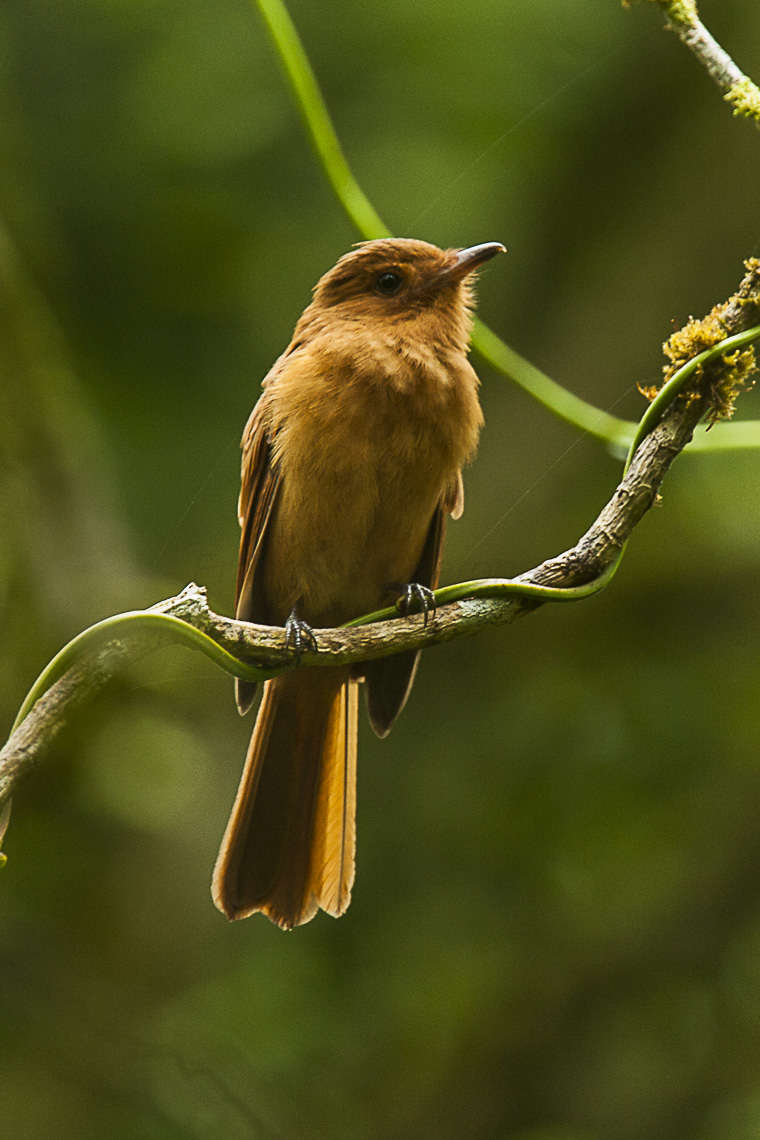
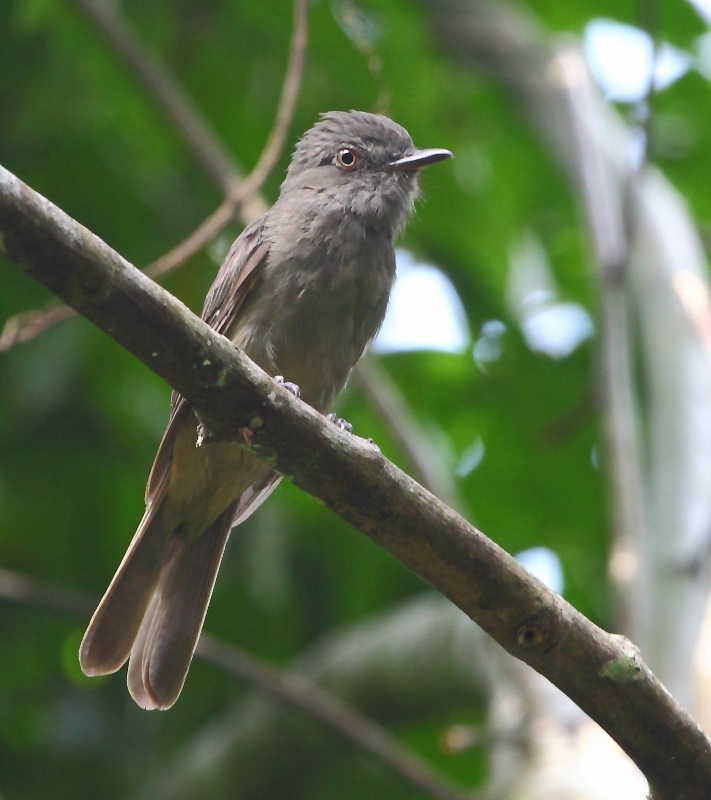
Grayish Mourner
Rhytipterna simplex
Order: Passeriformes / Family: Tyrannidae
Wikimedia Commons
About the Grayish Mourner
The Grayish Mourner (Rhytipterna simplex) belongs to the Tyrannidae family, a diverse group of passerine birds widely distributed across the Neotropics. This bird is primarily found in the lowland forests of Central and South America, ranging from Honduras to Bolivia and Brazil. It thrives in a variety of forest types, including both primary and secondary growth, as well as forest edges. The Grayish Mourner plays a vital ecological role in its habitat by acting as both a predator and a seed disperser. Its diet primarily consists of insects, which helps control insect populations, while its consumption of fruits aids in the dispersal of seeds, contributing to plant regeneration and forest health. During the breeding season, which varies geographically, the Grayish Mourner becomes more vocal and conspicuous. It is often heard delivering its distinctive, mournful song from a high perch. This call is essential for territory establishment and mate attraction. Despite being relatively inconspicuous visually, its vocalizations make it one of the more noticeable birds in its ecological niche. The Grayish Mourner's presence across a wide range of habitats underscores its adaptability and resilience. It is a key species in maintaining the ecological balance of tropical forest ecosystems. Its ability to thrive in both undisturbed and disturbed habitats highlights its role as a flexible and resilient member of the avian community. The seasonal behaviors of the Grayish Mourner reflect its adaptability to changing environmental conditions. During the wet season, when insect abundance is high, it primarily focuses on insect prey. As the dry season approaches and fruit availability increases, its diet shifts accordingly. This dietary flexibility not only aids its survival but also has broader ecological implications, as it influences seed dispersal patterns and plant community dynamics. The Grayish Mourner's significance extends beyond its immediate environment. As a member of the Tyrannidae family, it shares evolutionary and ecological characteristics with other flycatchers, underscoring the importance of preserving diverse forest habitats. Conservation efforts aimed at protecting tropical forests will inherently benefit this species, ensuring its continued role in maintaining biodiversity and ecosystem health.
The Grayish Mourner belongs to the family Tyrannidae, within the order Passeriformes. These birds typically live 5-9 years, with some individuals living up to 11 years..
How to Identify a Grayish Mourner
The Grayish Mourner is a medium-sized bird, measuring approximately 20-22 cm in length. Its plumage is predominantly gray, with subtle variations that can aid in identification. Adult birds exhibit a uniform gray coloration on the back and wings, with slightly lighter gray underparts. The tail is a darker gray, providing a slight contrast. Juveniles may appear paler with a more brownish tint to their feathers. There is little sexual dimorphism in this species, meaning males and females look similar. However, the female's plumage may be slightly duller in hue. One of the key identification features of the Grayish Mourner is its bill, which is relatively large and slightly hooked at the tip, typical of flycatchers in the Tyrannidae family. The bird's eyes are dark, set against its smooth gray head, giving it a somewhat somber expression. In comparison to similar species, such as the Dusky-capped Flycatcher, the Grayish Mourner lacks the prominent crest and presents a more uniform gray appearance. In flight, the Grayish Mourner displays a strong, purposeful wingbeat, maintaining a steady trajectory. When perched, it often adopts an upright stance, occasionally flicking its tail. This posture, combined with its distinctive vocalizations, can aid birders in positively identifying this species in the field.
Having trouble telling birds apart? Upload a photo to our bird identification tool for an instant species match.
Grayish Mourner Habitat and Range
Preferred Habitat
The Grayish Mourner inhabits a variety of tropical forest types, showing a preference for lowland forests up to elevations of 1200 meters. It thrives in both primary and secondary forests, as well as forest edges and clearings. In regions like the Amazon Basin, it occupies dense understory areas where it can forage effectively. During the dry season, it may venture into semi-deciduous forests, demonstrating its adaptability to different forest conditions. While it primarily inhabits rural and forested areas, the Grayish Mourner can occasionally be found in more urbanized settings, provided that sufficient tree cover and food resources are available. Its presence in a range of habitats underscores its ecological flexibility and ability to exploit various forest environments.
Geographic Range
The Grayish Mourner's range spans Central and South America, from southern Honduras through Nicaragua, Costa Rica, and Panama, extending into Colombia, Venezuela, and southward through the Amazon Basin in Brazil, reaching Bolivia and the eastern slopes of the Andes. This bird does not engage in long-distance migrations, instead exhibiting local movements in response to seasonal food availability. Population density varies across its range, with higher concentrations in regions like the Amazon Basin and lowland forests of Colombia and Ecuador. Although it occupies a broad geographic range, local populations may fluctuate based on habitat conditions and food resources.
Want to know which birds visit your area? Browse our backyard birds by location guides for region-specific species lists.
What Does the Grayish Mourner Eat?
The Grayish Mourner primarily feeds on insects, making it an important insectivore in its ecosystem. It employs a sit-and-wait foraging strategy, often perching quietly before making sudden sallies to capture prey. Its diet includes a variety of insects such as beetles, grasshoppers, and moths. During the wet season, when insect abundance peaks, its diet is heavily insect-based. In the dry season, the Grayish Mourner supplements its diet with fruit, particularly from trees and shrubs common in its habitat. Its ability to switch between invertebrates and fruits allows it to maintain its energy needs year-round. The prey size varies, but it typically targets small to medium-sized insects that it can easily handle and consume. Feeding occurs mainly during the early morning and late afternoon when it is most active.
Grayish Mourner Behavior and Social Structure
The Grayish Mourner exhibits a solitary lifestyle, often maintaining individual territories throughout the year. It defends its territory with vocalizations and displays, using its characteristic song to establish boundaries and deter intruders. Courtship involves subtle displays, with males performing aerial maneuvers and vocalizations to attract females. Flocking behavior is uncommon, though individuals may occasionally join mixed-species foraging flocks to exploit abundant food sources. In response to predators, the Grayish Mourner employs a combination of alarm calls and evasive flight. Its daily activity patterns include periods of intense foraging interspersed with rest and preening. The bird's adaptability to changing environments and social structures is evident in its interactions with other species and its response to fluctuating resource availability.
Grayish Mourner Nesting and Reproduction
The Grayish Mourner constructs open cup nests, typically situated in the forks of tree branches, between 3 to 10 meters above the ground. Nests are built using materials like twigs, leaves, and grasses, carefully woven to provide a secure cradle for the eggs. The female lays a clutch of 2-3 eggs, which she incubates for approximately 14-16 days. Both parents participate in feeding the chicks, which fledge around 18-20 days after hatching. The Grayish Mourner typically raises one brood per year, although favorable conditions may allow for a second brood. Parental roles are well-defined, with both parents sharing duties in chick-rearing and nest defense.
Grayish Mourner Sounds and Vocalizations
The Grayish Mourner's primary song is a series of mournful, descending whistles, each note lasting about one second. The rhythm is slow and deliberate, with a quality that resonates through its forested habitat. Its call notes are softer, often used in communication between mates or signaling mild alarm. Alarm calls are sharp and more rapid, serving to alert others to potential threats. During the dawn chorus, the Grayish Mourner's song is a prominent feature, often heard long before the bird is seen. The tonal quality of its song can be compared to a distant, echoing flute, distinct from other forest birds.
Interesting Facts About the Grayish Mourner
- 1The Grayish Mourner's song can carry over long distances, making it easier to hear than to see.
- 2Despite its somber name, the Grayish Mourner plays a lively role in forest ecosystems as both predator and seed disperser.
- 3The Grayish Mourner's bill is specially adapted to catching insects on the wing, exhibiting a slight hook typical of Tyrannidae flycatchers.
- 4This species demonstrates remarkable adaptability, thriving in both undisturbed primary forests and altered secondary habitats.
- 5The Grayish Mourner often joins mixed-species flocks, benefiting from the diverse foraging strategies of its companions.
- 6Its vocalizations are a key tool in territorial defense, serving to establish presence and deter rival males.
- 7The Grayish Mourner's ability to adjust its diet seasonally is crucial for survival, particularly during resource-scarce periods.
Grayish Mourner Conservation Status
The Grayish Mourner is currently listed as Least Concern by the IUCN, with a stable population trend. Its wide range and adaptability to various forest types contribute to its resilience. Nonetheless, habitat destruction, particularly deforestation in the Amazon Basin, poses a significant threat to its population. Conservation efforts focus on protecting large tracts of tropical forests and mitigating habitat loss through sustainable land-use practices. The Grayish Mourner's historical population has remained relatively stable, but continued vigilance is necessary to ensure its habitat is preserved for future generations.
Other Tyrannidae Species


Birds Similar to the Grayish Mourner
These species are often confused with the Grayish Mourner due to similar appearance or overlapping range.