
Great Skua
Stercorarius skua
Order: Charadriiformes / Family: Stercorariidae
Wikimedia Commons
About the Great Skua
The Great Skua (Stercorarius skua) is a formidable seabird known for its robust build and aggressive demeanor. This species is a member of the Stercorariidae family and is recognized for its adeptness at piracy, often stealing food from other birds. Found primarily in the North Atlantic, the Great Skua breeds on rocky islands such as the Shetlands and Orkneys of Scotland, as well as the Faroe Islands and Iceland. During the breeding season, these birds are highly territorial, and their presence is marked by loud, harsh calls. Their role in the ecosystem includes both predation and kleptoparasitism, where they steal prey from other seabirds, especially gulls and terns. This behavior serves as an ecological control, managing the populations of other species in their habitat.
Great Skuas are powerful fliers, covering vast distances during migration. In winter, they migrate south to the waters off the coasts of Spain, Portugal, and as far as the coast of Morocco. As apex predators among seabirds, they primarily hunt fish and smaller sea birds, showcasing their adaptability in various marine environments. Their presence helps maintain a balance within the marine food web, as they are both predators and scavengers, cleaning up dead or dying fish.
The ecological significance of the Great Skua extends beyond its immediate environment. By regulating prey populations and scavenging, they contribute to the health of the marine ecosystem. Their seasonal behaviors are closely tied to their breeding cycle, with intense territoriality and pair bonding rituals observed during the nesting period. Great Skuas are a vital component in their habitats, illustrating the intricate interdependencies within marine ecosystems.
The Great Skua belongs to the family Stercorariidae, within the order Charadriiformes. These birds typically live average 15-20 years; max recorded 27 years..
How to Identify a Great Skua
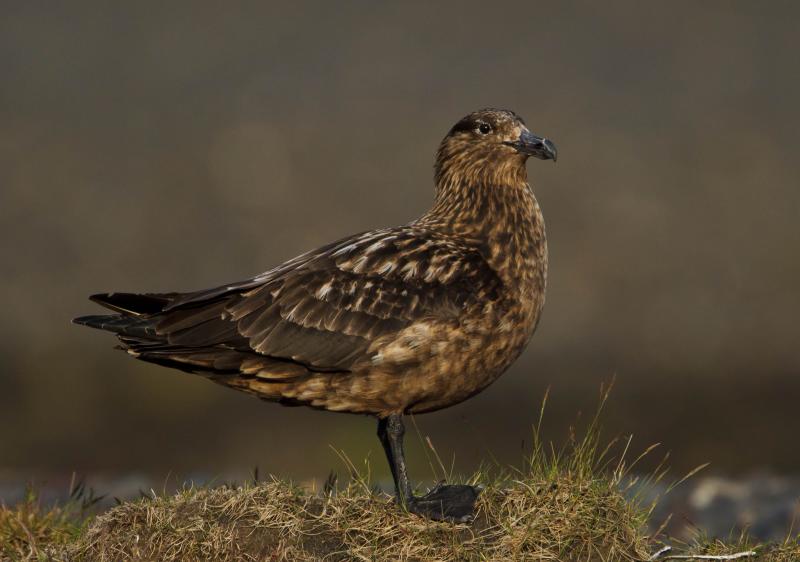
The Great Skua is a large, robust seabird with a wingspan ranging from 125 to 140 cm. It displays a predominantly brown plumage, with a mottled appearance due to the lighter feather edges. Both sexes appear similar, though females are slightly larger. The bird's powerful build is accentuated by its broad wings and a thick neck. In flight, the Great Skua is recognizable by its distinctive white wing flashes which are visible against its darker plumage. Juveniles resemble adults but tend to have less distinct feather edging, giving them a more uniform appearance.
Great Skuas can be confused with other skua species, particularly the Pomarine Jaeger, but the Great Skua is more robust and lacks the elongated central tail feathers seen in other jaegers. When perched, its stance is upright, and its hefty bill is prominent, highlighting its predatory nature. The bird's silhouette in flight is characterized by broad wings and a slightly rounded tail.
Despite their large size, Great Skuas are agile fliers. Their flight is powerful, with deep wing beats interspersed with glides. This agility aids them in their piratical foraging habits, where they adeptly harass other seabirds to surrender their catches.
Having trouble telling birds apart? Upload a photo to our bird identification tool for an instant species match.
Great Skua Habitat and Range
Preferred Habitat
The Great Skua inhabits open marine environments, favoring coastal regions for breeding. During the breeding season, they nest on rocky islands, cliffs, and moorland, often choosing sites with sparse vegetation for better visibility. Elevations up to 400 meters are typical for nesting sites, with a preference for remote locations to minimize human disturbance.
Outside the breeding season, Great Skuas are pelagic, spending most of their time at sea. They are rarely found inland, preferring the open ocean where they can hunt and scavenge efficiently. Their presence is minimal in urban areas, though they may occasionally be seen near coastal towns.
Seasonally, Great Skuas shift from their northern breeding grounds to southern waters, ranging from the North Atlantic islands to the Mediterranean and as far as the northwest coast of Africa in winter. This shift allows them to exploit different marine resources throughout the year.
Geographic Range
The Great Skua's range is primarily within the North Atlantic. During the breeding season, they are found on islands such as the Orkneys, Shetlands, and Faroe Islands, extending to Iceland and Norway. These regions provide the ideal isolated and rugged environments they require for nesting.
In winter, their range expands as they migrate southward. They frequent the Atlantic coasts of Europe, including the British Isles, France, and the Iberian Peninsula. Some populations reach the coastal waters of northwest Africa, including Morocco, indicating a broad wintering distribution.
Migration corridors are primarily oceanic, with birds covering significant distances between breeding and wintering grounds. Population density hotspots include the breeding islands, where they concentrate during the nesting season, and off the Iberian coast during winter. Their numbers are fewer along migration routes, as they disperse widely over open waters.
Want to know which birds visit your area? Browse our backyard birds by location guides for region-specific species lists.
What Does the Great Skua Eat?
The Great Skua is an opportunistic feeder, with a diet that primarily includes fish and other seabirds. They often resort to kleptoparasitism, where they harass gulls, terns, and other seabirds to steal their catch. Fish species like herring and mackerel are common targets, and the skuas often follow fishing vessels to scavenge discards.
Seasonal diet changes occur, with more birds and eggs consumed during the breeding season when these resources are readily available. This predation helps control seabird populations, especially on breeding islands.
Their foraging techniques are diverse. They are adept at aerial chases, using their agility and speed to pursue prey. The size of prey varies, with fish typically ranging from 15 to 30 cm in length. Feeding schedules align with daylight, as their visual hunting relies on sight, although they can scavenge at any time of day when the opportunity arises.
Great Skua Behavior and Social Structure
Great Skuas exhibit strong territorial behavior, particularly during the breeding season. Pairs aggressively defend their nesting sites from intruders, including other skuas and human visitors. Their courtship displays involve aerial chases and synchronized flying, strengthening pair bonds.
Socially, Great Skuas are generally solitary or found in pairs, except during migration when loose flocks may form. They exhibit dominance hierarchies when feeding, often displacing smaller birds to secure food. Their response to predators is vigorous, with individuals diving at intruders near their nests.
Daily activity patterns are diurnal, with peak activity corresponding to daylight hours when they hunt and patrol their territories. Their behavior reflects a high degree of adaptability, allowing them to exploit various food sources and habitats effectively.
Great Skua Nesting and Reproduction
The Great Skua nests on the ground, often in exposed areas with minimal vegetation. Nests are simple scrapes lined with grass and bits of down. Preferred locations include rocky islands with sparse vegetation, providing clear sightlines for detecting threats.
Clutch size typically consists of two eggs, though occasionally three, with an incubation period of about 27 to 30 days. Both parents share incubation duties, showcasing a cooperative breeding effort.
Fledging occurs approximately 50 days post-hatching. Parental roles are shared, with both adults feeding and protecting the chicks. Great Skuas usually produce one brood per year, given the investment required in rearing their young in often harsh environments.
Great Skua Sounds and Vocalizations
The Great Skua's vocalizations are harsh and loud, fitting its aggressive demeanor. Its primary call is a grating 'skua-skua' or 'kwe, kwe' sound, often heard during territorial disputes or when alarmed. The rhythm is rapid, and the pitch is low, conveying urgency.
Alarm calls are sharp and raucous, effectively deterring potential threats. During the dawn chorus, their calls dominate the soundscape of their breeding colonies, serving as an acoustic marker of their territory.
Compared to other seabirds, the Great Skua's calls are less melodious, but they are distinctive and serve critical communication functions within their social structure.
Interesting Facts About the Great Skua
- 1Great Skuas can chase and harass other birds for over 30 minutes to steal food, showcasing their persistence.
- 2During migration, Great Skuas can travel over 1,000 km in a single flight, crossing entire seas between feeding grounds.
- 3Despite their formidable reputation, Great Skuas weigh only about 1.2 to 1.8 kg, making them agile and swift.
- 4The Great Skua's name derives from the Faroese word 'skúgvur,' reflecting its strong ties to the North Atlantic.
- 5Great Skuas show remarkable site fidelity, often returning to the same nesting sites year after year.
- 6Their aggressive behavior extends to humans, with skuas known to dive-bomb intruders near their nests.
- 7Some Great Skuas have been observed using tools, such as dropping shellfish from heights to crack them open.
Great Skua Conservation Status
The Great Skua is currently classified as Least Concern by the IUCN, though its population trend shows regional variability. In some areas, numbers are stable or increasing, while others face pressures from habitat disturbance and climate change. Primary threats include oil spills, overfishing, which reduces their food supply, and human disturbance during the breeding season. Conservation efforts focus on monitoring populations and protecting key breeding sites from human and environmental impacts. Historically, the Great Skua's population has faced challenges from hunting and habitat loss, but current protections have helped stabilize numbers. Continued vigilance is needed to ensure this iconic seabird thrives in its natural habitat.


