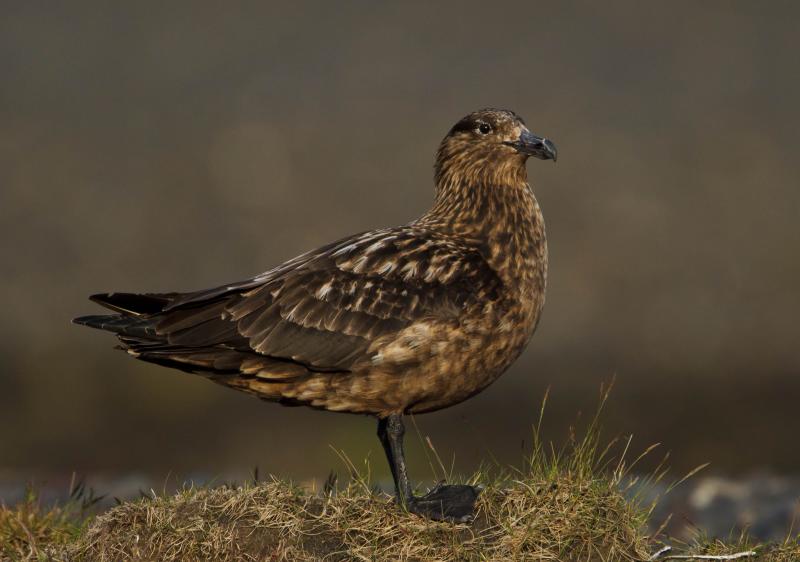
South Polar Skua
Stercorarius maccormicki
Order: Charadriiformes / Family: Stercorariidae

Wikimedia Commons
About the South Polar Skua
The South Polar Skua, scientifically known as Stercorarius maccormicki, is a formidable seabird that holds a critical role in its ecosystem. As a member of the family Stercorariidae, this bird is most renowned for its aggressive and opportunistic feeding behavior, which includes kleptoparasitism, the act of stealing food from other birds. During the austral summer, the South Polar Skua breeds along the Antarctic coastlines and nearby islands, where it capitalizes on the rich marine life present in these frigid waters. The skua's presence is not just a spectacle for visiting ornithologists, but also a vital component in regulating the populations of other seabirds, particularly penguins from whom they often steal food.
The significance of the South Polar Skua extends beyond its predatory habits. This bird serves as an indicator of the health of the marine ecosystem. Changes in skua populations can reflect shifts in prey availability, often due to environmental changes such as climate fluctuations or human activities. Skuas breed in colonies that can range from a few pairs to several hundred, depending on food availability and predation risk. These colonies are predominantly found in ice-free areas near penguin or petrel colonies, which provide ample feeding opportunities.
The ecological role of the South Polar Skua involves both predation and scavenging. While they frequently prey on fish and other marine organisms, they are also known to consume carrion and human refuse when available. Their adaptability in feeding habits allows them to thrive in the harsh Antarctic environment. Seasonal behaviors of the South Polar Skua include long-distance migrations that take them across oceans to reach wintering grounds in the northern hemisphere, including the Pacific and Atlantic Oceans. These migrations are essential for avoiding the harsh Antarctic winter and finding suitable feeding grounds.
The South Polar Skua belongs to the family Stercorariidae, within the order Charadriiformes. These birds typically live average 13-20 years with max recorded at 30 years..
How to Identify a South Polar Skua
Field identification of the South Polar Skua involves noting its robust build and dark plumage. Adults typically exhibit a dark brown coloration with lighter barring on the wings and a pale underwing flash, which can be seen clearly in flight. Juveniles often appear more uniformly brown, lacking the distinct barring of adults. Both sexes are similar in appearance, with females generally being slightly larger than males, though this size difference can be challenging to discern in the field.
Skuas have a powerful flight silhouette, characterized by broad wings, a slightly hooked bill, and a strong, stocky body. When perched, the South Polar Skua maintains a confident posture, often seen standing tall and alert on rocky outcrops or ice floes. Confusion with similar species such as the Brown Skua or the Northern Skua can occur; however, the South Polar Skua is typically smaller and has a more distinctly patterned wing.
The flight of the South Polar Skua is direct and purposeful, with strong, deliberate wingbeats. This bird is also known for its agile and aggressive aerial maneuvers when pursuing other birds. Observers can distinguish the South Polar Skua from similar species by its distinctive call, a harsh 'kek-kek-kek,' often heard during territorial disputes or aggressive interactions.
Having trouble telling birds apart? Upload a photo to our bird identification tool for an instant species match.
South Polar Skua Habitat and Range
Preferred Habitat
South Polar Skuas inhabit some of the most extreme environments on Earth, primarily breeding along the rocky coastlines of Antarctica and subantarctic islands. They favor areas close to penguin colonies or petrel nesting sites, which provide abundant food sources. The elevation of their breeding sites ranges from sea level to higher coastal cliffs, depending on the availability of ice-free nesting areas.
During the non-breeding season, South Polar Skuas migrate to the open oceans of the northern hemisphere. They are pelagic outside the breeding season, rarely venturing close to land except during migration stopovers. This species shows a remarkable adaptability in habitat use, moving from the icy, barren expanses of Antarctica to the vast and often warmer waters of the Pacific and Atlantic Oceans.
Unlike many seabirds, the South Polar Skua shows little interest in urban or heavily populated areas, preferring the solitude of remote coastal and oceanic environments. Their presence in human-altered landscapes is typically limited to scavenging opportunities at fishing ports or on ships.
Geographic Range
The South Polar Skua has a breeding range that is confined to Antarctica and its surrounding islands. Key breeding sites include the Antarctic Peninsula, Ross Island, and the coastal regions of East Antarctica. During the breeding season, these birds are highly concentrated in these areas, where they compete fiercely for nesting sites and food resources.
In the non-breeding season, the South Polar Skua demonstrates remarkable migratory behavior, traveling northward to spend the austral winter in the northern hemisphere. Their wintering range includes the Pacific Ocean, extending as far north as the waters off Alaska, and the Atlantic Ocean, reaching up to the coastlines of the northeastern United States and Western Europe.
Migration corridors for the South Polar Skua include vast expanses of open ocean, with birds often covering thousands of kilometers between breeding and wintering grounds. Population density hotspots during the non-breeding season are primarily oceanic, with occasional sightings near coastal areas that provide temporary feeding opportunities.
Want to know which birds visit your area? Browse our backyard birds by location guides for region-specific species lists.
What Does the South Polar Skua Eat?
The diet of the South Polar Skua is diverse and opportunistic, reflecting its role as both a predator and a scavenger. Primary food sources include fish, squid, and krill, which they capture with skillful diving and surface seizing techniques. During the breeding season, they often rely heavily on other seabirds, such as penguins and petrels, stealing fish from these birds or preying on their eggs and chicks.
Seasonal dietary changes occur as skuas migrate from their breeding grounds in Antarctica to their wintering areas in the northern hemisphere. In these regions, their diet shifts more towards pelagic fish and squid, capitalizing on the abundance of prey in nutrient-rich oceanic waters. South Polar Skuas are known for their kleptoparasitic behavior, frequently harassing other seabirds to steal food, a practice that requires both agility and aggression.
Skuas typically forage during daylight hours, aligning their activity with the availability of prey. Prey size varies, but they are capable of taking large fish and even young seabirds when the opportunity arises. They are also adept at scavenging, consuming carrion and human refuse when available, a testament to their adaptability in various environments.
South Polar Skua Behavior and Social Structure
The social structure of the South Polar Skua is primarily solitary outside the breeding season, but during breeding, they form loose colonies. Territorial behavior is pronounced during this period, with pairs fiercely defending their nesting sites from intruders. Courtship displays include aerial chases and vocalizations, which serve to strengthen pair bonds and establish territory dominance.
Skuas exhibit a range of aggressive behaviors, particularly when defending their nests or competing for food. They are known to attack much larger birds and even humans who venture too close to their nests. This aggression is balanced by their resourcefulness, as they often follow ships to scavenge scraps or steal from other seabirds.
Daily activity patterns of the South Polar Skua are largely diurnal, with peak activity occurring during early morning and late afternoon, coinciding with the activity of their prey. They are capable of covering vast distances in search of food, displaying remarkable endurance and adaptability to changing environmental conditions.
South Polar Skua Nesting and Reproduction
South Polar Skuas construct simple nests on the ground, using pebbles, moss, and feathers to form a shallow depression. Nesting sites are usually located on ice-free coastal areas, often near penguin or petrel colonies. These locations provide both protection and proximity to food sources.
The typical clutch size for South Polar Skuas is one to two eggs, with both parents sharing incubation duties. The incubation period lasts about 25 to 30 days, after which the chicks hatch covered in down. Parental care is intensive, with both the male and female actively feeding and protecting the young.
Fledging occurs approximately 50 days after hatching, at which point the young skuas begin to forage independently. Generally, South Polar Skuas produce one brood per year, although they may attempt a second if the first is unsuccessful. The strong bond between breeding pairs often lasts multiple seasons, contributing to the stability of their social structure.
South Polar Skua Sounds and Vocalizations
The vocalizations of the South Polar Skua are distinctive and often harsh. Their primary call, a repeated 'kek-kek-kek,' serves as both a territorial and alarm signal. This call is typically loud and raucous, conveying aggression or warning to intruders.
In addition to their primary call, skuas may emit softer, more guttural sounds during courtship displays, which can resemble a low growl or chuckle. These sounds help to reinforce pair bonds and establish territory within breeding colonies.
During the dawn chorus, South Polar Skuas are less vocal than many other seabirds, preferring to rely on visual displays and aggressive posturing. Their calls are more frequent during territorial disputes or when defending their nests, ensuring the safety of their offspring from potential threats.
Interesting Facts About the South Polar Skua
- 1The South Polar Skua can migrate over 10,000 km from its breeding grounds in Antarctica to its wintering areas in the northern hemisphere.
- 2These birds are known for their kleptoparasitic behavior, often stealing food from other seabirds like penguins and petrels.
- 3South Polar Skuas have a unique mating bond, with pairs often staying together for multiple breeding seasons.
- 4They are one of the few bird species that breed exclusively in Antarctica, taking advantage of its rich marine resources.
- 5Despite their aggressive nature, South Polar Skuas are highly adaptable, capable of surviving in both polar and temperate marine environments.
- 6Their diet shifts from primarily krill and fish in Antarctica to pelagic fish and squid in northern waters during the non-breeding season.
- 7South Polar Skuas are known to follow ships, scavenging for food scraps, showcasing their opportunistic feeding habits.
South Polar Skua Conservation Status
The South Polar Skua is currently classified as Least Concern by the IUCN, with stable population trends observed across its range. However, they face threats from climate change, which impacts their prey availability and nesting habitats. Human activities, such as fishing and pollution, also pose risks by altering food sources and introducing contaminants. Conservation efforts focus on monitoring population trends and protecting critical breeding habitats in Antarctica. Historical population changes have been minimal, though ongoing research is crucial to understanding the long-term impacts of environmental shifts on this species. Efforts to mitigate climate change and reduce human impact on marine ecosystems are essential for preserving the South Polar Skua and its ecological role. International cooperation is vital to ensure the protection of both breeding and foraging habitats across their migratory range.
Other Stercorariidae Species


Birds Similar to the South Polar Skua
These species are often confused with the South Polar Skua due to similar appearance or overlapping range.