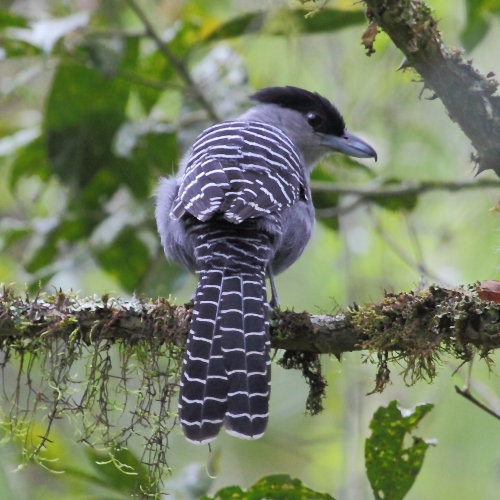
Grey-headed Antbird
Myrmeciza griseiceps
Order: Passeriformes / Family: Thamnophilidae

Wikimedia Commons
About the Grey-headed Antbird
The Grey-headed Antbird, Myrmeciza griseiceps, is a compelling inhabitant of the dense understory in tropical lowland forests of Central and South America. This bird is a member of the Thamnophilidae family, a group known for its association with army ant swarms. The Grey-headed Antbird plays an essential ecological role as both predator and prey within its environment. It is often found in countries such as Panama, Colombia, and Venezuela, where it frequents humid forest habitats, particularly those rich in epiphytes and dense foliage. These birds exhibit a remarkable adaptation to their forest habitats, using their agile bodies and strong legs to navigate through thick underbrush in search of food. Ecologically, the Grey-headed Antbird contributes to the control of insect populations, feeding primarily on insects stirred by army ant swarms. This feeding behavior links them intricately to the forest's ecological web. The presence of the Grey-headed Antbird in these ecosystems is a clear indicator of forest health, as they thrive in pristine, undisturbed areas. Seasonally, this species does not display significant migration patterns, maintaining territories year-round. However, local movements might occur in response to fluctuations in food availability. The bird's presence in primary forests underscores the importance of these habitats for the conservation of biological diversity. Human encroachment and deforestation pose significant threats to the Grey-headed Antbird's habitat, making conservation efforts crucial to ensure its survival. Understanding the bird's role in the forest ecosystem can aid in developing effective conservation strategies, highlighting the interconnectedness of species and the habitats they rely on. The Grey-headed Antbird's reliance on dense forest understory for foraging and nesting makes it particularly sensitive to habitat destruction, underscoring the need for preserving large tracts of continuous forest cover.
The Grey-headed Antbird belongs to the family Thamnophilidae, within the order Passeriformes. These birds typically live average 4-6 years, with a maximum recorded of 8 years..
How to Identify a Grey-headed Antbird
The Grey-headed Antbird is a medium-sized bird, measuring about 16 centimeters in length. Its most distinguishing feature is the gray crown and nape, which contrast sharply with its darker, brownish-black body. Males and females exhibit similar plumage, though females may have slightly duller tones. The bird's underparts are a mix of gray and white, with a streaked appearance. Juveniles, on the other hand, often display a more muted color palette compared to adults, lacking the defining gray head. In terms of posture, the Grey-headed Antbird frequently perches with its tail cocked, a common behavior among antbirds as they scan for insect prey. When in flight, the bird exhibits a direct, purposeful silhouette, though it is more often seen hopping and flitting through the understory rather than engaging in prolonged flights. Confusion with similar species, such as the Dusky Antbird, arises due to their overlapping ranges and comparable plumage; however, the Grey-headed Antbird can be distinguished by its unique gray crown. The bird's vocalizations, a series of sharp, metallic notes, also serve as an auditory cue for identification.
Having trouble telling birds apart? Upload a photo to our bird identification tool for an instant species match.
Grey-headed Antbird Habitat and Range
Preferred Habitat
The Grey-headed Antbird inhabits the dense, humid understory of tropical lowland evergreen forests. It is primarily found at elevations ranging from sea level to about 1200 meters. This species favors regions with rich vegetation, including areas with a high density of epiphytes and lianas. While primarily a denizen of primary forests, the Grey-headed Antbird can occasionally be found in secondary growth, provided sufficient understory cover is available. It is particularly associated with areas where army ants are abundant, as these provide a reliable source of stirred-up insect prey. Seasonal habitat shifts are minimal, as the bird tends to maintain territories year-round. Urban environments and heavily altered landscapes are unsuitable for the Grey-headed Antbird, which relies heavily on intact forest cover for survival.
Geographic Range
The Grey-headed Antbird is native to parts of Central and South America. Its range extends from Panama in the north through Colombia and into northwestern Venezuela. Within these countries, the bird is most commonly found in lowland tropical forests. The Grey-headed Antbird does not exhibit migratory behavior; instead, it remains within its established territories throughout the year. Within its range, population densities are highest in undisturbed forest tracts, where the bird can exploit a rich supply of insects. Despite its relatively restricted range, the Grey-headed Antbird can be locally common in suitable habitats. The species is notably absent from regions where forest cover has been significantly degraded or removed.
Want to know which birds visit your area? Browse our backyard birds by location guides for region-specific species lists.
What Does the Grey-headed Antbird Eat?
The diet of the Grey-headed Antbird primarily consists of insects and other small arthropods. This bird is a specialized feeder, often following swarms of army ants to capture prey stirred up by the ants' movement. The Grey-headed Antbird employs a sit-and-wait foraging strategy, positioning itself strategically to snatch insects flushed from the leaf litter. Its strong legs and agile movements enable it to quickly navigate the forest floor and understory. While army ants are a significant focus of its feeding strategy, the bird also consumes a variety of other insects and spiders, adapting its diet to seasonal availability. During periods when ant swarms are less active, the Grey-headed Antbird may spend more time foraging independently, searching for prey among the leaf litter and low vegetation.
Grey-headed Antbird Behavior and Social Structure
The Grey-headed Antbird exhibits a solitary or paired social structure, with pairs often defending territories year-round. These territories are typically centered around areas with frequent army ant activity, providing a consistent food source. Territorial disputes are common, with birds engaging in vocal displays and posturing to deter intruders. During the breeding season, courtship displays involve vocalizations and mutual preening between pairs. The Grey-headed Antbird is generally a non-flocking species, although it may temporarily join mixed-species flocks during periods of high food availability. Its response to predators includes remaining motionless and using its cryptic plumage to blend into the surroundings. Daily activity patterns primarily involve foraging during the cooler morning and late afternoon hours, with periods of rest during the heat of midday.
Grey-headed Antbird Nesting and Reproduction
The Grey-headed Antbird constructs its nest low in the understory, often less than two meters above the ground. The nest is a cup-shaped structure made from twigs, leaves, and other plant materials, carefully woven together to provide camouflage. Preferred nest sites include dense thickets or the bases of trees, where concealment from predators is maximized. The typical clutch size consists of two eggs, which are incubated by both parents for approximately 16-18 days. After hatching, the chicks remain in the nest for another 12-14 days before fledging. Parental duties are shared, with both adults participating in feeding and caring for the young. The Grey-headed Antbird typically raises one brood per year, although conditions may allow for a second brood in particularly favorable years.
Grey-headed Antbird Sounds and Vocalizations
The primary song of the Grey-headed Antbird is a series of sharp, metallic 'tik-tik-tik' notes, delivered in rapid succession. These vocalizations serve both territorial and mating purposes, with males singing most actively at dawn and dusk. Call notes include a variety of sharp clicks and chirps, which facilitate communication between individuals, particularly in dense forest habitats. Alarm calls, employed in response to perceived threats, consist of harsher, more urgent notes, alerting other birds to the presence of predators. The dawn chorus of the Grey-headed Antbird is a particularly notable feature of its acoustic profile, as it joins other forest birds in a symphony of calls at first light.
Interesting Facts About the Grey-headed Antbird
- 1The Grey-headed Antbird is often seen following army ant swarms, a behavior known as 'ant-following,' which is critical for their feeding strategy.
- 2Despite their name, antbirds do not eat ants but rather prey on insects and other small creatures disturbed by the ants.
- 3The species' vocalizations are surprisingly varied, with different calls used for territory defense, mating, and signaling alarm.
- 4Grey-headed Antbirds play a vital role in controlling insect populations, acting as natural pest regulators within their ecosystems.
- 5These birds are an indicator species, meaning their presence can reflect the health of the forest ecosystem they inhabit.
- 6Grey-headed Antbirds have a close relationship with certain plant species, relying on dense understory vegetation for nesting.
- 7Myrmeciza griseiceps was first described in the early 20th century, highlighting the rich biodiversity of tropical forests.
Grey-headed Antbird Conservation Status
According to the IUCN Red List, the Grey-headed Antbird is currently listed as Near Threatened, with populations exhibiting a declining trend. This decline is primarily attributed to habitat loss due to deforestation and land conversion for agriculture. Conservation efforts focus on protecting remaining forest habitats and promoting sustainable land-use practices. Historical records indicate a more extensive range prior to widespread habitat degradation. Current conservation initiatives involve collaboration with local communities and governments to establish protected areas and forest reserves. Continued monitoring and research are essential to understanding population dynamics and implementing effective conservation strategies.