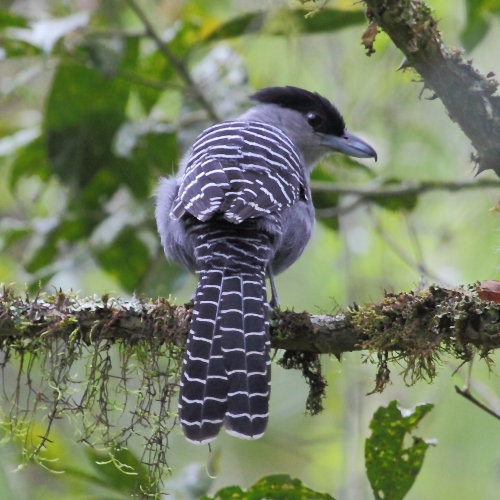
Guianan Warbling-Antbird
Hypocnemis cantator
Order: Passeriformes / Family: Thamnophilidae

Wikimedia Commons
About the Guianan Warbling-Antbird
The Guianan Warbling-Antbird, scientifically known as Hypocnemis cantator, inhabits the dense underbrush of tropical rainforests in northeastern South America. This small bird is a member of the Thamnophilidae family, characterized by its intricate vocalizations and vibrant coloration. The Guianan Warbling-Antbird plays a vital ecological role by controlling insect populations, thus maintaining the delicate balance of its ecosystem. It primarily resides in the lowland rainforests of Guyana, Suriname, French Guiana, and parts of northern Brazil and Venezuela. These regions offer the dense cover and abundant insect life that the Guianan Warbling-Antbird requires for survival. During the breeding season, which typically coincides with the onset of the rainy season, this species becomes highly vocal, using its song both to attract mates and to defend its territory from rivals.
The significance of the Guianan Warbling-Antbird extends beyond its role as an insect predator. It serves as an indicator species for the health of its rainforest habitat. Because it is sensitive to habitat disturbances such as deforestation and habitat fragmentation, its presence or absence can provide valuable insights into the state of forest ecosystems. Efforts to conserve the Guianan Warbling-Antbird often align with broader conservation initiatives aimed at preserving tropical rainforests and their biodiversity. These efforts are critical, as the forests of northeastern South America face ongoing threats from logging, agriculture, and mining.
Ecologically, the Guianan Warbling-Antbird shares its habitat with a diverse range of species, including other antbirds, primates, and myriad insect species. Its interactions with army ant swarms are particularly noteworthy. The bird follows these swarms to capture insects flushed out by the ants, demonstrating a fascinating example of interspecies interaction. This behavior not only highlights the complex web of relationships within the rainforest but also underscores the adaptability and intelligence of the Guianan Warbling-Antbird. Throughout the year, the bird's behavior and habitat use may shift slightly in response to changes in food availability and weather conditions, ensuring its continued survival in a dynamic environment.
The Guianan Warbling-Antbird belongs to the family Thamnophilidae, within the order Passeriformes. These birds typically live 5 years with a maximum recorded of 8 years.
How to Identify a Guianan Warbling-Antbird
The Guianan Warbling-Antbird is a striking bird that exhibits marked sexual dimorphism. Males are adorned with a black and white face pattern, featuring a prominent black mask that contrasts sharply with their white throat and breast. The rest of their plumage is a rich brown, providing effective camouflage in the dappled light of the forest understory. Females, in contrast, lack the bold facial markings of the males but are equally captivating with their subtler grayish-brown plumage and slightly rufous underparts. Juveniles resemble the females but are generally duller in coloration.
In the field, the Guianan Warbling-Antbird can be distinguished from similar species by its distinctive vocalization, a series of clear, melodious whistles often delivered in a descending sequence. Its posture while perching is typically upright, and it often remains motionless for extended periods while scanning for prey. This behavior, coupled with its relatively small size, makes it a challenge to spot among the dense foliage.
When in flight, the Guianan Warbling-Antbird exhibits a fast, direct flight pattern, usually only covering short distances between perches. This flight silhouette, combined with its unique face patterns and vocalizations, helps differentiate it from other antbirds and forest-dwelling species within its range. Observers should take care to note the bird's behavior and vocalizations to avoid confusion with other similar species, such as the Spix's Warbling-Antbird or the Yellow-breasted Antwren.
Having trouble telling birds apart? Upload a photo to our bird identification tool for an instant species match.
Guianan Warbling-Antbird Habitat and Range
Preferred Habitat
The Guianan Warbling-Antbird predominantly inhabits lowland tropical rainforests, where it favors the dense undergrowth and thickets that provide ample cover and foraging opportunities. These birds are typically found at elevations ranging from sea level up to approximately 900 meters, although they are most common in the lowlands. Within these forests, the Guianan Warbling-Antbird prefers areas with plentiful leaf litter and fallen logs, which support a high density of insects and other invertebrates.
Seasonal shifts in habitat use are minimal, as the dense rainforest provides a relatively stable environment year-round. However, during the wetter months, the bird might frequent slightly higher ground to avoid waterlogged areas. Unlike some bird species, the Guianan Warbling-Antbird does not adapt well to urban environments and is rarely found outside its preferred forest habitat. It is, however, occasionally observed in secondary forests and forest edges where primary forest has been disturbed, though it fares best in undisturbed, mature rainforest.
Overall, the continued health of the Guianan Warbling-Antbird's habitat is crucial for its survival, making the conservation of tropical rainforests a top priority for ensuring the species' long-term viability.
Geographic Range
The Guianan Warbling-Antbird occupies a relatively restricted range within the northeastern part of South America. Its primary range encompasses the countries of Guyana, Suriname, French Guiana, and extends into northern Brazil and southern Venezuela. Within this region, the bird is a resident species, meaning it does not undertake long-distance migrations but may move locally in response to food availability or environmental conditions.
Population density is highest in areas of undisturbed lowland rainforest, particularly where army ant swarms are frequent. In such areas, the Guianan Warbling-Antbird can be a common sight, often observed following these swarms in search of prey. However, its distribution becomes patchier in regions where deforestation or habitat degradation has occurred.
The bird's presence is notably absent from the highland areas of the Guiana Shield, as it prefers the humid, lowland conditions of coastal and riverine forests. Conservation efforts in these regions focus on preventing further habitat loss and degradation, ensuring that the Guianan Warbling-Antbird and other endemic species can continue to thrive in their natural habitats.
Want to know which birds visit your area? Browse our backyard birds by location guides for region-specific species lists.
What Does the Guianan Warbling-Antbird Eat?
The diet of the Guianan Warbling-Antbird mainly consists of insects and other small invertebrates, such as spiders and caterpillars. Its foraging strategy involves a keen reliance on the movements of army ant swarms, which flush insects from the leaf litter, making them easy prey. This bird exhibits a specialized feeding behavior, remaining close to the ground or on low vegetation as it follows the ant swarms through the forest.
The Guianan Warbling-Antbird employs a method known as 'sallying' to capture its prey. It perches quietly until it spots potential food, then darts out to snatch the insect with precision before returning to a perch. This technique is effective both in dense underbrush and more open areas within the rainforest.
Seasonal changes in diet are minimal, as the bird relies heavily on the relatively constant availability of insect prey year-round. During the wetter months, however, it may consume a higher proportion of flying insects, which become more abundant. The bird's feeding schedule is primarily diurnal, with peak activity occurring in the early morning and late afternoon when insect activity is highest.
Guianan Warbling-Antbird Behavior and Social Structure
The Guianan Warbling-Antbird exhibits a complex array of behaviors, particularly in its social and territorial interactions. This species is generally monogamous and pairs maintain year-round territories. Both males and females participate in territorial defense, often using their vocalizations to assert dominance and ward off intruders.
Courtship displays are subtle, involving mutual preening and vocal exchanges between the pair. These interactions strengthen pair bonds and ensure cooperation during the breeding season. The bird typically forages alone or in pairs, rarely forming larger flocks, which is typical of many antbird species.
In terms of daily activity, the Guianan Warbling-Antbird is most active during the early morning and late afternoon. During these times, it is often seen foraging near the ground or in low vegetation. Its response to predators includes a combination of remaining motionless to avoid detection and giving alarm calls to alert its mate or conspecifics. Despite its small size, the bird is bold in defending its territory against potential threats, including other birds and small mammals.
Guianan Warbling-Antbird Nesting and Reproduction
Nesting for the Guianan Warbling-Antbird involves the construction of a well-hidden, cup-shaped nest typically situated low to the ground in dense vegetation. The nest is crafted from a combination of twigs, leaves, and other plant materials, providing camouflage against predators.
The typical clutch size consists of two eggs, with both parents sharing responsibilities in incubation. The incubation period lasts approximately two weeks, during which time the parents take turns keeping the eggs warm and protecting the nest site from potential threats. After hatching, the chicks remain in the nest for another two weeks before fledging.
Both parents continue to care for the fledglings, assisting them in finding food and avoiding danger until they are independent. The Guianan Warbling-Antbird usually raises one brood per year, although in optimal conditions, a second brood may be attempted. The nesting season aligns with the onset of the rainy season, ensuring that food resources are abundant for the growing chicks.
Guianan Warbling-Antbird Sounds and Vocalizations
The primary song of the Guianan Warbling-Antbird is a series of melodious whistles, often described as sweet and descending in pitch. This song serves multiple purposes, including territory defense and mate attraction. It is especially prominent during the breeding season, when males sing frequently to establish their presence.
In addition to its song, the Guianan Warbling-Antbird emits a variety of call notes, ranging from short, sharp chips to softer, more complex calls. These calls facilitate communication between mates and are also used to signal alarm when threats are detected.
The dawn chorus behavior of this species is particularly noteworthy, as it participates actively in the cacophony of morning bird songs within the rainforest. The quality and rhythm of its vocalizations make it a key component of the auditory landscape in its habitat, providing an enchanting soundtrack to the early hours of the day.
Interesting Facts About the Guianan Warbling-Antbird
- 1The Guianan Warbling-Antbird often follows army ant swarms to catch prey, showcasing a unique interspecies interaction.
- 2Despite its small size, the Guianan Warbling-Antbird exhibits bold territorial behavior, defending its area vigorously.
- 3The bird's melodious song can be heard throughout the rainforest, especially during the breeding season when males sing frequently.
- 4The Guianan Warbling-Antbird's nesting season aligns with the rainy season, providing abundant food for its chicks.
- 5This species plays a crucial role in insect population control, helping maintain ecological balance in its habitat.
- 6The Guianan Warbling-Antbird's presence serves as an indicator of forest health, offering insights into the state of rainforest ecosystems.
- 7Researchers study the bird's vocalizations to understand communication and territoriality within dense rainforest environments.
Guianan Warbling-Antbird Conservation Status
The Guianan Warbling-Antbird is currently listed as Least Concern by the IUCN, with its population considered stable. However, ongoing habitat loss due to deforestation poses a significant threat to its long-term survival. Logging, agriculture, and mining activities continue to encroach on its rainforest habitat, leading to fragmentation and degradation. Conservation efforts focus primarily on protecting and preserving large tracts of rainforest in the Guianan Shield region. Initiatives include the establishment of protected areas and sustainable land-use practices that balance human activity with ecological preservation. Historically, the Guianan Warbling-Antbird has maintained relatively stable populations due to the vast, undisturbed expanses of rainforest available in its range. Continued vigilance and conservation efforts are essential to ensure that this ecological equilibrium remains intact.