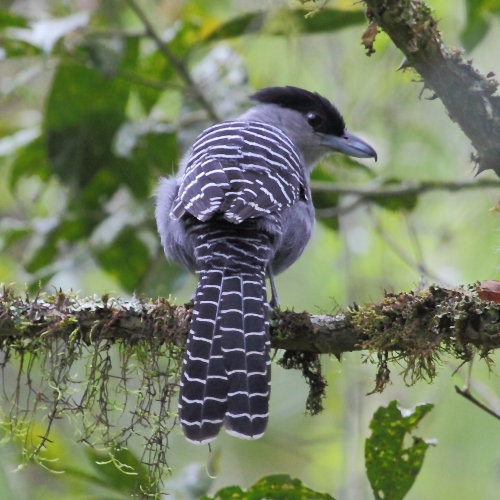
Hairy-crested Antbird
Rhegmatorhina melanosticta
Order: Passeriformes / Family: Thamnophilidae

Wikimedia Commons
About the Hairy-crested Antbird
The Hairy-crested Antbird (Rhegmatorhina melanosticta) is a fascinating member of the Thamnophilidae family, found predominantly in the lowland rainforests of the Amazon Basin. This bird's presence signifies a rich and complex ecosystem, as it relies heavily on the dense undergrowth and the presence of army ants, around which it forages. Known for its elusive nature, the Hairy-crested Antbird plays a crucial role in its habitat by controlling insect populations and participating in a specialized feeding guild.
This antbird's significance extends beyond its ecological role. It serves as an indicator species for the health of its rainforest environment. The health of its population directly reflects the state of the forest, making it an essential species for conservationists who aim to monitor and protect these vital ecosystems. The presence of the Hairy-crested Antbird often indicates an intact and undisturbed rainforest, given its requirement for specific habitat conditions.
The ecological role of the Hairy-crested Antbird is particularly evident during the wet season, when army ant activity increases. This period sees a boom in the availability of prey, allowing the bird to thrive and support its offspring. During the dry season, while ant swarms are less frequent, the bird continues to forage independently or in small groups, demonstrating its adaptability. Throughout the year, the Hairy-crested Antbird is a resident of its habitat, not known for significant migratory behavior, which underscores its dependency on the stable environment of the Amazon Basin.
The Hairy-crested Antbird belongs to the family Thamnophilidae, within the order Passeriformes. These birds typically live average 5-7 years, with a maximum recorded of 10 years..
How to Identify a Hairy-crested Antbird
Identifying the Hairy-crested Antbird involves observing several distinct features. Adults exhibit a striking mix of black and brown plumage, with males typically showcasing a darker tone than females. The bird's namesake, its hairy crest, is a prominent feature that stands erect when the bird is alert or displaying. Juvenile Hairy-crested Antbirds resemble adults but may exhibit a duller plumage, lacking the full development of their characteristic crest.
Despite these distinctive features, the Hairy-crested Antbird can sometimes be confused with other antbird species, such as the Spot-backed Antbird. However, the Hairy-crested Antbird's unique crest and lack of significant white spotting on the back help distinguish it from similar species. In flight, the Hairy-crested Antbird maintains a compact silhouette, with its wings held close to the body, which is typical of many understory birds adapted for maneuvering through dense foliage.
Perching posture is another key identifier. The Hairy-crested Antbird often perches low to the ground, poised attentively as it listens for prey. Its alert stance and frequent flicking of the tail, combined with its preference for the dim, shadowy environment of the forest floor, contribute to its elusive nature.
Having trouble telling birds apart? Upload a photo to our bird identification tool for an instant species match.
Hairy-crested Antbird Habitat and Range
Preferred Habitat
The Hairy-crested Antbird inhabits the humid lowland rainforests of the Amazon Basin, favoring areas with dense undergrowth and an abundance of leaf litter. This bird thrives in primary forests and is less commonly found in secondary or disturbed habitats. Its preferred elevation ranges from sea level to about 1,200 meters, where the forest provides the dense cover and rich insect life crucial for its survival.
Unlike some other antbirds, the Hairy-crested Antbird shows little variation in its habitat preference throughout the year. It remains a permanent resident of its preferred environment, consistently utilizing the same territories unless significant habitat changes occur. While it is predominantly associated with forest interiors, it does not typically venture into urban areas or fragmented landscapes, highlighting its reliance on intact forest ecosystems.
Geographic Range
The Hairy-crested Antbird is primarily found across the Amazon Basin, with its range encompassing parts of Brazil, Peru, and Colombia. It is a non-migratory species, residing year-round in its preferred habitat. Within this vast range, the bird is most frequently encountered in regions where the forest remains undisturbed and dense undergrowth thrives.
In Brazil, the Hairy-crested Antbird's distribution covers large expanses of the Amazon rainforest, from the western regions bordering Peru to the central and eastern parts of the country. In Peru, it inhabits the Amazonian lowlands, particularly in areas such as the Madre de Dios and Loreto regions. Colombian populations are mainly restricted to the Amazonian departments, where the forest remains extensive and pristine.
Population density hotspots are often associated with large, continuous tracts of forest where army ants are abundant. These areas support the bird's specialized foraging habits, allowing it to maintain stable populations despite the pressures of habitat loss in parts of its range.
Want to know which birds visit your area? Browse our backyard birds by location guides for region-specific species lists.
What Does the Hairy-crested Antbird Eat?
The diet of the Hairy-crested Antbird primarily consists of insects and other small arthropods, which it captures by following swarming army ants. This bird is an obligate ant-follower, relying on the ants to flush out prey from the leaf litter, making it an integral part of its foraging strategy. The bird's keen eyesight and agile movements allow it to seize insects such as beetles, spiders, and grasshoppers with precision.
Seasonal changes in diet are minimal, although the abundance of prey tends to increase during the wet season when army ants are more active. In times of decreased ant activity, the Hairy-crested Antbird may forage more independently or in small groups, demonstrating flexibility in its feeding behavior.
The Hairy-crested Antbird typically forages during daylight hours, with peak activity occurring in the early morning and late afternoon. This schedule coincides with the periods of greatest army ant activity, optimizing the bird's chances of encountering a productive swarm and securing a consistent food supply.
Hairy-crested Antbird Behavior and Social Structure
Socially, the Hairy-crested Antbird often associates with mixed-species flocks, although it predominantly remains solitary or in pairs when foraging. It exhibits territorial behavior, defending its feeding grounds from other antbird species. Aggressive displays, including crest raising and vocalizations, are common during territorial disputes.
During the breeding season, the Hairy-crested Antbird engages in intricate courtship displays. Males demonstrate their fitness through vocal performances and by presenting food to potential mates. Once pairs form, they often remain together for the duration of the breeding season, contributing to nesting and chick-rearing.
Flocking patterns are typically observed outside the breeding season, when individuals may join small groups to increase foraging efficiency. The Hairy-crested Antbird maintains a daily activity pattern centered around ant swarms, with periods of rest and preening interspersed between active foraging bouts. When faced with predators, the bird relies on its cryptic plumage and the dense forest cover to avoid detection, seldom engaging in direct confrontation.
Hairy-crested Antbird Nesting and Reproduction
The Hairy-crested Antbird constructs its nest in well-concealed locations within the dense undergrowth of the rainforest. Nests are typically cup-shaped and made from a combination of leaves, twigs, and moss, providing camouflage against the forest floor. These nests are carefully placed low in shrubs or on the ground, enhancing concealment from predators.
Clutch sizes generally consist of two to three eggs, which both parents incubate. The incubation period lasts approximately 14 days, during which the adults share duties, ensuring the eggs are kept warm and protected. Following hatching, the chicks remain in the nest for about 12-15 days before fledging.
Parental roles are well-balanced, with both males and females participating in feeding and caring for the chicks. The Hairy-crested Antbird typically raises one brood per year, although in areas with abundant resources, a second brood may occasionally occur. This reproductive strategy allows the bird to make the most of the favorable conditions offered by the Amazon's complex ecosystem.
Hairy-crested Antbird Sounds and Vocalizations
The primary song of the Hairy-crested Antbird is a series of sharp, piercing notes delivered in rapid succession. These calls are often described as a 'whip-crack' sound, cutting through the dense forest, particularly during the early morning and late afternoon when the bird is most active.
In addition to its primary song, the Hairy-crested Antbird uses a variety of call notes to communicate with mates and signal alarm. Alarm calls are more abrupt and staccato, serving as a warning to nearby birds of potential danger.
The dawn chorus includes a blend of their primary song interspersed with call notes, adding to the rich tapestry of sounds found in the Amazon rainforest. Compared to other forest birds, the Hairy-crested Antbird's vocalizations are distinct in their rhythm and intensity, making them a valuable tool for identification.
Interesting Facts About the Hairy-crested Antbird
- 1The Hairy-crested Antbird relies exclusively on army ant swarms, a behavior known as obligate ant-following.
- 2Its distinctive crest is not just for show; it plays a crucial role in communication during territorial displays.
- 3The Hairy-crested Antbird's diet consists almost entirely of insects, making it an important pest controller in its ecosystem.
- 4This bird's vocalizations are among the most recognizable in the Amazon, often compared to a whip-crack in sound.
- 5Despite its reliance on specific habitats, the Hairy-crested Antbird is not migratory, remaining in its territory year-round.
- 6It is one of the few bird species where both parents share equal responsibilities in raising the young.
- 7The Hairy-crested Antbird's presence is an indicator of a well-preserved forest environment, highlighting its ecological importance.
Hairy-crested Antbird Conservation Status
Currently, the Hairy-crested Antbird is listed as Least Concern by the IUCN, with stable population trends. However, habitat destruction due to logging, agriculture, and development poses significant threats to its environment. Conservation efforts focus on preserving large tracts of continuous rainforest and promoting sustainable land-use practices. Historically, the Hairy-crested Antbird has maintained stable populations due to its reliance on intact forest habitats. The ongoing challenge is balancing human needs with environmental preservation to ensure these critical ecosystems remain viable. Conservation organizations actively monitor population trends and work with local communities to foster awareness and protective measures. While the species currently faces limited direct threats, the overarching issue of habitat fragmentation could impact its long-term survival. Collaborative efforts between governments, NGOs, and indigenous groups are vital to safeguard the future of the Hairy-crested Antbird and its rainforest home.