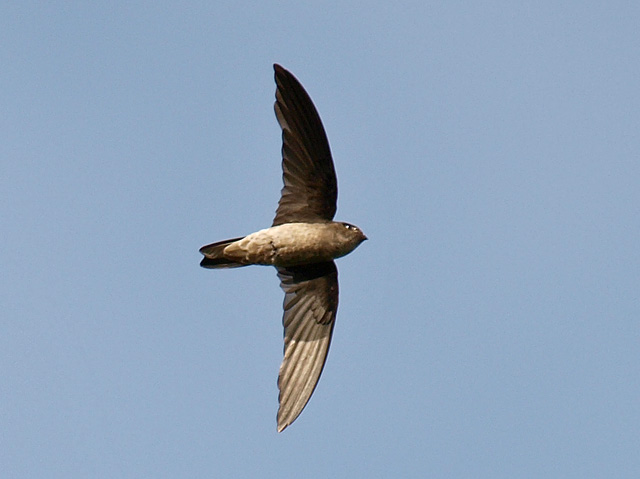
Halmahera Swiftlet
Aerodramus infuscatus
Order: Apodiformes / Family: Apodidae

Wikimedia Commons
About the Halmahera Swiftlet
The Halmahera Swiftlet, known scientifically as Aerodramus infuscatus, is a small, agile bird within the Apodidae family. Found primarily on the island of Halmahera in Indonesia, this swiftlet plays a crucial role in the local ecosystem by controlling insect populations. Its presence is vital in forests and open areas where it feeds on insects while on the wing. The species is particularly adapted to tropical climates, thriving in the lush environments of the Maluku Islands. Aerodramus infuscatus is a non-migratory bird, meaning it stays within its range year-round, contributing to the ecological balance by consistently preying on flying insects.
The significance of the Halmahera Swiftlet extends beyond its ecological role. It is part of a complex avian community in the Indo-Pacific region, where its ability to navigate dense forests and open skies aids in the pollination and seed dispersal, indirectly supporting plant diversity. These swiftlets often share their habitats with other avian species, including various pigeons and raptors, which together create a dynamic and interdependent ecosystem.
Behaviorally, the Halmahera Swiftlet exhibits fascinating adaptations such as using echolocation to navigate dark caves where they often roost and nest. This ability, rare among birds, is shared with only a few other swiftlet species, allowing them to thrive in environments that are inaccessible to many predators. This echolocation capability, combined with their swift flying skills, makes them expert insect hunters. During the breeding season, they gather in colonies, which enhances their social bonds and increases reproductive success. The Halmahera Swiftlet remains an important species for study due to its unique adaptations and role in the tropical ecosystems of Southeast Asia.
The Halmahera Swiftlet belongs to the family Apodidae, within the order Apodiformes. These birds typically live average 4-6 years with a max recorded of 9 years.
How to Identify a Halmahera Swiftlet
The Halmahera Swiftlet is a small bird, measuring about 12 cm in length, with a predominantly dark, glossy plumage that appears blackish-brown from a distance. Its body is compact, with long, slender wings that allow for rapid and agile flight. The tail is slightly forked, a characteristic feature that aids in aerial maneuverability. Juveniles resemble adults in coloration, but their plumage may appear slightly duller until they molt into their adult feathers.
There is little sexual dimorphism in the Halmahera Swiftlet, meaning males and females look quite similar. Observers need to rely on behavior rather than plumage to differentiate between sexes, particularly during the breeding season when courtship displays occur. In flight, the Halmahera Swiftlet can be confused with other swift species, but the combination of its habitat, size, and flight pattern aids in identification.
When observing these birds, note their constant flight and rarely seen perching behavior. They are almost always in motion, capturing insects mid-air. Their silhouette against the sky is distinct due to the forked tail and sickle-shaped wings, which help differentiate them from swallows and other swifts.
Having trouble telling birds apart? Upload a photo to our bird identification tool for an instant species match.
Halmahera Swiftlet Habitat and Range
Preferred Habitat
The Halmahera Swiftlet mainly inhabits the tropical and subtropical forests of Halmahera Island. These environments provide the necessary food resources and nesting sites that the species requires. The swiftlet is most commonly found at low to mid-elevations, typically ranging up to 1,500 meters above sea level, where insect abundance is highest.
Forested areas, particularly those with caves or other sheltered locations, are preferred, as they provide secure nesting sites. The swiftlet shows some adaptability to degraded habitats, often foraging over open fields and near coastal areas. However, it generally avoids heavily urbanized regions, preferring the cover and resources provided by natural landscapes.
Seasonal changes do not significantly affect the habitat preferences of the Halmahera Swiftlet, as it remains in its tropical environment throughout the year. This consistent habitat use highlights the importance of forest conservation on Halmahera Island to maintain swiftlet populations.
Geographic Range
The Halmahera Swiftlet's range is quite restricted, primarily limited to Halmahera Island in the North Maluku province of Indonesia. This island is part of the Maluku Islands, situated within the larger region of Southeast Asia. The species does not undertake long migrations, remaining within this locality year-round.
Within Halmahera, the swiftlet is most frequently observed in lowland and mid-elevation forests, where it can find ample food supplies and suitable nesting sites. The population density tends to be higher in regions where forest cover is intact, reflecting the species' reliance on these habitats for both foraging and breeding.
Although the swiftlet does not exhibit migratory behavior, it may display local movements in response to food availability, often congregating in areas with high insect activity. Such movements ensure that the swiftlet can exploit the best feeding opportunities throughout the year, maintaining its presence across the island.
Want to know which birds visit your area? Browse our backyard birds by location guides for region-specific species lists.
What Does the Halmahera Swiftlet Eat?
The diet of the Halmahera Swiftlet primarily consists of small flying insects, which it captures in flight with remarkable agility. The bird's foraging technique involves rapid, acrobatic maneuvers, allowing it to catch insects such as flies, beetles, and moths mid-air. This diet is consistent year-round, reflecting the stable insect populations in its tropical habitat.
Seasonal variations do not greatly influence the swiftlet's dietary habits, but during certain times of the year, specific insect species may become more abundant, offering an increased food supply. For example, after periods of rain, when insect activity peaks, the swiftlet may exploit these temporary abundance surges.
The swiftlet's feeding schedule occurs throughout the day, with peak activity typically in the early morning and late afternoon when insect prey is most active. By maintaining a diverse diet, the Halmahera Swiftlet plays a crucial role in controlling insect populations, contributing to the ecological balance in its habitat.
Halmahera Swiftlet Behavior and Social Structure
Halmahera Swiftlets exhibit a highly social structure, often forming large colonies for both roosting and nesting. These colonies are typically found in caves or other sheltered environments, where the birds can use their echolocation skills to navigate in darkness. This social behavior provides protection against predators and increases breeding success by facilitating cooperative interactions.
During the breeding season, swiftlets engage in elaborate courtship displays, which include synchronized flying maneuvers and vocalizations. These displays strengthen pair bonds and ensure successful mating. Outside the breeding season, their social structure remains intact, with individuals often seen foraging together in loose flocks.
The swiftlet's response to predators involves rapid, evasive flight, aided by its agile wing structure. These birds are most active during daylight hours, spending the majority of their time on the wing, which minimizes predation risk. Their daily routines revolve around foraging and social interactions within their colony.
Halmahera Swiftlet Nesting and Reproduction
Halmahera Swiftlets construct their nests in dark, secluded environments, often choosing caves or crevices that offer protection from the elements and predators. The nests are composed primarily of plant material and saliva, which hardens to create a secure structure. This unique nesting method is a defining characteristic of swiftlets.
The typical clutch size for the Halmahera Swiftlet ranges from one to two eggs. Both parents share responsibilities, with the incubation period lasting about 18 to 23 days. After hatching, the chicks remain in the nest for approximately 35 to 40 days before fledging. Parental roles are shared, with both male and female providing food and care to the young.
The species usually raises one brood per year, although in favorable conditions, a second brood may occur. The communal nesting sites are critical for their reproductive success, offering safety in numbers and enhancing the survival chances of the young.
Halmahera Swiftlet Sounds and Vocalizations
The Halmahera Swiftlet produces a series of high-pitched, rapid calls that serve both communication and echolocation purposes. The rhythm is consistent and repetitive, with a distinct metallic quality. These calls are most often heard near nesting sites, where they facilitate social interactions within the colony.
In addition to these communication calls, the swiftlet emits distinct, sharp alarm notes when threatened by predators. These serve to alert other colony members of potential danger. Unlike many songbirds, the Halmahera Swiftlet does not participate in a dawn chorus, as its vocalizations are more functional than melodic.
The swiftlet's calls are often compared to short, clipped whistles, making them distinct yet somewhat challenging to detect for the untrained ear. Their echolocation clicks, while inaudible to humans, are integral to their navigation in dark environments.
Interesting Facts About the Halmahera Swiftlet
- 1The Halmahera Swiftlet uses echolocation, a trait shared with only a few other bird species, allowing it to navigate in dark caves.
- 2Swiftlets can spend almost their entire lives in flight, only landing to nest and rest, a testament to their aerial prowess.
- 3The nests of swiftlets, made from saliva, are a key ingredient in bird's nest soup, a delicacy in some cultures.
- 4Halmahera Swiftlets form large colonies, sometimes numbering in the thousands, which provide safety and social interaction.
- 5These birds can capture and consume hundreds of insects daily, playing a crucial role in controlling pest populations.
- 6The swiftlet's rapid, agile flight is powered by its long wings and streamlined body, specialized for high-speed maneuvers.
- 7Despite being a small bird, the swiftlet covers extensive foraging territories to fulfill its dietary needs.
Halmahera Swiftlet Conservation Status
The Halmahera Swiftlet is currently classified as Least Concern by the IUCN, with a stable population trend. However, habitat loss due to deforestation presents a potential threat to its long-term survival. Conservation efforts focus on preserving the island's natural forests, which are crucial for maintaining the swiftlet's habitat. While the swiftlet is not currently endangered, ongoing monitoring is necessary to ensure that its population remains stable, especially given the pressures of habitat fragmentation and human encroachment. Historical data suggests that the population has remained relatively stable over recent decades, although local fluctuations may occur due to environmental changes.
Other Apodidae Species


Birds Similar to the Halmahera Swiftlet
These species are often confused with the Halmahera Swiftlet due to similar appearance or overlapping range.