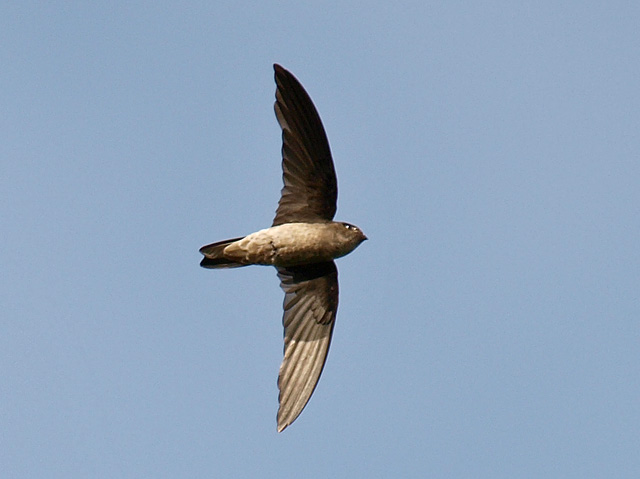
Himalayan Swiftlet
Aerodramus brevirostris
Order: Apodiformes / Family: Apodidae

Wikimedia Commons
About the Himalayan Swiftlet
The Himalayan Swiftlet (Aerodramus brevirostris) is a fascinating avian species belonging to the Apodidae family, known for its remarkable adaptation to high-altitude environments. This bird is predominantly found in the towering ranges of the Himalayas, extending across countries such as Nepal, India, Bhutan, and parts of China. As an integral component of these ecosystems, the Himalayan Swiftlet plays a crucial role in insect population control, consuming large quantities of airborne insects daily. These swiftlets are renowned for their aerial agility, which allows them to navigate the rugged terrain and dense forests of their habitat with ease. Their presence is often observed at elevations ranging from 1,000 to 4,000 meters, where they exploit the rich, insect-laden air currents.
In terms of ecological significance, the Himalayan Swiftlet contributes to the balance of its environment by regulating insect populations, thus supporting the health of plant life and reducing the spread of diseases. This bird's role extends to being a bioindicator of ecosystem health, as its presence and abundance can reflect changes in environmental conditions. During the breeding season, which typically spans from May to July, these swiftlets engage in intricate courtship displays and nest building within caves, cliffs, and other sheltered locations. Their nesting sites are often strategically chosen to provide protection from predators and environmental extremes.
The Himalayan Swiftlet exhibits seasonal behaviors, such as altitudinal migration, moving to lower altitudes during the colder months to maintain access to food sources. This adaptability ensures their survival in the face of changing climatic conditions. The swiftlet's ability to echolocate, a trait shared with only a few other bird species, aids in its navigation and foraging, particularly in low-light conditions. This adaptation is especially beneficial when they traverse forested and mountainous landscapes where visual cues are limited. Their presence in these regions underscores the importance of conserving mountainous habitats, which are increasingly threatened by human activities such as deforestation and climate change.
The Himalayan Swiftlet belongs to the family Apodidae, within the order Apodiformes. These birds typically live typically 6-9 years in the wild..
How to Identify a Himalayan Swiftlet
The Himalayan Swiftlet is a small bird, measuring approximately 11 to 13 centimeters in length, with a wingspan ranging from 27 to 30 centimeters. Its plumage is predominantly dark gray, appearing almost black in certain lighting, with a slightly paler underbody that can aid in distinguishing it from similar species in flight. The wings are long and sickle-shaped, contributing to its aerodynamic prowess, while the tail is short and squared with a subtle notch. Juvenile swiftlets resemble adults but may exhibit slightly duller plumage and less defined markings.
There are no significant differences in appearance between male and female Himalayan Swiftlets, making sexual dimorphism minimal. This lack of distinct sexual differences can make identification challenging in the field, especially when observing from a distance. However, the bird's distinctive flight silhouette, characterized by rapid wingbeats and gliding, aids in its identification.
Himalayan Swiftlets may be confused with other swift species, such as the White-throated Needletail, but the latter has a more robust build and distinctive white throat patch. Additionally, the Himalayan Swiftlet's echolocation ability is unique among swifts, setting it apart from many related species that lack this adaptation. Observers should note the swiftlet's perching posture, often clinging vertically to cave walls or cliffs, which is distinct from the horizontal perching of many other birds.
Having trouble telling birds apart? Upload a photo to our bird identification tool for an instant species match.
Himalayan Swiftlet Habitat and Range
Preferred Habitat
Himalayan Swiftlets primarily inhabit high-altitude regions characterized by rugged mountains and dense forests. They are typically found between 1,000 and 4,000 meters above sea level, favoring habitats that provide ample food sources and suitable nesting sites. During the breeding season, these swiftlets prefer to nest in caves and on cliff faces, often within remote and inaccessible areas that offer protection from predators. The presence of such natural structures is critical to their nesting success.
In terms of seasonal habitat shifts, Himalayan Swiftlets exhibit altitudinal migration. They descend to lower elevations during the winter months when harsh weather conditions prevail at higher altitudes. This movement ensures continued access to insect prey. While they generally avoid urban areas, their adaptability allows them to navigate the edges of human settlements where food availability is high. In rural settings, they may be observed foraging over fields and open landscapes, taking advantage of insect swarms.
Geographic Range
The Himalayan Swiftlet's range extends across the majestic Himalayas, covering regions in Nepal, northern India, Bhutan, and parts of Tibet and southwestern China. This bird's breeding range is primarily concentrated within these mountainous areas, where suitable nesting sites and abundant food sources exist. The swiftlet demonstrates a preference for high-altitude environments, although it may be found at lower elevations during the non-breeding season.
Migration patterns of the Himalayan Swiftlet involve altitudinal shifts rather than long-distance travel. As temperatures drop in the higher altitudes during winter, the swiftlets move to lower regions where conditions are more favorable. These movements are typically localized within the same geographic regions, ensuring that swiftlets remain within reach of the resources they require.
Population density hotspots for this species can be found in areas with extensive cave systems, which provide ideal nesting habitat. Dense populations are often observed in regions like the Annapurna range in Nepal and the northeastern states of India, where both environmental conditions and food availability align to support swiftlet colonies.
Want to know which birds visit your area? Browse our backyard birds by location guides for region-specific species lists.
What Does the Himalayan Swiftlet Eat?
The diet of the Himalayan Swiftlet primarily consists of a wide variety of insects, making it an important player in controlling insect populations. The swiftlet's feeding strategy involves high-speed aerial foraging, where it captures small insects in mid-flight. This technique allows it to consume a significant number of prey items throughout the day, with diet composition varying seasonally based on available insect populations.
During the breeding season, the swiftlet exploits the abundance of flying ants, beetles, and other swarming insects, which are rich in protein and crucial for chick development. As the seasons change, its diet adapts to include other flying insects like moths and smaller flies, ensuring a consistent food supply. The swiftlet's ability to employ echolocation aids in detecting prey in low-light conditions, making it an effective forager from dawn until dusk.
Prey size ranges from tiny midges to larger beetles, with the swiftlet demonstrating a preference for insects that are abundant and easily captured in flight. This selective feeding helps maintain ecological balance by targeting pest species that can otherwise affect plant health and agricultural productivity. The swiftlet's role in ecosystems highlights the interconnectedness of species and the importance of conserving their natural habitats.
Himalayan Swiftlet Behavior and Social Structure
The Himalayan Swiftlet exhibits a social structure characterized by loose colonies, particularly during the breeding season. These birds are highly communal, often forming large flocks that enhance foraging efficiency and predator avoidance. Despite their social nature, they exhibit minimal territorial behavior, focusing instead on collaborative foraging and nesting efforts.
Courtship displays involve intricate aerial maneuvers and synchronized flight patterns, which serve to strengthen pair bonds. During the breeding season, swiftlets engage in communal nesting within chosen sites like caves and cliffs. This communal nesting behavior provides safety in numbers, reducing the risk of predation on eggs and chicks.
The swiftlet's daily activity patterns revolve around foraging, with peak activity occurring during the early morning and late afternoon. They are adept at avoiding predators, utilizing rapid flight and erratic maneuvers to evade birds of prey. In terms of response to threats, swiftlets often rely on alarm calls to alert other members of their flock, enabling coordinated evasive action.
Flocking patterns vary seasonally, with larger congregations observed during migration periods. The swiftlet's capacity for long-distance and high-altitude flight is facilitated by its powerful wing muscles and streamlined body, both of which are adapted to the demands of its aerial lifestyle.
Himalayan Swiftlet Nesting and Reproduction
Himalayan Swiftlets construct nests within the safety of caves, cliffs, and occasionally man-made structures. These nests are primarily composed of hardened saliva, which the swiftlets use to bind together plant materials, feathers, and other available resources. This unique nest-building technique results in a sturdy structure that adheres firmly to vertical surfaces.
The typical clutch size for the Himalayan Swiftlet consists of two to three eggs, with incubation responsibilities shared between the male and female. The incubation period lasts approximately 18 to 21 days, during which both parents take turns keeping the eggs warm and protected. Once hatched, the chicks remain in the nest for about 25 to 28 days before fledging.
Parental roles are evenly distributed, with both parents actively involved in feeding and caring for the young. The swiftlets typically produce one brood per year, though in favorable conditions, they may attempt a second. The choice of nesting site is critical to the swiftlet's reproductive success, as it provides protection from predators and harsh environmental conditions.
Their nesting locations, often in remote and hard-to-reach areas, ensure that the swiftlet population remains resilient despite environmental pressures. The reliance on specific nesting habitats underscores the importance of protecting these areas from human disturbance and habitat degradation.
Himalayan Swiftlet Sounds and Vocalizations
The primary song of the Himalayan Swiftlet is a series of rapid, high-pitched chattering notes that resemble the sound of a small, fast-moving stream. These vocalizations, often heard during flight or near nesting sites, serve both communication and echolocation purposes. The swiftlet's call notes are sharp and staccato, functioning as contact calls within flocks.
Alarm calls are more intense, with increased volume and urgency to alert other swiftlets of potential predators. During the dawn chorus, the swiftlet's vocalizations become more pronounced as they engage in synchronized flights and social interactions.
Compared to other birds, the Himalayan Swiftlet's sounds may be less melodic, focusing more on functionality and adaptability to its environment. The echolocation clicks, barely audible to the human ear, are a testament to its evolutionary adaptation, enabling navigation and foraging in low-light conditions. This acoustic capability is particularly useful when swiftlets nest and forage in dark cave environments, where traditional vision is limited.
Interesting Facts About the Himalayan Swiftlet
- 1The Himalayan Swiftlet is one of the few bird species capable of echolocation, similar to bats.
- 2Swiftlet nests, made entirely from saliva, are sought after for bird's nest soup, a delicacy in some cultures.
- 3These swiftlets can fly continuously for hours, covering vast areas to forage for insects.
- 4The ability to echolocate allows the Himalayan Swiftlet to navigate and forage in total darkness.
- 5Himalayan Swiftlets can often be seen in large flocks, which help deter predators through sheer numbers.
- 6During breeding, swiftlets engage in synchronized aerial displays, showcasing their acrobatic prowess.
- 7The swiftlet's rapid, high-pitched calls are a vital component of their social interactions and alert systems.
Himalayan Swiftlet Conservation Status
The Himalayan Swiftlet is currently classified as Least Concern by the IUCN, with a population trend that is believed to be stable. However, ongoing threats such as habitat destruction, climate change, and human encroachment pose potential risks to their long-term survival. Conservation efforts focus on preserving the natural habitats that are crucial for swiftlet nesting and foraging. Protection of cave systems and forested areas within the Himalayan region is vital to maintaining swiftlet populations. Additionally, research initiatives aim to better understand their ecological role and adaptability to changing environments. Historically, the Himalayan Swiftlet population has experienced fluctuations due to natural and anthropogenic factors. Increased awareness and conservation action in recent years have contributed to stabilizing their numbers. Continued monitoring and habitat protection remain essential to ensure the swiftlet's resilience against future challenges.
Other Apodidae Species


Birds Similar to the Himalayan Swiftlet
These species are often confused with the Himalayan Swiftlet due to similar appearance or overlapping range.