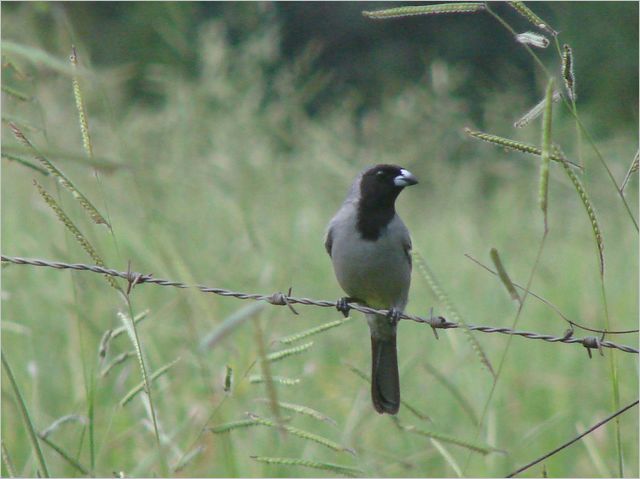
Hooded Tanager
Nemosia pileata
Order: Passeriformes / Family: Thraupidae

Wikimedia Commons
About the Hooded Tanager
The Hooded Tanager, known scientifically as Nemosia pileata, captivates bird enthusiasts with its striking appearance and active behavior. This small passerine bird belongs to the Thraupidae family, which encompasses a diverse range of tanagers found predominantly in the Neotropics. The Hooded Tanager stands out with its unique coloration, characterized by a stark contrast between its black hood and the vibrant blue and white tones of its body. Its geographical range spans from northeastern Brazil through the Guianas, reaching into Venezuela and parts of Colombia. Within these regions, it predominantly inhabits lowland and montane forests, often favoring areas with dense foliage. The presence of the Hooded Tanager in various ecosystems highlights its ecological role as both a seed disperser and a consumer of small insects, contributing to the health and diversity of its habitat. During the breeding season, this bird becomes particularly active and vocal, using its song to establish territory and attract mates. Its adaptability allows it to thrive in secondary growth and edge habitats, where it often forms mixed-species flocks, enhancing its foraging success. The Hooded Tanager plays a significant role in maintaining the ecological balance of its environment, acting as both a predator of insects and a prey species for larger birds and mammals. By observing this bird, researchers gain insights into the complexities of tropical ecosystems and the interdependence of species within these habitats. The Hooded Tanager's seasonal behaviors also offer a window into the dynamic changes that occur in its environment throughout the year. For instance, during the dry season, it may travel to lower elevations in search of food and water, while the wet season sees a return to higher altitudes, where fruit and insects are more plentiful. This adaptability ensures the survival of the species despite environmental fluctuations and habitat changes. The Hooded Tanager's presence in both primary and secondary forests underlines its resilience and capacity to adjust to different ecological niches, a valuable trait in the face of ongoing habitat transformation across its range.
The Hooded Tanager belongs to the family Thraupidae, within the order Passeriformes. These birds typically live typically around 4-6 years in the wild..
How to Identify a Hooded Tanager
The adult Hooded Tanager is unmistakable due to its striking black cap, extending from the forehead to the nape, contrasting sharply with the rest of its plumage. Its back and wings exhibit a rich blue, while the underparts are predominantly white, creating a visually arresting combination. Juveniles lack the pronounced black cap found in adults, instead showing a more subdued grayish tone on the head, which gradually darkens as they mature. Male and female Hooded Tanagers are similar in appearance, although females might exhibit slightly duller tones. In flight, the Hooded Tanager displays a distinctive silhouette with its short tail and rounded wings, allowing for agile maneuvering through dense foliage. When perching, it often adopts an upright posture, facilitating its lateral scanning for prey and predators alike. A potential source of confusion is the Blue-gray Tanager, which shares a similar range and habitat. However, the Blue-gray Tanager lacks the Hooded Tanager's characteristic black cap, and its overall coloration is more uniformly blue-gray. Careful observation of these field marks aids in accurate identification of this vibrant species.
Having trouble telling birds apart? Upload a photo to our bird identification tool for an instant species match.
Hooded Tanager Habitat and Range
Preferred Habitat
The Hooded Tanager thrives in a variety of habitats, primarily favoring lowland and montane forests where dense vegetation provides ample cover and feeding opportunities. It is commonly found in the Atlantic Forest of Brazil, a biodiversity hotspot, as well as in the tropical rainforests of the Guianas and Venezuela. This habitat preference underscores its reliance on forested areas, although it exhibits a degree of adaptability by inhabiting secondary growth and forest edges. While it typically occupies elevations up to 1,500 meters, it can be found at higher altitudes during certain times of the year, particularly in search of food. The Hooded Tanager's ability to inhabit both pristine and disturbed environments reflects its ecological plasticity, allowing it to persist in regions undergoing rapid environmental change. In urban settings, it occasionally ventures into gardens and parks, though its presence there is less frequent compared to more densely vegetated areas.
Geographic Range
The distribution of the Hooded Tanager spans across several South American countries, with its primary range encompassing eastern Brazil, the Guianas, Venezuela, and parts of Colombia. It is a resident bird, meaning it does not engage in long-distance migrations. However, it may exhibit some altitudinal migration, moving between different elevations in response to seasonal variations in resource availability. The Hooded Tanager is most populous in the Atlantic Forest, where it benefits from the rich diversity of plant and insect life. In Venezuela and Colombia, it is typically found in the forested regions of the Orinoco basin and the eastern slopes of the Andes. The population density of the Hooded Tanager is highest in areas where forest cover remains intact, though it can adapt to fragmented landscapes, provided there is sufficient vegetative cover and food resources.
Want to know which birds visit your area? Browse our backyard birds by location guides for region-specific species lists.
What Does the Hooded Tanager Eat?
The Hooded Tanager's diet is diverse, consisting primarily of fruits and insects, which it forages for in the mid to upper canopy. Its preference for fruit makes it an important seed disperser, contributing to forest regeneration and plant diversity. During the breeding season, the Hooded Tanager increases its intake of protein-rich insects to meet the demands of raising young. This shift in diet underscores the bird's adaptability and the dynamic nature of its feeding habits. The Hooded Tanager employs a variety of foraging techniques, including gleaning insects from foliage and catching them mid-air. Its small size allows it to navigate through dense vegetation, where it deftly plucks fruit and insects alike. Prey items typically include small arthropods such as caterpillars and beetles. Feeding activity peaks in the early morning and late afternoon, aligning with the availability of prey and the bird's energy requirements.
Hooded Tanager Behavior and Social Structure
The social structure of the Hooded Tanager is characterized by its tendency to form small groups, often joining mixed-species flocks that enhance foraging efficiency and predator vigilance. These flocks usually consist of other tanagers and small passerines, creating a dynamic and cooperative feeding environment. Territorial behavior becomes prominent during the breeding season, with males actively defending their chosen areas through songs and displays. Courtship involves elaborate displays, including wing and tail flicking, combined with vocalizations that serve to strengthen pair bonds. The Hooded Tanager exhibits a daily activity pattern that involves peak activity during the cooler hours of the day, such as early morning and late afternoon, to avoid the midday heat. In response to predators, it employs a variety of alarm calls and mobbing behavior, often joined by other flock members to deter the threat. The Hooded Tanager's interactions within its ecosystem reflect its role as both prey and predator, contributing to the intricate balance of tropical forest life.
Hooded Tanager Nesting and Reproduction
The Hooded Tanager constructs a cup-shaped nest, meticulously weaving together grasses, twigs, and leaves, often lining it with softer materials such as feathers or plant down. Nest placement typically occurs in the fork of a tree branch, providing stability and concealment from predators. Clutch size ranges from two to three eggs, which are usually pale blue or white with faint speckling, aiding in camouflage. Both parents share incubation duties, which last approximately 12 to 14 days, ensuring the eggs maintain a consistent temperature. Upon hatching, the chicks are altricial, requiring significant parental care. Fledging occurs about two weeks after hatching, with parents continuing to feed and protect the young until they are independent. The Hooded Tanager may raise two broods per year, depending on food availability and environmental conditions, demonstrating a reproductive strategy that maximizes offspring survival.
Hooded Tanager Sounds and Vocalizations
The primary song of the Hooded Tanager is a series of high-pitched, melodious notes delivered in a rapid sequence, often described as bright and cheerful. These vocalizations play a crucial role in territory establishment and mate attraction. In addition to its song, the Hooded Tanager emits various call notes, including sharp 'tseet' sounds used for communication within flocks and as alarm calls when predators are nearby. The dawn chorus, a time when many bird species vocalize, sees the Hooded Tanager contributing its vibrant song to the symphony of the forest. The clarity and rhythm of its calls make them easily distinguishable from other species, aiding birdwatchers in locating this active passerine.
Interesting Facts About the Hooded Tanager
- 1The Hooded Tanager's distinctive black cap is a key feature for distinguishing it from similar species in its range.
- 2In mixed-species flocks, the Hooded Tanager often takes on a leadership role, guiding the group through forest canopies.
- 3The bird's diet of fruits and insects reflects its dual role as both a seed disperser and insect predator.
- 4Hooded Tanagers exhibit seasonal movements within their range, adjusting to the availability of food resources.
- 5The Hooded Tanager's song is a distinctive melodious series of notes that stands out during the dawn chorus.
- 6Despite their small size, Hooded Tanagers display remarkable agility, darting through dense foliage in search of food.
- 7Urban expansion poses a threat to the Hooded Tanager, though it shows some adaptability to modified landscapes.
Hooded Tanager Conservation Status
The International Union for Conservation of Nature (IUCN) currently lists the Hooded Tanager as a species of Least Concern, reflecting its relatively stable population across its range. However, ongoing threats such as deforestation and habitat fragmentation pose significant challenges to its long-term viability. Conservation efforts focus on preserving critical habitats, particularly in regions like the Atlantic Forest, where biodiversity is exceptionally high. Historical population changes have been influenced by land-use practices, emphasizing the need for sustainable development to protect this and other forest-dependent species. Continued monitoring and habitat restoration are vital to ensuring the Hooded Tanager remains a vibrant component of South America's avifauna.
Other Thraupidae Species


Birds Similar to the Hooded Tanager
These species are often confused with the Hooded Tanager due to similar appearance or overlapping range.