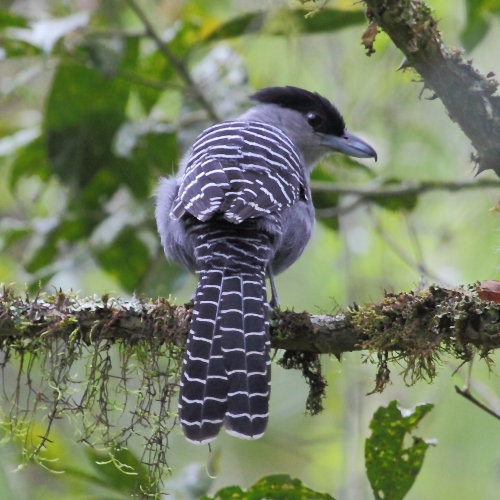
Humaita Antbird
Schistocichla humaythae
Order: Passeriformes / Family: Thamnophilidae

Wikimedia Commons
About the Humaita Antbird
The Humaita Antbird (Schistocichla humaythae) is a fascinating species belonging to the family Thamnophilidae, which is well-known for its complex social structures and unique adaptations. This bird is predominantly found in the Amazon Basin, with sightings recorded in Brazil, particularly in the states of Amazonas and Acre. These regions provide the dense understory habitat that the Humaita Antbird requires for its survival. Its presence is a key indicator of the health of the forest ecosystem, as it plays a significant role in insect population control. The bird's ecological role is deeply intertwined with the symbiotic relationships it forms within its habitat. During the wet season, the Humaita Antbird thrives in the lush, verdant expanses, making use of the increased insect activity for feeding. As the dry season approaches, its behavior and movement patterns shift, often becoming more territorial as resources become scarce. The antbird's ability to adapt its foraging strategies to seasonal changes underscores its resilience. This adaptability makes the Humaita Antbird a central figure in the ecological dynamics of the Amazon. In recent years, its significance has been increasingly recognized by conservationists, who study its habits to better understand the broader environmental changes occurring within the rainforest. Despite its relative obscurity among the general public, the Humaita Antbird is a subject of considerable interest among ornithologists and ecologists. Its presence is often used to gauge the impact of deforestation and other anthropogenic changes on local biodiversity. Understanding the Humaita Antbird's role in the ecosystem provides valuable insights into the preservation of biodiversity in one of the world's most critical habitats.
The Humaita Antbird belongs to the family Thamnophilidae, within the order Passeriformes. These birds typically live around 3-5 years, with some individuals living up to 6 years..
How to Identify a Humaita Antbird
The Humaita Antbird is primarily recognized by its warm brown plumage, which blends seamlessly with the forest floor. Adult birds exhibit a rich chestnut coloration on the back and wings, while the underparts are slightly paler, providing a subtle but noticeable contrast. Males and females are similar in appearance, making visual differentiation challenging without close observation. Juvenile Humaita Antbirds, however, can be distinguished by their more rufous tones and less defined markings. One of the most distinguishing features of the Humaita Antbird is its dark eye, which stands out against the lighter feathers of the face. This feature is particularly helpful when trying to locate the bird in its dense habitat. In flight, the bird presents a stocky silhouette with rounded wings and a short tail, a typical trait among antbirds. Its perching posture is often upright, frequently seen clinging to vertical branches or stems while scanning for prey. The Humaita Antbird can sometimes be confused with other sympatric antbird species; however, its unique vocalizations and specific plumage characteristics are reliable identification aids.
Having trouble telling birds apart? Upload a photo to our bird identification tool for an instant species match.
Humaita Antbird Habitat and Range
Preferred Habitat
The Humaita Antbird inhabits the dense understory of the Amazonian rainforest, thriving in areas with abundant leaf litter and undergrowth. It favors the humid, shaded environments provided by the forest floor, which supports a rich array of insect life. Elevations where this bird is commonly found range from lowland regions just above sea level to areas slightly elevated, not exceeding 600 meters. Unlike some other species, the Humaita Antbird shows limited tolerance for edge habitats, preferring the interior of primary forests where human disturbance is minimal. During seasonal shifts, it may move slightly within its preferred habitat to adjust for changes in food availability, but it remains largely non-migratory. Urban encroachment poses a significant risk to its habitat, as the bird is rarely found in heavily disturbed areas or those converted for agriculture.
Geographic Range
The Humaita Antbird's range is primarily concentrated in the western Amazon Basin. It is most commonly observed in the Brazilian states of Amazonas and Acre. Its presence extends into parts of southeastern Peru and northeastern Bolivia, where suitable habitats exist. The bird's range does not include large-scale migratory movements, as it is a resident species that remains within its established territories throughout the year. Population densities are highest in undisturbed forests, with notable hotspots in regions where conservation efforts have preserved substantial tracts of primary rainforest. Despite its relatively limited range, the Humaita Antbird is considered widespread within its favored habitats. However, its dependence on intact forest environments means that any significant habitat destruction could lead to localized declines.
Want to know which birds visit your area? Browse our backyard birds by location guides for region-specific species lists.
What Does the Humaita Antbird Eat?
The primary diet of the Humaita Antbird consists of insects and small arthropods, which it skillfully extracts from the forest floor's leaf litter. Ants, beetles, and spiders form the core of its diet, though it will opportunistically consume other invertebrates when available. Seasonal changes influence its feeding habits, with a noticeable shift towards caterpillars and other soft-bodied insects during the wet season when these prey items are more abundant. The Humaita Antbird employs a foraging technique known as 'leaf gleaning,' where it meticulously searches through debris and foliage to uncover hidden prey. It often follows swarms of army ants, capitalizing on the disturbance caused by these insects to flush out potential food sources. This bird typically forages alone or in pairs, with feeding occurring throughout the day, peaking during the cooler morning and late afternoon hours.
Humaita Antbird Behavior and Social Structure
The Humaita Antbird exhibits a range of intriguing behaviors that reflect its adaptation to the dense Amazonian understory. Socially, it is often observed alone or in pairs, with pair bonds being strong and often lasting beyond a single breeding season. Territorial behavior is a prominent aspect of its lifestyle, with males frequently engaging in vocal displays to assert dominance and ward off rivals. During courtship, males perform a series of displays that include wing flicking and tail fanning, accompanied by a distinctive series of calls. Flocking is rare for this species, although it may occasionally join mixed-species foraging groups to exploit food resources more efficiently. The bird's response to predators involves a combination of camouflage and strategic movement within the underbrush, making use of its cryptic plumage to avoid detection. Daily activity patterns show peak activity during the early morning and late afternoon, coinciding with the optimal foraging times in its habitat.
Humaita Antbird Nesting and Reproduction
The nesting habits of the Humaita Antbird are intricately linked to its forest environment. Nests are typically constructed close to the ground, often in low shrubs or among dense undergrowth, utilizing a variety of plant materials such as leaves, twigs, and moss. The structure is a cup-shaped nest, designed to blend seamlessly into the surrounding foliage. Clutch sizes generally consist of two to three eggs, which are incubated by both parents for a period of 14 to 16 days. Upon hatching, both male and female parents participate in feeding and caring for the young, which fledge approximately 12 to 15 days after hatching. The Humaita Antbird typically raises one brood per year, although in areas with abundant food resources, a second brood may occasionally be attempted. Parental roles are well-balanced, with both sexes contributing equally to the incubation and rearing of the chicks.
Humaita Antbird Sounds and Vocalizations
The Humaita Antbird's vocalizations are a defining aspect of its presence in the rainforest. Its primary song consists of a series of clear, melodious whistles that increase in intensity and pitch, often lasting several seconds. These songs serve both as a territorial call and a communication tool between mates. In addition to its song, the bird emits short, sharp call notes used in alarm situations or when startled. During the dawn chorus, the Humaita Antbird is particularly vocal, contributing to the cacophony of sounds that characterize the Amazonian morning. Its calls can be compared to the sound of a small, high-pitched wind instrument, with a rhythmic pattern that is easily recognizable once learned.
Interesting Facts About the Humaita Antbird
- 1The Humaita Antbird was only recently recognized as a distinct species, highlighting its unique characteristics.
- 2Its reliance on army ant swarms for feeding makes it a fascinating example of interspecies relationships.
- 3The Humaita Antbird's song can travel long distances through the dense forest, aiding in territory establishment.
- 4This bird's cryptic coloration provides excellent camouflage against predators in its forest habitat.
- 5Despite its elusive nature, the Humaita Antbird is a key species for birdwatchers visiting the Amazon.
- 6The bird's nest is often hidden so well that finding it requires careful observation and patience.
- 7The Humaita Antbird's presence in an area is often used as an indicator of environmental health.
Humaita Antbird Conservation Status
The Humaita Antbird is currently classified as Least Concern by the IUCN, though its population trends are closely monitored due to ongoing habitat loss. Deforestation and land conversion for agriculture are the primary threats to its survival, as these activities drastically reduce the available habitat. Conservation efforts focus on preserving large tracts of primary forest and promoting sustainable land use practices. Historical population data suggest that the bird's numbers have remained relatively stable where habitats are protected, but declines have been noted in areas experiencing significant environmental change. Continued conservation efforts are essential to maintain the population stability of this species and ensure that future generations can experience the rich biodiversity of the Amazon Basin.