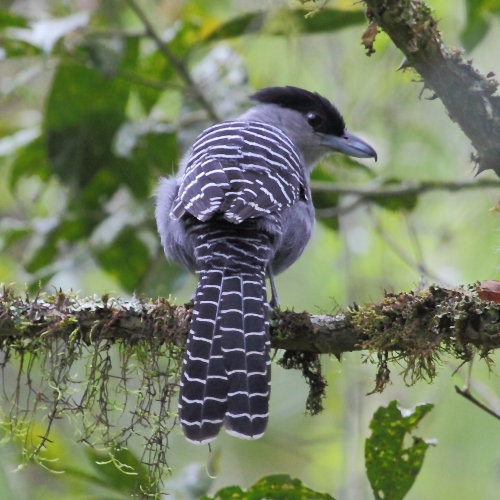
Ihering's Antwren
Myrmotherula iheringi
Order: Passeriformes / Family: Thamnophilidae

Wikimedia Commons
About the Ihering's Antwren
Ihering's Antwren (Myrmotherula iheringi) is a captivating small bird belonging to the family Thamnophilidae. It inhabits the rich, dense forests of southeastern Brazil, particularly within states like São Paulo and Rio de Janeiro. This species thrives in the understory of humid lowland and montane forests, demonstrating a strong preference for areas with thick foliage and vine tangles. The significance of the Ihering's Antwren lies in its role as an insectivore, helping control insect populations and contributing to the ecological balance of its habitat. Its presence indicates a healthy forest ecosystem, as it often requires intact forest canopies to thrive. This bird's ecological role extends to seed dispersal, albeit indirectly, as its feeding habits influence the distribution of insects that interact with various plant species. Seasonally, Ihering's Antwren remains primarily sedentary, although slight altitudinal movements may occur in response to food availability and weather conditions. Its apparent territoriality keeps it in relatively stable ranges year-round, making it a reliable resident of its chosen habitat. This bird's subtle beauty and ecological importance make it a subject of interest for ornithologists and bird enthusiasts alike. Its presence in a forest is often detected by its distinctive vocalizations before the bird itself is seen, as it blends seamlessly into the leafy environment. The Ihering's Antwren is not just a fascinating bird to observe but also an integral part of the biodiversity in the regions it inhabits, serving as both a predator and a prey species, maintaining the delicate balance of its ecosystem.
The Ihering's Antwren belongs to the family Thamnophilidae, within the order Passeriformes. These birds typically live average 5 years with a maximum recorded of 8 years..
How to Identify a Ihering's Antwren
In the field, Ihering's Antwren can be identified by its small size and distinct plumage. The adult males exhibit a predominantly gray body, contrasted by striking white wing bars that stand out against the dense foliage they inhabit. Females differ slightly, displaying a more subdued gray with slightly warmer, brownish tones on their upperparts. Juveniles resemble the females but with even less defined markings. The differences between males and females are subtle, yet noticeable with careful observation. The bird's compact form, combined with its short tail and rounded wings, creates a distinctive silhouette. Despite its small size, typically around 10 cm in length, its bustling activity and constant movement through the undergrowth make it a lively presence in the forest. While observing Ihering's Antwren, birdwatchers may confuse it with other small antwrens, but its unique wing pattern and vocalizations help distinguish it. In flight, it moves swiftly and directly, its wings producing a faint whirring sound. When perching, it often maintains a horizontal posture, allowing its wing bars to be visible even from a distance. These features are key to identifying this species among the rich tapestry of life within its habitat.
Having trouble telling birds apart? Upload a photo to our bird identification tool for an instant species match.
Ihering's Antwren Habitat and Range
Preferred Habitat
Ihering's Antwren primarily inhabits the dense, humid forests of southeastern Brazil. These forests, ranging from lowland tropical to montane regions, provide the perfect environment for the antwren, with thick foliage and plentiful insect life. The bird is most commonly found in areas rich in undergrowth and vine tangles, which offer both food and protection. It tends to favor elevations between 200 and 1,000 meters, although it can sometimes be found at lower altitudes in exceptionally dense forest areas. Seasonal shifts in habitat are minimal, as the bird remains relatively sedentary. Unlike some bird species, Ihering's Antwren does not readily adapt to urban or significantly altered landscapes, preferring instead the stability and resources of untouched forest environments.
Geographic Range
The breeding and year-round range of Ihering's Antwren is confined to the Atlantic Forest biome of southeastern Brazil. This region, stretching along the coastal areas of states like São Paulo, Rio de Janeiro, and parts of Minas Gerais, serves as the primary habitat for the species. Within this range, the bird is more densely populated in areas with intact forest canopies. While it remains largely sedentary, slight altitudinal movements might occur, particularly in response to food availability and climatic conditions. The absence of significant migration patterns differentiates Ihering's Antwren from other neotropical birds, anchoring it firmly within its native range year-round. Population densities tend to be highest in undisturbed forest areas, where the intricate ecosystem supports a diverse array of insect life.
Want to know which birds visit your area? Browse our backyard birds by location guides for region-specific species lists.
What Does the Ihering's Antwren Eat?
Ihering's Antwren predominantly feeds on insects and other small arthropods, making it an insectivore par excellence. Its diet includes ants, beetles, spiders, and caterpillars, which it gleans from leaves, branches, and the forest floor. Seasonal variations in diet are influenced by the availability of prey, with the bird exploiting seasonal insect blooms during certain times of the year. The antwren employs an active foraging technique, moving swiftly through the underbrush and using its sharp eyesight to detect movement. It often joins mixed-species flocks, benefiting from the collective vigilance and flushing of insects by other birds. Its feeding schedule is primarily diurnal, with peak activity occurring in the early morning and late afternoon when insect activity is at its highest.
Ihering's Antwren Behavior and Social Structure
Ihering's Antwren exhibits a fascinating array of behaviors, particularly in its social and territorial interactions. This species is typically found in pairs or small family groups, maintaining defined territories that they defend vocally and physically against intruders. The birds engage in elaborate courtship displays, with males flitting energetically and showcasing their wing patterns to attract females. Flocking behavior is evident when they join mixed-species groups, a strategy that enhances their foraging efficiency and predator avoidance. The antwren's response to potential threats involves a combination of alarm calls and rapid, evasive maneuvers. Daily activity patterns include periods of intense foraging interspersed with rest and preening. Despite their small size, these birds demonstrate a boldness that belies their delicate appearance, often approaching intruders to investigate potential threats.
Ihering's Antwren Nesting and Reproduction
Nesting for Ihering's Antwren involves constructing a small, cup-shaped nest made from fine twigs, leaves, and spider silk. These nests are typically located in dense foliage, often suspended from a low shrub or tree branch to provide concealment from predators. The female lays a clutch of 2 to 3 eggs, which both parents incubate for approximately 14 to 16 days. After hatching, the chicks are altricial and require constant care and feeding from both parents. The fledging period lasts about 12 to 15 days post-hatching, during which the young are fed a diet rich in insects to support their rapid growth. The number of broods per year can vary depending on environmental conditions, but typically one to two broods are raised annually.
Ihering's Antwren Sounds and Vocalizations
The primary vocalization of Ihering's Antwren is a rapid series of sharp, high-pitched notes that resemble a mechanical trill. This song serves both as a territorial marker and a mating call, often delivered from a hidden perch within dense foliage. Call notes are shorter and less complex, used primarily for communication between pairs or within family groups. Alarm calls are harsher, more urgent, and act as a warning signal to conspecifics and other species in mixed flocks. During the dawn chorus, the antwren's trills contribute a distinctive cadence to the forest's acoustic tapestry, marking the start of the day's activity.
Interesting Facts About the Ihering's Antwren
- 1Ihering's Antwren is named after Hermann von Ihering, a German-Brazilian zoologist known for his work on Brazilian wildlife.
- 2Despite its small size, the antwren's song can be heard up to 100 meters away in dense forest habitats.
- 3Myrmotherula iheringi is part of a diverse genus containing over 30 species, each adapted to specific forest niches.
- 4The Atlantic Forest, home to Ihering's Antwren, is one of the world's most diverse and endangered ecosystems.
- 5Ihering's Antwren often participates in mixed-species flocks, enhancing its foraging efficiency and predator awareness.
Ihering's Antwren Conservation Status
The IUCN currently lists Ihering's Antwren as Near Threatened, with its population trend showing signs of decline. The primary threat to its survival is habitat destruction due to deforestation for agriculture, urban expansion, and logging activities in its native range. Conservation efforts focus on preserving and restoring the Atlantic Forest, a biodiversity hotspot that supports numerous endemic species. Historical population changes reflect the broader environmental challenges facing the region, emphasizing the need for targeted conservation strategies. Protecting large tracts of forest and supporting sustainable land-use practices remain crucial for the species' long-term survival.