
Scaly-throated Honeyguide
Indicator maculicollis
Order: Piciformes / Family: Indicatoridae

Wikimedia Commons
About the Scaly-throated Honeyguide
The Scaly-throated Honeyguide (Indicator maculicollis) is an intriguing bird native to the lush and diverse landscapes of sub-Saharan Africa, particularly prevalent in regions such as Uganda, Kenya, Tanzania, and the Democratic Republic of the Congo. This bird is an integral part of its ecosystem, contributing to the complex interspecies relationships that thrive in the African woodlands and forests. Known for its peculiar feeding habits, the Scaly-throated Honeyguide exhibits brood parasitism, a rare behavior among birds that involves laying its eggs in the nests of other species. This bird's ecological role extends beyond its parasitic tendencies, as it often leads humans and other animals to beehives, benefiting from the aftermath of hive raids. Traditionally, the honeyguide’s unique behavior has forged a symbiotic relationship with humans who seek honey. By guiding them to hives, the honeyguide gains access to beeswax and larvae once the hive is opened. Found predominantly in tropical and subtropical regions, the Scaly-throated Honeyguide prefers the dense cover of forests and woodland areas, where it can exploit the rich insect life and available nesting opportunities. During the breeding season, which varies by region, this honeyguide displays a remarkable adaptability, altering its habits to find hosts for its eggs. The Scaly-throated Honeyguide's presence in these ecosystems highlights its significance as a species that not only survives but thrives by utilizing complex interactions within its environment.
The Scaly-throated Honeyguide belongs to the family Indicatoridae, within the order Piciformes. These birds typically live average 7-8 years, with some living longer in optimal conditions..
How to Identify a Scaly-throated Honeyguide
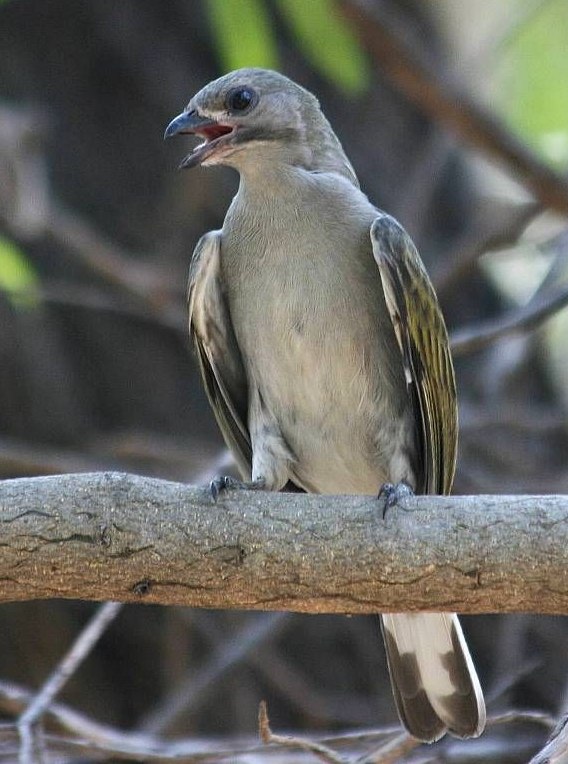
The Scaly-throated Honeyguide can be identified by its olive-green upperparts and distinctive scaly-patterned throat, which gives the bird its common name. Adults display a pale yellowish wash on the underparts, a notable contrast to their darker upper body. The eyes are dark brown, and the bill is short and stout, well-suited for its diet of beeswax and insects. Juvenile Scaly-throated Honeyguides differ slightly, exhibiting a duller plumage with less pronounced throat scaling, making them less conspicuous than adults. Unlike many other bird species, there is little sexual dimorphism in the Scaly-throated Honeyguide, meaning males and females appear similar in size and coloration. This can make it challenging for observers to differentiate between the sexes in the field. The honeyguide's flight silhouette is compact, with a slightly rounded tail and short, broad wings that aid in maneuverability through dense foliage. When perched, the bird often maintains an upright posture, frequently seen on branches in the mid to upper canopy levels. This posture, along with its unique vocalizations, can assist birdwatchers in identifying the species even if the scaly throat is not immediately visible. The Scaly-throated Honeyguide's resemblance to other honeyguides can cause confusion, yet its distinctive throat pattern sets it apart from similar species like the Greater Honeyguide.
Having trouble telling birds apart? Upload a photo to our bird identification tool for an instant species match.
Scaly-throated Honeyguide Habitat and Range
Preferred Habitat
Primarily inhabiting subtropical and tropical forests, the Scaly-throated Honeyguide thrives in dense woodlands and forest edges where it can find suitable hosts for laying its eggs. These environments, often rich in both flora and fauna, provide ample foraging opportunities and nesting sites for this species. The Scaly-throated Honeyguide can be found at elevations ranging from sea level to about 2,500 meters, with a preference for areas that offer a variety of potential host species for its brood parasitism. While primarily a forest-dwelling bird, it occasionally ventures into more open woodland areas, though it is less common in urban or heavily cultivated regions. Seasonal shifts in habitat are generally minimal, as the honeyguide does not undertake extensive migrations. However, slight movements in search of optimal nesting conditions and food sources may occur. The bird's preference for forested habitats makes it less likely to be seen in highly urbanized or agricultural landscapes, emphasizing the importance of forest conservation for the maintenance of its populations.
Geographic Range
The Scaly-throated Honeyguide's range extends across sub-Saharan Africa, from the dense rainforests of West Africa to the open woodlands of East Africa. It is notably present in countries such as Angola, Cameroon, and Gabon, with a population that is particularly dense in the montane and lowland forests of Uganda and Tanzania. This species does not exhibit long-distance migratory behavior, instead remaining relatively localized within its range. Breeding and foraging territories overlap significantly, allowing the bird to utilize familiar environments year-round. Population density varies, with higher concentrations found in regions where suitable host species and food resources are abundant. While the Scaly-throated Honeyguide is generally considered non-migratory, some seasonal movement may occur within its range to exploit seasonal abundance of food and nesting opportunities in different areas. This localized movement ensures that the bird remains within regions that support its specific ecological needs. The honeyguide's range is bounded by the availability of suitable forest and woodland habitats, making it vulnerable to habitat loss and fragmentation.
Want to know which birds visit your area? Browse our backyard birds by location guides for region-specific species lists.
What Does the Scaly-throated Honeyguide Eat?
The Scaly-throated Honeyguide has a specialized diet that primarily consists of beeswax and bee larvae, which it accesses by following traditional honey-gathering practices. This unusual diet requires the bird to interact closely with both humans and animals capable of opening beehives. In addition to beeswax, the honeyguide consumes a variety of insects, which provide essential nutrients such as protein. The bird's foraging technique involves keen observation and sometimes leading larger animals to hives, where it waits for them to disturb the bees. Seasonal variations in available food sources can affect its diet, though beeswax remains a constant preference. The honeyguide's feeding schedule is opportunistic, often aligning with human activity in areas where honey harvesting occurs. In regions where beeswax is less available, the honeyguide adapts by increasing its insect consumption, demonstrating a degree of dietary flexibility that supports its survival across diverse habitats.
Scaly-throated Honeyguide Behavior and Social Structure
The Scaly-throated Honeyguide exhibits a fascinating array of behaviors, with its social structure revolving around solitary or loosely paired individuals rather than large flocks. Territorial behavior is pronounced, particularly during breeding periods when males may become more vocal to assert dominance and secure mating opportunities. Courtship displays are subtle, relying more on vocalizations and less on visual displays. The honeyguide's response to predators is typically evasive, using its agility to maneuver through dense foliage. Daily activity patterns involve periods of foraging interspersed with rest, often in the mid-canopy level where it can easily survey its surroundings. While generally solitary, the honeyguide engages in interactions with other species, notably during its guiding behavior, where it leads potential hive raiders to honey sources. This behavior underscores its role in the ecosystem as a facilitator of interspecies cooperation.
Scaly-throated Honeyguide Nesting and Reproduction
As a brood parasite, the Scaly-throated Honeyguide does not build its own nest. Instead, it targets the nests of other bird species, laying its eggs for them to incubate and rear. Preferred host species include those that construct enclosed or semi-enclosed nests, such as barbets and woodpeckers. The female honeyguide often removes an egg from the host's nest before laying her own, ensuring that the host will devote resources to her offspring. Clutch size typically consists of a single egg per host nest, though a female may parasitize multiple nests in a single breeding season. The incubation period aligns with that of the host species, ensuring the honeyguide chick hatches concurrently with or slightly before the host's own chicks. Once hatched, the honeyguide chick often exhibits aggressive behavior, outcompeting or even eliminating host chicks to monopolize parental care. The fledging timeline is closely tied to the host species, with honeyguide chicks leaving the nest once they are fully developed and capable of independent survival.
Scaly-throated Honeyguide Sounds and Vocalizations
The Scaly-throated Honeyguide's vocalizations are distinctive, contributing to its identification in dense forest environments. Its primary song consists of a series of high-pitched, trilling notes that rise and fall in a rhythmic sequence. These calls serve both as territorial markers and as communication during the breeding season. Besides its primary song, the honeyguide emits sharp, clear call notes that may be used in alarm contexts or to solicit attention from potential hive raiders. The bird's vocal activity peaks during dawn and dusk, a period when its calls can carry over long distances in the forest. Compared to other birds in its habitat, the honeyguide's vocalizations are relatively simple yet effective in fulfilling its ecological roles.
Interesting Facts About the Scaly-throated Honeyguide
- 1The Scaly-throated Honeyguide is one of the few birds known to consume beeswax as a primary food source.
- 2Unlike many brood parasites, the Scaly-throated Honeyguide chick often evicts host chicks from the nest.
- 3This honeyguide is known for leading humans to beehives, a behavior that benefits both parties.
- 4The Scaly-throated Honeyguide's guiding behavior is not limited to humans but extends to other animals as well.
- 5Despite its parasitic nesting habits, this honeyguide plays a crucial role in its ecosystem by facilitating interspecies cooperation.
- 6The species' range is largely determined by the availability of forested habitats, highlighting its vulnerability to deforestation.
- 7The Scaly-throated Honeyguide's vocalizations are adapted to carry over long distances in dense forest environments.
Scaly-throated Honeyguide Conservation Status
The IUCN currently lists the Scaly-throated Honeyguide as a species of least concern, with a stable population trend. However, ongoing threats such as habitat destruction and deforestation pose significant risks to its long-term survival. Conservation efforts focus on habitat preservation, particularly in key regions where forest cover is rapidly declining. Historical population trends indicate relative stability, yet localized declines have occurred in areas heavily affected by human activity. Continued monitoring and habitat protection are essential to ensure that this unique bird maintains its ecological niche. Conservation organizations emphasize the importance of sustainable land use practices to mitigate the effects of habitat loss.
Other Indicatoridae Species



Birds Similar to the Scaly-throated Honeyguide
These species are often confused with the Scaly-throated Honeyguide due to similar appearance or overlapping range.
