
Spotted Honeyguide
Indicator maculatus
Order: Piciformes / Family: Indicatoridae

Wikimedia Commons
About the Spotted Honeyguide
The Spotted Honeyguide, scientifically known as Indicator maculatus, is a member of the family Indicatoridae and is widely recognized for its distinctive ecological role in African forests. This small bird, native to sub-Saharan Africa, plays a crucial role in the ecosystem by engaging in mutualistic relationships with honey-seeking animals. As a brood parasite, the Spotted Honeyguide lays its eggs in the nests of other bird species, leaving the host parents to raise its young. This behavior is reminiscent of the cuckoo, though honeyguides specifically target hole-nesting birds such as barbets and woodpeckers.
The Spotted Honeyguide is primarily found in the woodlands and forests of western and central Africa, with a range extending from Sierra Leone to Uganda and south to Angola. The species thrives in a variety of forested habitats, including lowland rainforests and montane forests, where it can often be observed following mammals such as honey badgers and humans in search of bees' nests. By guiding these mammals to honey sources, it gains access to beeswax, a crucial component of its diet, which other birds typically avoid.
Seasonal changes influence the Spotted Honeyguide's behavior, particularly in its breeding patterns. During the breeding season, which coincides with the rainy season in many parts of its range, the honeyguide becomes more active in its search for nests to parasitize. Outside of the breeding season, its social behavior can vary, with solitary individuals or small family groups being the norm. The Spotted Honeyguide's ecological role extends beyond its parasitic habits, as it contributes to the dynamics of the forest by participating in the complex web of predator-prey and mutualistic interactions.
The Spotted Honeyguide belongs to the family Indicatoridae, within the order Piciformes. These birds typically live average 6-7 years, with limited data on maximum lifespan..
How to Identify a Spotted Honeyguide
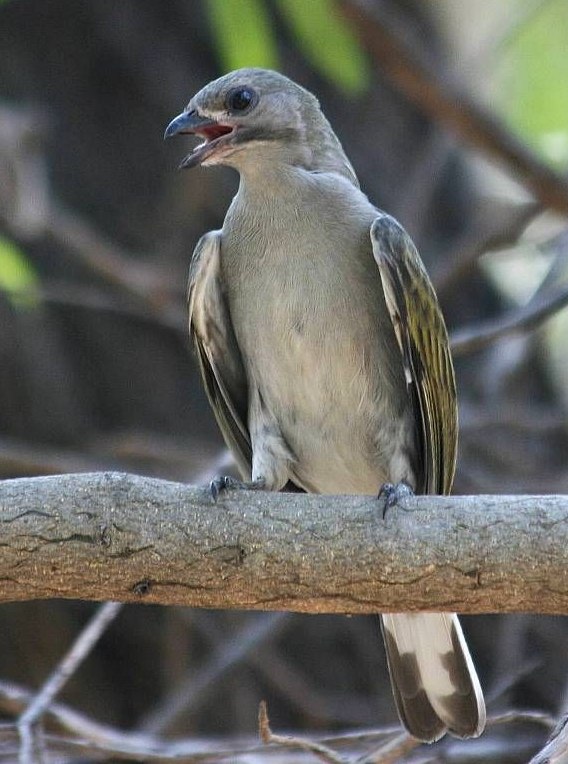
The adult Spotted Honeyguide is a small bird, measuring approximately 18 cm in length. Its plumage is predominantly olive-brown with distinctive white spotting on the breast and flanks, which gives the species its name. The underparts are lighter, with a slightly yellowish tinge. Both males and females exhibit similar plumage, making visual differentiation challenging. Juvenile Spotted Honeyguides resemble adults but often have less pronounced spotting and a more uniform coloration on the underparts.
In flight, the Spotted Honeyguide displays a somewhat rounded silhouette with short wings and a slightly rounded tail. Its flight is characterized by rapid wing beats interspersed with glides, allowing for agile maneuvering through dense forest canopies. When perched, the bird typically adopts a horizontal posture, often remaining still and inconspicuous within the foliage.
Distinguishing the Spotted Honeyguide from similar species can be challenging. It is often confused with the Lesser Honeyguide due to similar size and habitat preference. However, the Spotted Honeyguide can be identified by its unique spotting pattern and the lack of a pale eyebrow stripe, which the Lesser Honeyguide possesses. Observers should pay close attention to these subtle differences when identifying the species in the field.
Having trouble telling birds apart? Upload a photo to our bird identification tool for an instant species match.
Spotted Honeyguide Habitat and Range
Preferred Habitat
The Spotted Honeyguide inhabits a range of forested environments in sub-Saharan Africa, thriving in both lowland and montane forest habitats. It is commonly found in primary and secondary forests, as well as forest edges and clearings. The bird favors areas with dense canopy cover, which provides ample opportunities for foraging and nesting.
The species is typically found at elevations ranging from sea level to 2,500 meters, although it is more commonly observed in lowland areas. Seasonal habitat shifts occur in response to changes in food availability, with the Spotted Honeyguide sometimes venturing into more open areas during periods of food scarcity.
In terms of urban versus rural distribution, the Spotted Honeyguide is predominantly a resident of rural and forested areas, with limited presence in urban settings. Its reliance on natural forests and traditional nesting sites makes it less adaptable to heavily urbanized environments, although it may occasionally be found in suburban areas near forest edges.
Geographic Range
The Spotted Honeyguide's range spans much of the forested areas of western and central Africa. Its breeding range extends from Sierra Leone and Liberia in the west, across southern Nigeria and Cameroon, and reaching as far east as Uganda and the Democratic Republic of the Congo. Additionally, the species is found in Angola and northern Zambia.
The bird is a year-round resident in these regions, with no significant long-distance migration patterns observed. However, local movements do occur, driven by food availability and breeding opportunities. These movements are mostly altitudinal, with individuals moving between lower and higher elevations depending on resource distribution.
Population densities of the Spotted Honeyguide are highest in regions with extensive forest cover, particularly in countries such as Gabon and the Republic of the Congo, where vast areas of suitable habitat remain. Despite its wide range, the species tends to be patchily distributed, with densities varying based on local habitat quality and availability of nesting sites.
Want to know which birds visit your area? Browse our backyard birds by location guides for region-specific species lists.
What Does the Spotted Honeyguide Eat?
The Spotted Honeyguide's diet primarily consists of beeswax and the larvae and pupae found within beehives. This unique dietary preference sets it apart from most other birds, as it relies heavily on the wax produced by bees, which is indigestible to many avian species. The bird also consumes a variety of insects, primarily caterpillars and beetles, which provide essential proteins and nutrients.
Seasonal diet changes occur in response to fluctuations in resource availability. During the rainy season, when bees are more active and hives are abundant, the Spotted Honeyguide's consumption of beeswax increases significantly. In drier periods, the bird's diet shifts slightly towards a higher proportion of insects and other invertebrates.
The Spotted Honeyguide employs a foraging technique that involves following potential honey-gathering partners, such as honey badgers or humans, to locate beehives. Once a hive is found, the bird waits for its partner to break open the hive, after which it consumes the wax and larvae. This symbiotic relationship is vital for the honeyguide, allowing it to access food resources that would otherwise remain out of reach.
Spotted Honeyguide Behavior and Social Structure
The Spotted Honeyguide exhibits a fascinating blend of social and solitary behaviors. It is known for its unique mutualistic interactions with honey-seeking mammals and humans, whom it guides to beehives in exchange for access to wax and larvae. This guiding behavior is a remarkable example of interspecies communication, with the honeyguide utilizing specific calls to attract the attention of potential partners.
Territoriality is observed among Spotted Honeyguides, with individuals defending their feeding areas and potential nesting sites. During the breeding season, which aligns with the regional rainy season, courtship displays become more prominent. Males engage in calling and visual displays to attract females, although the specifics of these displays remain less documented compared to other bird species.
The Spotted Honeyguide's response to predators involves a combination of cryptic behavior and vocal alarms. It often remains motionless and silent when predators are nearby, relying on its camouflaged plumage to avoid detection. Flocking behavior is infrequent, as the species typically forages alone or in small family groups. Daily activity patterns include active foraging during the cooler morning and late afternoon hours, with periods of rest during the heat of the day.
Spotted Honeyguide Nesting and Reproduction
The Spotted Honeyguide's nesting strategy involves brood parasitism, where it relies on other bird species to incubate and rear its young. It typically targets hole-nesting birds, such as barbets and woodpeckers, to lay its eggs. The female Spotted Honeyguide locates a suitable host nest, often using a combination of patience and stealth, and deposits a single egg.
The incubation period is entirely dependent on the host species, as the Spotted Honeyguide does not contribute to the care of its young after laying the egg. The host parents incubate the egg alongside their own, and once hatched, the young honeyguide may exhibit aggressive behaviors to outcompete the host's offspring for resources.
Clutch size for the Spotted Honeyguide is generally limited to one egg per host nest, but a single female may parasitize multiple nests in a breeding season. The fledging timeline also varies based on the host species, with the young honeyguide typically fledging in a similar timeframe to the host's young. Parental roles are non-existent in the traditional sense, as the responsibility for raising the young falls entirely on the host parents.
Spotted Honeyguide Sounds and Vocalizations
The Spotted Honeyguide is known for its distinctive vocalizations, which play a crucial role in its communicative and guiding behaviors. Its primary song is a series of repeated, high-pitched notes with a clear, whistling quality. These notes are often delivered in quick succession, forming a rhythmic pattern that can carry over long distances.
In addition to its song, the Spotted Honeyguide produces a variety of call notes used in different contexts. Alarm calls are sharp and staccato, serving to alert fellow birds of potential threats. During dawn and dusk, the honeyguide participates in a subdued chorus, with its song joining those of other forest birds, creating a rich tapestry of sound.
The vocalizations of the Spotted Honeyguide are essential for its role as a guide, as it uses specific calls to attract partners for joint foraging ventures. These calls, distinct from its territorial or alarm notes, are characterized by a more enticing and melodic quality, designed to capture the attention of honey-seeking mammals or humans.
Interesting Facts About the Spotted Honeyguide
- 1The Spotted Honeyguide can digest beeswax, a trait shared with very few other bird species.
- 2This bird engages in a unique mutualism by leading honey badgers and humans to beehives.
- 3While parasitic, the Spotted Honeyguide's eggs often mimic those of its host species.
- 4The species communicates with potential partners through specific guiding calls.
- 5Spotted Honeyguides have been observed to lay eggs in up to ten different host nests per season.
- 6Despite their parasitic nature, Spotted Honeyguides contribute to forest dynamics by guiding animals to food sources.
- 7Their diet includes insects, but beeswax remains a critical component, especially in the wet season.
Spotted Honeyguide Conservation Status
The Spotted Honeyguide is currently classified as Least Concern by the IUCN, with population trends considered stable. However, localized threats, such as habitat destruction and fragmentation due to logging and agricultural expansion, pose potential risks to its habitat. Conservation efforts for the Spotted Honeyguide focus on preserving its forest habitats and maintaining the ecological integrity of the regions it inhabits. Protected areas and national parks in countries like Gabon and the Democratic Republic of the Congo play a vital role in safeguarding the bird's habitat and ensuring the continued availability of nesting and foraging resources. Historically, the Spotted Honeyguide has maintained stable population levels, thanks in part to its ability to adapt to a range of forested environments. Ongoing conservation measures aim to prevent future declines by promoting sustainable land management practices and raising awareness of the species' ecological importance.
Other Indicatoridae Species



Birds Similar to the Spotted Honeyguide
These species are often confused with the Spotted Honeyguide due to similar appearance or overlapping range.
