
Lesser Honeyguide
Indicator minor
Order: Coraciiformes / Family: Meropidae
Wikimedia Commons
About the Lesser Honeyguide
The Lesser Honeyguide, scientifically known as Indicator minor, is a fascinating bird that inhabits a vast range across sub-Saharan Africa. This diminutive bird, often overshadowed by its larger relatives, plays a pivotal role in the ecosystem through its mutualistic relationship with both humans and honey badgers. Their defining behavior involves leading these potential partners to wild bee nests, where after the honey is harvested, the Lesser Honeyguide benefits from the wax and larvae left behind. Throughout the African savannas, woodlands, and forest edges, the Lesser Honeyguide's presence is a testament to the intricate ecological interdependencies that exist in nature. While active throughout the year, the Lesser Honeyguide's guiding behavior is most notable during the dry season when food becomes scarcer, prompting it to seek human and animal assistance more actively. The bird is not just a participant in this mutualistic relationship but is also an important pollinator, feeding on insects and aiding in the control of pest populations. This avian species exhibits adaptability, thriving across various African countries such as Kenya, Tanzania, Zimbabwe, and Botswana. It demonstrates a preference for habitats that range from the dry acacia savannas to the moister miombo woodlands. The Lesser Honeyguide's adaptability to different environments underscores its resilience and ecological significance. Its presence in these diverse habitats not only highlights its role in assisting honey harvesters but also emphasizes its contribution to maintaining balanced ecosystems. In regions such as the Serengeti and the Okavango Delta, the bird's guiding behavior has been passed down through generations of indigenous peoples, further cementing its place in both natural and cultural landscapes.
The Lesser Honeyguide belongs to the family Meropidae, within the order Coraciiformes. These birds typically live average 5-7 years, with a maximum recorded of 10 years..
How to Identify a Lesser Honeyguide
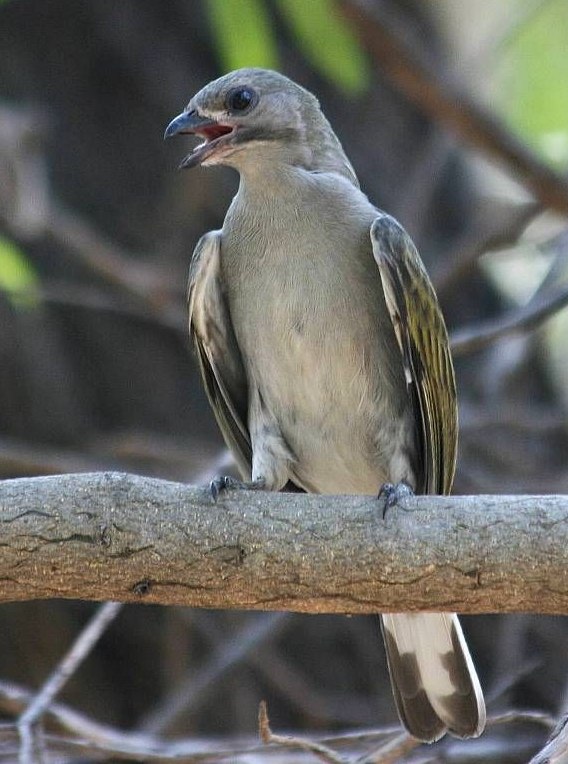
The Lesser Honeyguide is a small bird, usually measuring around 15-17 cm in length, characterized by its dull olive-green upperparts and pale underparts. Adult males and females exhibit similar plumage, with subtle differences that may not be immediately apparent to the casual observer. The male typically has a more pronounced white outer tail feather that contrasts with the darker central tail feathers, a distinguishing feature that aids in identification during flight. Juveniles are often more challenging to distinguish, having a more muted coloration with less contrast in their tail feathers. When compared to similar species such as the Greater Honeyguide, the Lesser Honeyguide is noticeably smaller and lacks the more prominent white markings on the throat and rump that are evident in its larger counterpart. In flight, the Lesser Honeyguide displays a rapid, undulating pattern that can be recognized by experienced birders. Perched, it maintains an upright posture, often flicking its wings, a behavior that may aid in its identification. The subtle nuances in plumage and behavior are crucial for differentiation in habitats where multiple honeyguide species may coexist.
Having trouble telling birds apart? Upload a photo to our bird identification tool for an instant species match.
Lesser Honeyguide Habitat and Range
Preferred Habitat
The Lesser Honeyguide predominantly inhabits the diverse landscapes of sub-Saharan Africa, favoring dry savannas, open woodlands, and forest edges. It is commonly found at elevations ranging from sea level to about 2000 meters, adapting to various environmental conditions. While it is primarily associated with rural and semi-wild areas, it can occasionally be spotted in more urbanized settings, particularly where gardens and parks provide suitable foraging opportunities. Seasonal habitat shifts are minimal, as the Lesser Honeyguide does not undertake long migrations, instead remaining within its established territories throughout the year. Its preference for environments with abundant bee activity ensures access to its primary food sources.
Geographic Range
The Lesser Honeyguide's range extends across much of sub-Saharan Africa. It is a resident species in countries including Kenya, Tanzania, Zimbabwe, Botswana, and South Africa. While it does not migrate long distances, it may exhibit local movements in response to food availability, particularly during periods of drought. Population density is highest in regions where bee populations are robust, such as the Serengeti and the Okavango Delta. The bird is notably absent from the dense, humid rainforests of Central Africa, preferring instead the mixed open habitats found in East and Southern Africa.
Want to know which birds visit your area? Browse our backyard birds by location guides for region-specific species lists.
What Does the Lesser Honeyguide Eat?
The diet of the Lesser Honeyguide primarily consists of beeswax and bee larvae, which it accesses after leading humans or honey badgers to bee nests. This mutualistic behavior ensures a steady supply of its specialized diet. In addition to wax and larvae, the bird consumes a variety of insects, including ants, termites, and other small arthropods, which it gleans from foliage and tree bark. Seasonal variations in diet are influenced by the availability of bee nests, which are more accessible during the dry season when bees are more active. Foraging techniques are opportunistic, with the bird capitalizing on both active hunting and scavenging from disturbed nests.
Lesser Honeyguide Behavior and Social Structure
The Lesser Honeyguide exhibits intriguing social behavior, often seen in loosely associated groups but not forming cohesive flocks. Its territorial behavior includes actively defending its feeding and nesting areas from conspecifics. Courtship displays are subtle, involving calls and flights to attract mates. During the breeding season, the bird becomes more vocal and visible, using its calls to establish dominance and attract partners. The response to predators involves a combination of evasive flight and vocal alarms, alerting nearby birds to threats. Daily activity patterns are diurnal, with peak activity occurring in the early morning and late afternoon, coinciding with the movement of bees and other insects.
Lesser Honeyguide Nesting and Reproduction
Lesser Honeyguides are brood parasites, laying their eggs in the nests of other bird species such as barbets and woodpeckers. They do not build their own nests, instead relying on the host species to incubate their eggs and rear their young. A female Lesser Honeyguide will lay a single egg in a host's nest, often removing one of the host's eggs to disguise the intrusion. The incubation period is typically around 13-15 days, with the fledging timeline for the young honeyguides extending to about 21-23 days post-hatching. Parental roles are minimal, as the host parents unknowingly take on the responsibilities of feeding and caring for the parasitic chick.
Lesser Honeyguide Sounds and Vocalizations
The vocal repertoire of the Lesser Honeyguide includes a distinctive, high-pitched call that consists of a series of rapid, melodious notes. This primary song serves both to attract mates and to assert territorial presence. Call notes are sharper and more abrupt, often used in communication between individuals or as warnings of nearby threats. The bird's vocal activity is most pronounced during the dawn chorus, when it participates in the collective cacophony of the African bush. Its calls, while not as complex as those of some songbirds, are a recognizable feature of its presence in its favored habitats.
Interesting Facts About the Lesser Honeyguide
- 1The Lesser Honeyguide's guiding behavior involves leading humans to bee nests, a mutualistic relationship that benefits both parties.
- 2This bird is one of the few avian species that can digest beeswax, thanks to specialized gut bacteria.
- 3Despite being a brood parasite, the Lesser Honeyguide's chicks are known to mimic the begging calls of their host species' young.
- 4The guiding behavior of the Lesser Honeyguide has been documented in the oral traditions of several African tribes for centuries.
- 5Lesser Honeyguides can travel over 1.5 kilometers while guiding humans or honey badgers to a bee nest.
- 6The bird's ability to find bee nests is attributed to its keen sense of smell, a rare trait among birds.
- 7Lesser Honeyguides can live up to 10 years in the wild, a testament to their adaptability and survival skills.
Lesser Honeyguide Conservation Status
The IUCN currently lists the Lesser Honeyguide as a species of Least Concern, with a stable population trend across its range. However, ongoing threats such as habitat loss due to agricultural expansion and deforestation could impact local populations. Conservation efforts focus on preserving natural habitats and promoting sustainable beekeeping practices that maintain balanced ecosystems. Historically, the population has remained relatively stable, benefiting from the widespread distribution of suitable habitats across sub-Saharan Africa.


