Kolombangra Leaf Warbler
Phylloscopus amoenus
Order: Passeriformes / Family: Phylloscopidae

Wikimedia Commons
About the Kolombangra Leaf Warbler
The Kolombangra Leaf Warbler, scientifically recognized as Phylloscopus amoenus, is a small yet captivating species that inhabits the forests of the Solomon Islands, with a particular prevalence on Kolombangara Island. This bird belongs to the Phylloscopidae family, a group renowned for their leaf-gleaning habits and melodic songs. The Kolombangra Leaf Warbler plays a significant ecological role in its habitat, primarily by controlling insect populations, as it feeds on a variety of arthropods. Its presence is an indicator of the health of the forest ecosystems in which it resides. The bird is a non-migratory resident of the subtropical and tropical moist lowland forests and montane forests. This species is particularly adapted to dense forest canopies where it can often be seen flitting energetically among the branches. The Kolombangra Leaf Warbler is integral to the local biodiversity and supports the intricate web of life within its habitat. During the breeding season, the bird is more actively engaged in courtship displays and territorial defense, while in the non-breeding season, it tends to form small flocks, which aids in foraging. The warbler's song, a series of high-pitched notes, becomes more pronounced during the breeding season, serving both to attract mates and to delineate territory. As a forest-dependent species, its survival is closely linked to the conservation of its woodland habitat. Thus, maintaining these habitats is crucial for the warbler's continued existence.
The Kolombangra Leaf Warbler belongs to the family Phylloscopidae, within the order Passeriformes. These birds typically live average 4-6 years with a maximum recorded lifespan of 8 years..
How to Identify a Kolombangra Leaf Warbler
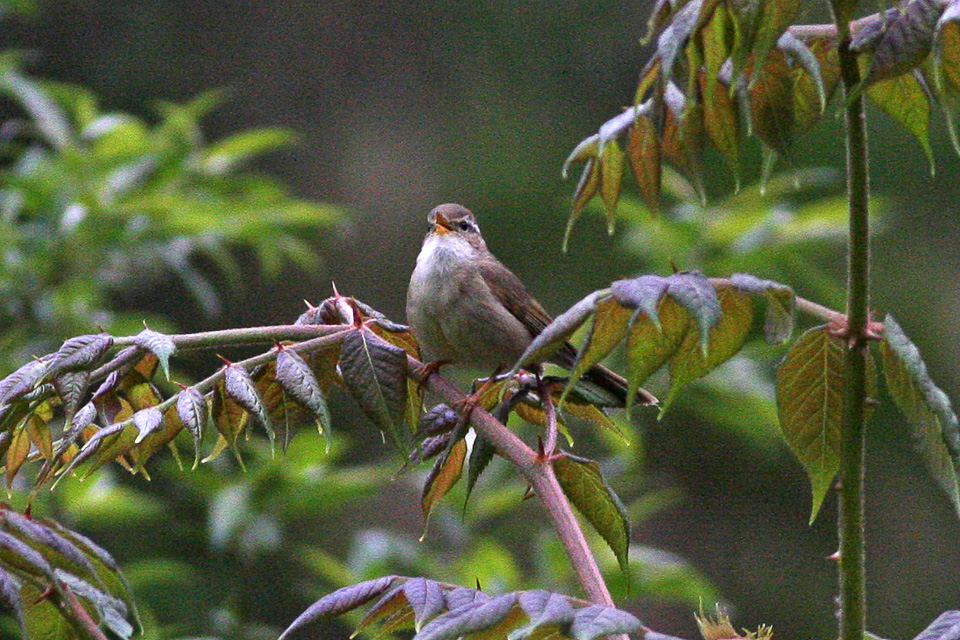
The Kolombangra Leaf Warbler is a small passerine bird, measuring approximately 10 to 11 centimeters in length. Its plumage is predominantly olive-green, which provides excellent camouflage among the forest foliage. The bird's underparts are paler, often displaying a subtle yellowish hue that is more pronounced in sunlight. Adults possess a distinct white or pale-yellow supercilium, which contrasts with their darker crown. Juveniles resemble adults but may exhibit slightly duller plumage. Both males and females appear similar, making them challenging to distinguish in the field based solely on plumage. However, during the breeding season, males may be more vocal and assertive in territorial displays. The Kolombangra Leaf Warbler might be confused with other Phylloscopus species, but its unique combination of size, olive-green coloration, and specific vocalizations help in accurate identification. In flight, the warbler's rapid wingbeats and agile maneuvers are characteristic, while its perching posture is typically upright and alert, often with its tail flicking.
Having trouble telling birds apart? Upload a photo to our bird identification tool for an instant species match.
Kolombangra Leaf Warbler Habitat and Range
Preferred Habitat
The Kolombangra Leaf Warbler thrives in subtropical and tropical moist lowland forests and montane forests, where dense canopies provide abundant foraging opportunities. It is most commonly found at elevations ranging from sea level to about 1,500 meters. These forests, rich in biodiversity, offer the leaf warbler a plethora of insects and a secure nesting environment. The bird shows a preference for primary forests but can also inhabit secondary growth areas if sufficient canopy cover is present. Unlike some other bird species, it is rarely found in urban settings, as it avoids open or heavily modified landscapes. Seasonal habitat shifts are minimal due to its non-migratory nature, but during the non-breeding season, it may venture slightly beyond its typical range in search of food.
Geographic Range
The Kolombangra Leaf Warbler's range is restricted to the Solomon Islands, with Kolombangara Island being its primary stronghold. This island, located in the western part of the Solomon archipelago, offers the dense forest environments that the warbler requires. As a non-migratory bird, its breeding and non-breeding ranges overlap significantly, confined largely to the same forested regions throughout the year. The warbler's population density tends to be highest in the less disturbed parts of Kolombangara Island, where primary forest conditions prevail. Other nearby islands may also host smaller populations, but these are less well-documented. Due to its limited range, the Kolombangra Leaf Warbler is susceptible to habitat disturbances that could impact its survival.
Want to know which birds visit your area? Browse our backyard birds by location guides for region-specific species lists.
What Does the Kolombangra Leaf Warbler Eat?
The Kolombangra Leaf Warbler primarily feeds on insects and other small arthropods, making it a crucial player in controlling pest populations within its habitat. Its diet includes various beetles, caterpillars, spiders, and flies, which it gleans from leaves and branches through agile, acrobatic movements. During the breeding season, the bird's dietary requirements increase to support the energy demands of raising young. Consequently, its foraging activity intensifies, and it may cover larger areas or spend more time foraging than at other times of the year. The warbler's feeding schedule is diurnal, with peak activity occurring during the early morning and late afternoon when insect activity is high. Although insects are its primary food source, the warbler may occasionally supplement its diet with small quantities of fruit or seeds, particularly during periods when insect availability is low.
Kolombangra Leaf Warbler Behavior and Social Structure
The Kolombangra Leaf Warbler exhibits a range of behaviors characteristic of forest-dwelling passerines. It is generally solitary or found in pairs, especially during the breeding season when males establish territories through song and displays. The warbler's territorial behavior is pronounced, with males aggressively defending their space against intruders. Courtship displays include a combination of vocalizations and visual displays, such as wing fluttering and tail fanning, to attract females. Outside the breeding season, the bird may join mixed-species foraging flocks, which enhances its foraging efficiency and provides protection against predators. The warbler is primarily active during daylight hours, with peak activity in the early morning and late afternoon. When faced with predators, it employs evasive flight maneuvers and seeks cover in dense foliage. Its alarm calls serve to alert other birds of potential threats, reinforcing the communal aspect of its behavior.
Kolombangra Leaf Warbler Nesting and Reproduction
The Kolombangra Leaf Warbler constructs its nest in dense foliage, often choosing a sheltered location in the understory or mid-canopy. The nest is typically a compact cup made of fine grasses, moss, and other plant materials, intricately woven to provide stability and concealment. Clutch size varies from two to four eggs, with incubation primarily undertaken by the female. The incubation period lasts about 12 to 14 days, after which the chicks hatch and are tended by both parents. The fledging timeline spans approximately 14 to 16 days post-hatching, during which time the chicks grow rapidly, nourished by a steady supply of insects brought by the parents. The warbler usually produces one or two broods per year, depending on environmental conditions and food availability. Both parents share in feeding the chicks and defending the nest from potential threats.
Kolombangra Leaf Warbler Sounds and Vocalizations
The Kolombangra Leaf Warbler's song is a series of high-pitched, melodious notes that vary in rhythm and pitch, typically delivered in rapid succession. This song, often heard during the breeding season, serves as both a territorial marker and a courtship display. The bird's call notes are less elaborate, consisting of short, sharp chips used for communication among individuals. Alarm calls are more urgent and staccato, designed to alert others to the presence of predators. During the dawn chorus, the warbler's song stands out with its clarity and persistence, contributing to the rich tapestry of sounds that characterize its forest habitat.
Interesting Facts About the Kolombangra Leaf Warbler
- 1The Kolombangra Leaf Warbler was first described scientifically in 1934, highlighting its relatively recent addition to ornithological records.
- 2Despite its limited range, the Kolombangra Leaf Warbler is an important bioindicator, reflecting the health of its forest ecosystem.
- 3This species is part of the large Phylloscopidae family, which contains over 60 species worldwide, many of which are similarly small and green.
- 4The Kolombangra Leaf Warbler exhibits a high degree of site fidelity, often returning to the same territory year after year.
- 5During the breeding season, the warbler's singing rate can increase significantly, with individuals singing hundreds of times per day.
- 6The warbler's foraging technique, known as leaf-gleaning, involves meticulously inspecting leaves and twigs for hidden insects.
- 7Kolombangara Island, home to the Kolombangra Leaf Warbler, is notable for its volcanic origin and rich biodiversity.
Kolombangra Leaf Warbler Conservation Status
Currently, the Kolombangra Leaf Warbler is classified as Least Concern by the IUCN, but its population trend is not well-documented. The primary threats to this species include habitat loss and degradation due to logging and land conversion for agriculture. Conservation efforts on Kolombangara Island focus on preserving forest habitats and promoting sustainable land-use practices. Historical population changes are difficult to assess due to the bird's limited range and the challenges of conducting comprehensive surveys in its dense forest environment.