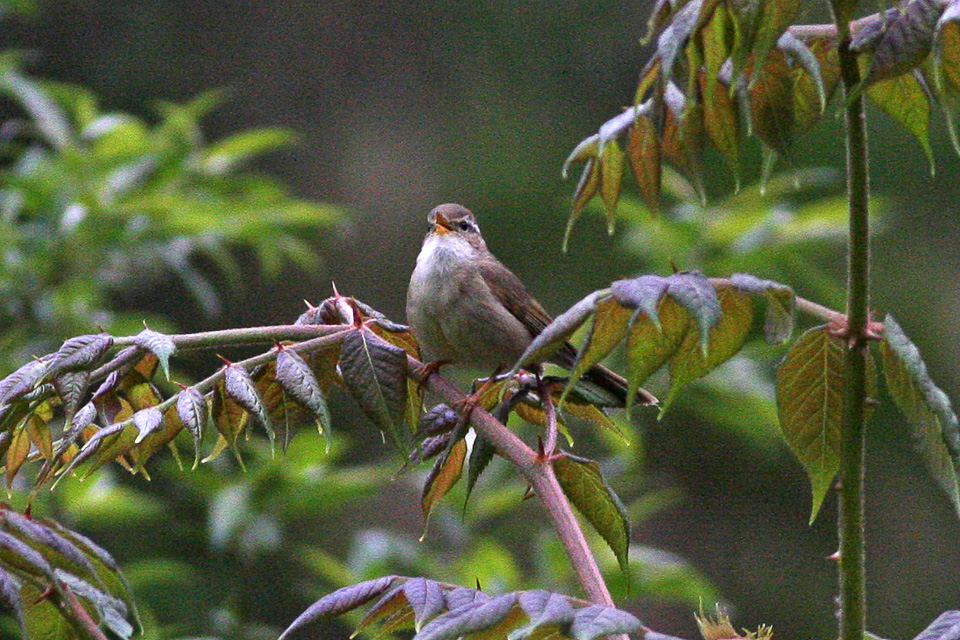
Western Bonelli's Warbler
Phylloscopus bonelli
Order: Passeriformes / Family: Phylloscopidae

Wikimedia Commons
About the Western Bonelli's Warbler
The Western Bonelli's Warbler (Phylloscopus bonelli) is an elegant, small songbird belonging to the family Phylloscopidae. This warbler is found predominantly in southern Europe and parts of North Africa, thriving in a variety of woodland habitats from the Iberian Peninsula to the eastern Mediterranean region. Its preference for open deciduous and mixed woodlands, especially those with a healthy undergrowth of shrubs and herbs, makes it a common resident in these areas. During the breeding season, the Western Bonelli's Warbler is often encountered in oak and pine forests where it builds its nests and raises its young.
Ecologically, the Western Bonelli's Warbler plays an essential role in controlling insect populations, as its diet consists largely of small invertebrates. This makes it an important component of its native ecosystems, affecting the population dynamics of the insects it preys upon. The warbler's presence in an area can indicate a healthy, balanced ecosystem, as it requires a rich supply of insects for feeding. During migration, this warbler traverses diverse landscapes, acting as both predator and prey, and thus influences food webs across a wide geographic range.
Seasonal behaviors of the Western Bonelli's Warbler include long migrations from its breeding grounds in Europe to wintering areas in sub-Saharan Africa. This journey, which occurs twice a year, highlights the warbler's adaptability and resilience. During migration, the warbler can be found in a variety of transient habitats, from coastal scrublands to urban parks, where it rests and refuels. Its migration is a spectacle of endurance and persistence, demonstrating its significant ecological role as a long-distance migrant.
The Western Bonelli's Warbler belongs to the family Phylloscopidae, within the order Passeriformes. These birds typically live typically 3-5 years, with a maximum recorded of 9 years..
How to Identify a Western Bonelli's Warbler
The Western Bonelli's Warbler is a small bird, approximately 11-12 cm in length, with a wingspan of about 18-20 cm. Adult plumage is characterized by olive-green upperparts and whitish underparts, with a faint yellow wash on the flanks. The wings have a distinct greenish hue, and the bird's tail is slightly forked, a useful feature for identification in flight. Its face is plain, with a subtle supercilium above the eye and a thin eye-ring that gives it a gentle expression.
Juveniles resemble adults but are generally duller, particularly on the upperparts. Males and females appear similar, which can make sexing in the field challenging. The Western Bonelli's Warbler can be confused with the Eastern Bonelli's Warbler, though the latter has a more eastern range and slightly paler underparts. In flight, the Western Bonelli's Warbler shows a nimble and undulating pattern, typical of many small passerines, while its perching posture is upright, often with a slightly cocked tail.
When observing this warbler, note its subtle, almost understated coloration. Its lack of bold markings can make it a challenge to spot among the foliage. However, its distinctive calls and songs often give away its presence, providing birders with the auditory clues needed to locate it.
Having trouble telling birds apart? Upload a photo to our bird identification tool for an instant species match.
Western Bonelli's Warbler Habitat and Range
Preferred Habitat
The Western Bonelli's Warbler inhabits a variety of woodland environments, preferring open deciduous and mixed forests. It is often found in oak and pine woods, where the undergrowth provides ample foraging opportunities. This species is adaptable and can also be found in shrublands and forest edges. Typically, it breeds at elevations ranging from sea level to about 2,000 meters in mountainous areas.
During migration, the warbler may frequent more diverse habitats, including scrublands, gardens, and urban parks, highlighting its adaptability to different environments. In winter, it occupies savannahs and open woodlands in sub-Saharan Africa, demonstrating its versatility in habitat selection. Despite its adaptability, the Western Bonelli's Warbler remains more commonly associated with rural and forested landscapes than urban settings.
Geographic Range
The Western Bonelli's Warbler breeds across parts of southern and western Europe, extending from the Iberian Peninsula through France and into Italy and the Balkans. Its range includes Mediterranean regions, and it is particularly abundant in Spain and Portugal. During the non-breeding season, this warbler migrates to sub-Saharan Africa, where it spends the winter months.
Migration routes for the Western Bonelli's Warbler generally pass over the western Mediterranean, crossing areas such as the Strait of Gibraltar. It winters in countries like Senegal, Gambia, and Mali, where it takes advantage of the warmer climate and abundant food resources. Population density hotspots tend to be in regions where suitable breeding habitats are extensive, such as southern France and northern Spain.
Want to know which birds visit your area? Browse our backyard birds by location guides for region-specific species lists.
What Does the Western Bonelli's Warbler Eat?
The Western Bonelli's Warbler primarily feeds on small invertebrates, including insects and spiders, making it an insectivorous bird. Its diet consists mainly of caterpillars, beetles, and flies, which it gleans from leaves and branches with agility. During the breeding season, the abundance of insects in forested habitats provides ample sustenance for the warbler and its chicks.
As autumn approaches and insect availability decreases, the warbler's diet may become more varied, incorporating small quantities of berries and seeds. The Western Bonelli's Warbler employs a range of foraging techniques, including hovering to pick insects from foliage or using rapid, darting movements to catch prey mid-air. Feeding occurs throughout the day, with peak activity during the cooler hours of morning and late afternoon.
Western Bonelli's Warbler Behavior and Social Structure
Social behavior in the Western Bonelli's Warbler is primarily solitary or occurs in pairs during the breeding season. Territorial behavior is prominent among males, who establish and defend territories through song and display. Courtship displays include fluttering flights and vocalizations designed to attract females and assert dominance over potential rivals.
The warbler's response to predators involves a variety of tactics, including staying motionless or seeking dense foliage for cover. Its small size and agile flight help it evade many threats. Daily activity patterns revolve around foraging and territory maintenance, with periods of rest during the heat of the day. Outside of the breeding season, the Western Bonelli's Warbler may join mixed-species foraging flocks, enhancing its feeding efficiency and protection from predators.
Western Bonelli's Warbler Nesting and Reproduction
Western Bonelli's Warblers construct cup-shaped nests, expertly crafted from grass, leaves, and fine twigs. These nests are typically located on or near the ground, well-hidden among dense shrubs or low branches, providing protection from predators and the elements. The clutch size ranges from 4 to 6 eggs, which are generally white with reddish-brown spots.
The incubation period lasts about 12-14 days, with both parents sharing incubation duties. After hatching, the chicks are altricial, requiring constant care and feeding from both parents. Fledging occurs approximately 12-14 days after hatching, and the young birds remain dependent on their parents for a short period thereafter. The Western Bonelli's Warbler usually raises one brood per year, although in optimal conditions, a second brood may occur.
Western Bonelli's Warbler Sounds and Vocalizations
The primary song of the Western Bonelli's Warbler is a distinctive, melodious series of high-pitched notes, often described as a rapid, tinkling trill. The song, delivered from a prominent perch, serves both to attract mates and assert territorial boundaries. Call notes are simple and consist of short, sharp 'chip' sounds, used for communication between individuals.
Alarm calls, issued in response to potential threats, are harsher and more urgent, serving to alert conspecifics. During the breeding season, the warbler's song is most prominent during the dawn chorus, contributing to the symphony of bird sounds marking the start of the day.
Interesting Facts About the Western Bonelli's Warbler
- 1The Western Bonelli's Warbler migrates over 5,000 kilometers twice a year, showcasing remarkable endurance.
- 2Despite its subtle coloration, the Western Bonelli's Warbler has a surprisingly loud and melodious song.
- 3The warbler's nest is often so well camouflaged that finding one in the wild can be incredibly challenging.
- 4Western Bonelli's Warblers can consume hundreds of insects daily, playing a key role in pest control.
- 5Unlike many birds, Western Bonelli's Warblers show little sexual dimorphism, making males and females hard to distinguish.
- 6This warbler's migration routes include crossing the challenging Sahara Desert, a testament to its resilience.
- 7During migration, the Western Bonelli's Warbler may travel with mixed-species flocks, enhancing its survival.
Western Bonelli's Warbler Conservation Status
The Western Bonelli's Warbler holds a conservation status of 'Least Concern' according to the IUCN Red List. Its population is currently stable, with no significant declines observed across its extensive range. However, habitat loss due to deforestation and land development poses a potential threat, particularly in its breeding territories. Conservation efforts focus on habitat preservation, ensuring that the woodlands and forests it relies on remain intact. Monitoring population trends and migration patterns helps in understanding potential impacts of environmental changes. Historically, the warbler has adapted well to changes within its habitat, but continued vigilance is essential to maintain its stable population status.