Kretschmer's Longbill
Macrosphenus kretschmeri
Order: Passeriformes / Family: Macrosphenidae

Wikimedia Commons
About the Kretschmer's Longbill
Kretschmer's Longbill (Macrosphenus kretschmeri) is a remarkable bird species found primarily in the dense, humid forests of Central and West Africa, including countries such as Cameroon, Gabon, and the Democratic Republic of Congo. As a member of the Macrosphenidae family, this small songbird plays a vital role in the ecosystem, primarily through its insectivorous diet, which helps control insect populations. Its presence is an indicator of healthy forest environments. This bird exhibits a strong preference for mid to lower canopy levels, where it deftly navigates through thick foliage in search of food. Seasonal behaviors of Kretschmer's Longbill include localized movements in response to food availability, though it generally remains within its established territories year-round. The species is also an important prey item for several higher trophic level predators, thus contributing to the ecological balance. Its elusive nature and preference for dense habitats make the Kretschmer's Longbill a species that often goes unnoticed despite its ecological significance.
The Kretschmer's Longbill belongs to the family Macrosphenidae, within the order Passeriformes. These birds typically live average 5 years, with a maximum recorded of 8 years..
How to Identify a Kretschmer's Longbill
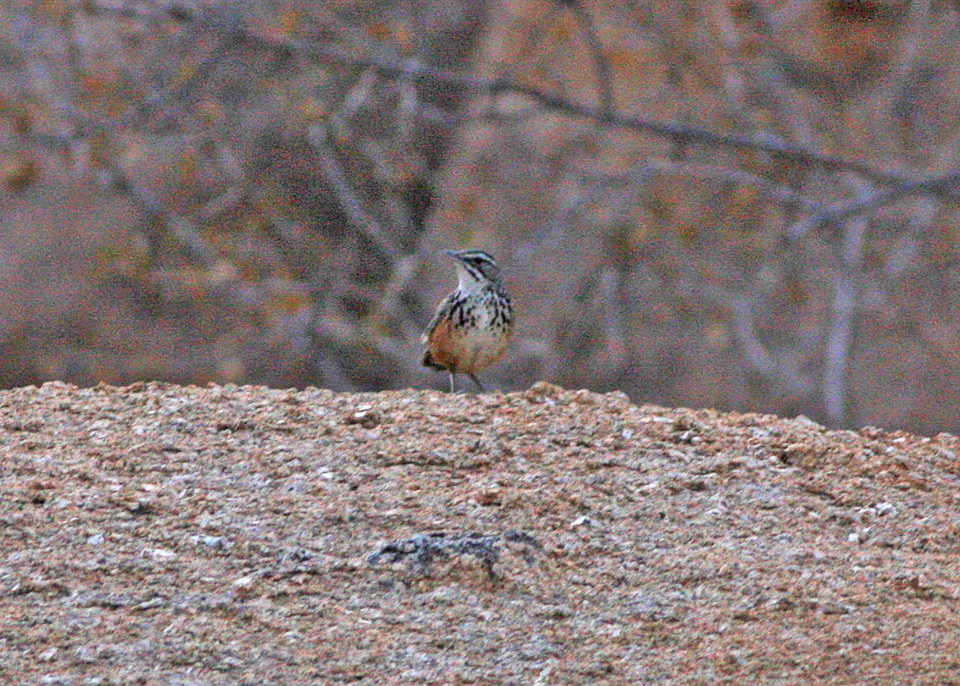
The Kretschmer's Longbill is characterized by its long, slender bill which is well-suited for probing into bark and leaves for insects. Adult plumage is predominantly olive-brown on the upperparts, transitioning to a lighter, buffy coloration on the underparts. There is little sexual dimorphism, with males and females appearing similar. Juveniles may have slightly duller plumage but are otherwise similar to adults. When observing this bird in the field, its distinctive bill and its rapid, flitting movements through the canopy are key identification markers. The Kretschmer's Longbill can be confused with similar species such as the Yellow Longbill, but its longer bill and distinct vocalizations help differentiate it. In flight, the bird presents a compact silhouette with rapid wingbeats, while its perching posture is typically horizontal, often with the tail cocked slightly.
Having trouble telling birds apart? Upload a photo to our bird identification tool for an instant species match.
Kretschmer's Longbill Habitat and Range
Preferred Habitat
Kretschmer's Longbill inhabits dense, humid tropical forests, favoring mid-elevation areas up to 1500 meters. It primarily occupies the middle to lower canopy layers, where dense foliage provides both food resources and protection from predators. This species can occasionally be found in secondary growth forests and forest edges, indicating some level of adaptability to habitat changes. However, it shows a marked preference for mature, undisturbed forests. Seasonal habitat shifts are minimal, as Kretschmer's Longbill resides in its chosen habitat year-round. It is rarely found in urban or suburban areas, as it avoids open spaces and heavily disturbed environments, relying instead on the cover provided by dense forest canopies.
Geographic Range
The distribution of Kretschmer's Longbill is largely confined to the tropical regions of Central and West Africa. It is commonly found in countries such as Cameroon, Gabon, the Republic of Congo, and the Democratic Republic of Congo. The bird's range is restricted to areas with appropriate forest cover, which limits its presence to regions with lush, undisturbed tropical forests. Within its range, the population density tends to be higher in national parks and protected areas where habitat preservation efforts support its ecological needs. Migration is not a characteristic behavior for this species, as it is largely sedentary, maintaining its territories throughout the year.
Want to know which birds visit your area? Browse our backyard birds by location guides for region-specific species lists.
What Does the Kretschmer's Longbill Eat?
Kretschmer's Longbill primarily feeds on a variety of insects and their larvae, which it skillfully extracts from bark crevices and leaf surfaces using its long, thin bill. Common prey items include beetles, caterpillars, and various arthropods. During certain times of the year, the bird may supplement its diet with small fruits and berries, especially when insect abundance is low. Foraging occurs mainly during the early morning and late afternoon, when insect activity is highest. The bird employs a meticulous gleaning technique, often hanging upside down to reach prey hidden in foliage. Its diet and foraging habits play a crucial role in controlling insect populations within its habitat.
Kretschmer's Longbill Behavior and Social Structure
Kretschmer's Longbill exhibits solitary behavior outside of the breeding season, with individuals maintaining and defending small territories. Territorial disputes are resolved through vocal displays and physical posturing rather than outright aggression. During the breeding season, pairs form monogamous bonds and engage in mutual preening and synchronized foraging as part of their courtship rituals. The species is generally quiet and inconspicuous, relying on its cryptic plumage to avoid detection by predators. When threatened, Kretschmer's Longbill may freeze motionless or quickly dart into dense foliage. Although primarily active during daylight hours, the bird's activity peaks during the cooler parts of the day, aligning with the periods of greatest insect availability.
Kretschmer's Longbill Nesting and Reproduction
The nesting habits of Kretschmer's Longbill involve the construction of cup-shaped nests composed of twigs, leaves, and other plant materials. These nests are typically situated within dense foliage, often at mid-canopy level, providing concealment from predators. The female lays a clutch of 2 to 3 eggs, which she incubates for approximately two weeks. Both parents participate in feeding the chicks, which fledge after about 12 to 14 days. The species usually raises one brood per year, although favorable conditions may lead to a second brood. Parental care continues until the fledglings are independent, ensuring high survival rates for the young.
Kretschmer's Longbill Sounds and Vocalizations
Kretschmer's Longbill is known for its melodious song, consisting of a series of clear, flute-like notes delivered in rapid succession. The song has a musical quality, often rising and falling in pitch. In addition to its primary song, the bird produces a variety of call notes, including short, sharp chirps used for communication between mates or as an alert to potential threats. Alarm calls are more urgent and repetitive, serving to deter predators. During the dawn chorus, Kretschmer's Longbill contributes with a vibrant rendition of its song, establishing territory and attracting mates.
Interesting Facts About the Kretschmer's Longbill
- 1Kretschmer's Longbill can consume up to 60% of its body weight in insects daily, aiding pest control in forests.
- 2Despite being a small bird, Kretschmer's Longbill can cover extensive territories in search of food, showcasing its adaptability.
- 3The long bill of Kretschmer's Longbill is perfectly adapted for extracting insects from narrow crevices in tree bark.
- 4Kretschmer's Longbill is a year-round resident of its forest habitat, with no recorded long-distance migrations.
- 5This bird's melodious song is a key tool for territory defense, often heard during the early morning hours.
- 6Kretschmer's Longbill's preference for dense undergrowth makes it a challenging species to observe in the wild.
- 7The species' reliance on specific forest habitats underscores the importance of conservation efforts in its range.
Kretschmer's Longbill Conservation Status
Currently, the Kretschmer's Longbill is classified as Least Concern by the IUCN due to its relatively stable population numbers and wide distribution across suitable habitats. However, ongoing threats such as deforestation and habitat fragmentation pose significant challenges. Conservation efforts focus on preserving forest habitats through protected areas and sustainable land management practices. Historically, the species has shown resilience to moderate habitat changes, but continued deforestation could lead to population declines. Monitoring and habitat restoration are essential to ensure the long-term survival of this species.