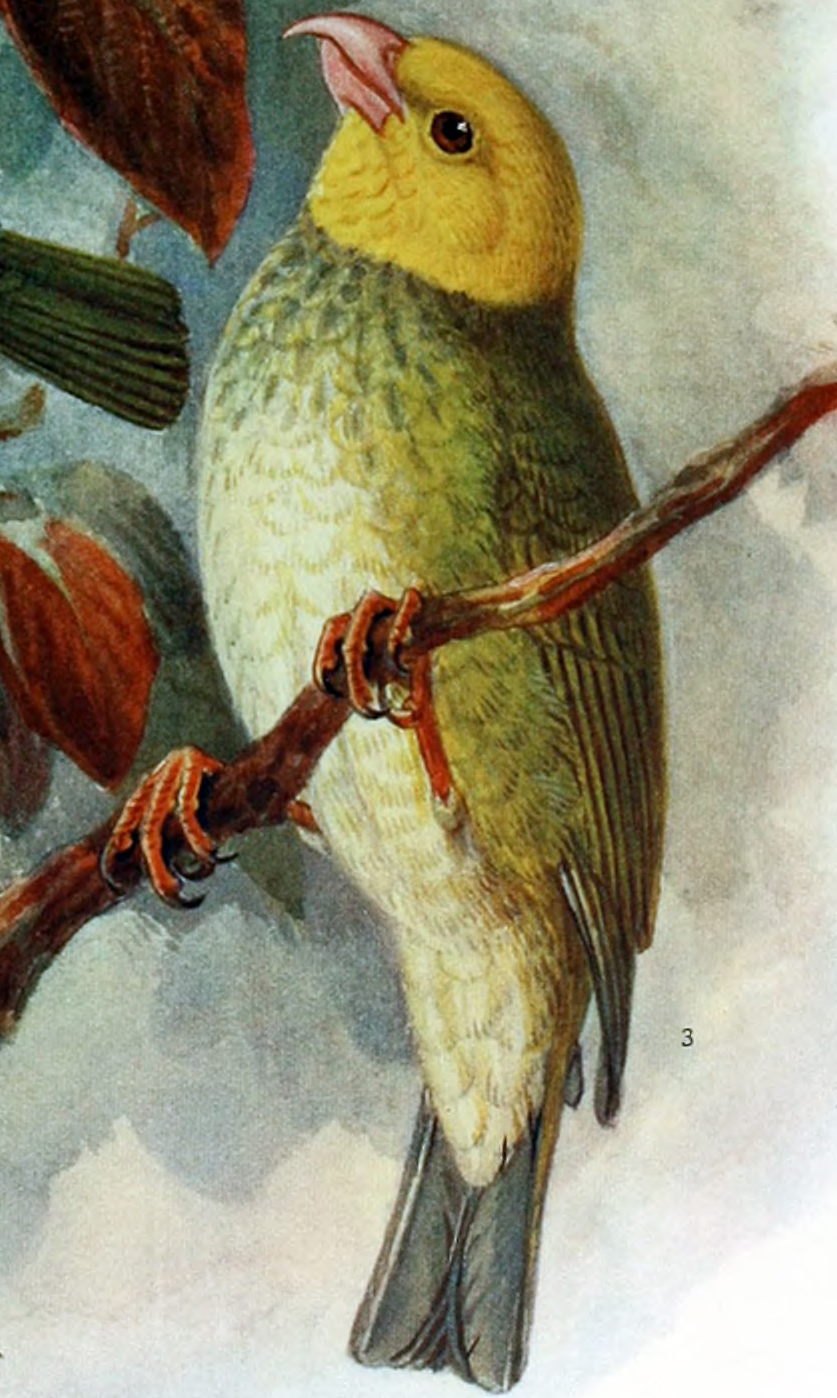
Lesser Koa-Finch
Rhodacanthis flaviceps
Order: Passeriformes / Family: Fringillidae

Wikimedia Commons
About the Lesser Koa-Finch
The Lesser Koa-Finch, scientifically known as Rhodacanthis flaviceps, is a distinct bird endemic to the Hawaiian Islands. Historically, this finch inhabited the upland forests of the Big Island, particularly areas abundant in koa trees, which play a crucial role in its life cycle. The bird is a member of the family Fringillidae, which includes other finches known for their seed-eating habits. Unfortunately, the Lesser Koa-Finch is currently classified as extinct, with its last confirmed sighting dating back to the late 19th century. The extinction was primarily driven by habitat destruction and the introduction of non-native species. Despite its disappearance, the Lesser Koa-Finch remains significant in the study of Hawaiian avifauna as it highlights the vulnerability of island ecosystems to human impact. The presence of these birds once contributed to the intricate balance of the Hawaiian forests, playing a role in seed dispersal and the maintenance of certain plant populations. Seasonal behaviors of the Lesser Koa-Finch were likely tied to the flowering and fruiting patterns of native plants. As a specialist feeder, its diet predominantly consisted of seeds, particularly those from the koa tree, making it highly dependent on the health and availability of these trees. The bird's foraging strategy involved cracking open seeds with its powerful bill, a trait shared with other finches but particularly refined in this species. The historical ecology of the Lesser Koa-Finch offers insights into the adaptive radiation of Hawaiian honeycreepers and the niche specialization that characterizes this group. The loss of the Lesser Koa-Finch serves as a poignant reminder of the fragility of island ecosystems and the cascading effects that can result from the loss of a single species.
The Lesser Koa-Finch belongs to the family Fringillidae, within the order Passeriformes. These birds typically live unknown due to extinction, but estimated 5-7 years in the wild..
How to Identify a Lesser Koa-Finch
The Lesser Koa-Finch was a medium-sized songbird recognized primarily by its vibrant yellow head, a feature that distinguished it from other Hawaiian finches. The rest of its plumage was primarily olive-green, providing excellent camouflage within the leafy canopies of its forest habitat. Males and females were similar in coloration, though males typically exhibited a slightly more intense yellow hue. Juveniles, on the other hand, might have displayed a more subdued coloration, with less pronounced yellow on the head. The finch's stout, conical bill was another key identification feature, perfectly adapted for cracking tough seeds. This bill shape is characteristic of the Fringillidae family but was particularly robust in the Lesser Koa-Finch, reflecting its specialized diet. In flight, the bird might have been identified by its relatively short, rounded wings and a somewhat undulating flight pattern, typical of many finch species. When perched, the Lesser Koa-Finch had an upright posture, often seen in pairs or small groups, making it easier to spot during its active foraging periods. Although no longer present, understanding these identification traits helps ornithologists distinguish between historical accounts and sightings of similar species that once coexisted in Hawaii.
Having trouble telling birds apart? Upload a photo to our bird identification tool for an instant species match.
Lesser Koa-Finch Habitat and Range
Preferred Habitat
The Lesser Koa-Finch primarily inhabited the high-altitude, dense koa forests of Hawaii's Big Island. These forests, situated at elevations typically ranging from 1,000 to 2,500 meters, provided the necessary resources and climatic conditions conducive to the bird's lifestyle. The finch's presence was closely linked to areas where koa trees (Acacia koa) were abundant, as these trees were a critical component of its diet and habitat. Seasonal shifts in habitat were minimal due to the relatively stable climate of the Hawaiian highlands, allowing the Lesser Koa-Finch to remain a year-round resident of these forests. Unlike many other finches, which might adapt to more urban or varied landscapes, the Lesser Koa-Finch was highly specialized, showing little inclination to venture into lower-altitude or more urbanized areas. This specialization, while advantageous within its natural habitat, ultimately contributed to its vulnerability as human activities began to encroach upon these areas.
Geographic Range
The Lesser Koa-Finch was once found exclusively on the Big Island of Hawaii, occupying a relatively narrow range within the island's upland forest regions. Its distribution was closely associated with native koa forests, which provided the primary food source and habitat. Unlike many bird species that exhibit extensive migratory behavior, the Lesser Koa-Finch was a sedentary species, with no known migration routes beyond its localized range. Its breeding and foraging activities were confined to specific areas where koa trees were abundant, particularly in the montane regions. Population density was highest in undisturbed forest areas where human impact was minimal, though such areas diminished rapidly with the advent of agricultural and urban development. The bird's limited range, combined with its specialized habitat requirements, ultimately played a role in its extinction, as even small-scale disturbances could have significant impacts on its population.
Want to know which birds visit your area? Browse our backyard birds by location guides for region-specific species lists.
What Does the Lesser Koa-Finch Eat?
The diet of the Lesser Koa-Finch primarily consisted of seeds from the koa tree, a critical resource that shaped much of its foraging behavior. These seeds provided essential nutrients and were available year-round, though seasonal variations in seed abundance likely influenced foraging patterns. In addition to koa seeds, the finch may have consumed other native plant seeds and possibly small insects, particularly during breeding seasons when protein requirements increased. The bird's strong, conical bill was well-suited for cracking open the hard outer shells of seeds, a technique that required precision and strength. Foraging typically occurred in the canopy layers of the forest, where the bird could avoid ground-dwelling predators and focus on the abundant seed supply. The Lesser Koa-Finch's specialized diet underscored its reliance on the health of koa forests, with any decline in these environments having direct repercussions on its survival.
Lesser Koa-Finch Behavior and Social Structure
The Lesser Koa-Finch displayed social behavior typical of many finch species, often observed in small groups or pairs, particularly during foraging. Territorial behavior was likely prominent, especially during the breeding season, when pairs would defend their chosen nesting sites from intruders. Courtship displays may have included vocalizations and visual cues, as is common among finches, though specific behaviors remain undocumented due to the bird's extinction. Flocking patterns outside the breeding season were more relaxed, with individuals sometimes joining mixed-species flocks, a strategy that could enhance foraging success and predator awareness. The Lesser Koa-Finch would have been primarily diurnal, with peak activity during the early morning and late afternoon, aligning with cooler temperatures and optimal foraging conditions. Its response to predators likely involved evasive flight and alarm calls, though the specific nature of these interactions remains speculative. The finch's daily activities revolved around foraging, preening, and social interactions, with rest periods during the hotter midday hours.
Lesser Koa-Finch Nesting and Reproduction
The Lesser Koa-Finch constructed its nests within the dense foliage of koa trees, utilizing materials such as twigs, grasses, and lichens to create a sturdy structure. Nests were typically positioned high in the canopy, providing protection from ground-based predators and environmental elements. The typical clutch size for the Lesser Koa-Finch ranged from two to four eggs, with both parents likely involved in incubation and feeding of the young, though specific parental roles are not well-documented. The incubation period was approximately two weeks, with fledging occurring roughly three weeks post-hatching. The finch's nesting cycle was closely aligned with periods of resource abundance, ensuring sufficient food supply during the critical stages of chick development. Given its specialized habitat requirements and the stable climate of its environment, the Lesser Koa-Finch might have attempted multiple broods per year, though this remains speculative.
Lesser Koa-Finch Sounds and Vocalizations
The vocalizations of the Lesser Koa-Finch, while not extensively documented, were likely melodic and complex, characteristic of many Hawaiian honeycreepers. The primary song would have consisted of a series of high-pitched notes delivered in a rhythmic pattern, possibly used for mate attraction and territorial defense. Call notes, distinct from the song, were likely simple and repetitive, serving as contact calls between individuals or as alarms in the presence of predators. The dawn chorus, a common feature among many bird species, might have been a prominent aspect of the Lesser Koa-Finch's daily routine, signaling the start of foraging activities. These vocalizations, although no longer heard in the wild, would have played a critical role in the bird's social and reproductive behaviors.
Interesting Facts About the Lesser Koa-Finch
- 1The Lesser Koa-Finch was one of the many bird species that evolved on the Hawaiian Islands, showcasing the unique adaptive radiation of the region.
- 2Its extinction was confirmed in the late 19th century, making it one of the early victims of human-induced habitat changes in Hawaii.
- 3The bird's diet was highly specialized, relying primarily on the seeds of the koa tree, illustrating its ecological niche.
- 4Despite its extinction, the Lesser Koa-Finch serves as a symbol of the fragile balance of island ecosystems.
- 5The introduction of non-native species, such as rats and pigs, played a significant role in altering the habitat of the Lesser Koa-Finch.
- 6The loss of the Lesser Koa-Finch is part of a broader pattern of avian extinctions in Hawaii, one of the most affected regions globally.
- 7This species was once part of a diverse group of Hawaiian honeycreepers, each filling unique ecological roles.
Lesser Koa-Finch Conservation Status
The Lesser Koa-Finch, once a vibrant part of Hawaii's avian landscape, is now classified as extinct by the IUCN. The primary drivers of its extinction were habitat destruction due to deforestation and the introduction of non-native species, which altered the ecological balance of its environment. Conservation efforts in Hawaii today focus on protecting remaining habitats and preventing further loss of other native species. Historical population declines of the Lesser Koa-Finch highlight the urgency of these efforts. While direct conservation actions for this species are no longer possible, its story underscores the importance of proactive measures to safeguard existing biodiversity on island ecosystems.
Other Fringillidae Species


Birds Similar to the Lesser Koa-Finch
These species are often confused with the Lesser Koa-Finch due to similar appearance or overlapping range.