
Lesser Shortwing
Brachypteryx leucophris
Order: Passeriformes / Family: Muscicapidae

Wikimedia Commons
About the Lesser Shortwing
The Lesser Shortwing, Brachypteryx leucophris, is a small passerine bird belonging to the family Muscicapidae, distinguished by its melodious song that often reveals its presence in the dense forest undergrowth it prefers. This bird is mostly found in the subtropical and tropical montane forests across parts of Asia, including the Himalayas, Southeast Asia, and the Malay Peninsula. It plays a crucial role in the ecosystem as an insectivore, helping to control insect populations and contributing to the health of its forest environment.
In terms of ecological significance, the Lesser Shortwing is an important bioindicator species, reflecting the health of its montane forest habitats. Its preference for dense, undisturbed undergrowth means that its presence or absence can indicate changes in forest quality, such as those caused by deforestation or habitat fragmentation. The bird’s secretive nature and preference for thick cover make it a challenge to study, yet these traits also highlight the importance of preserving its natural habitat.
The Lesser Shortwing is typically seen alone or in pairs, foraging close to the ground where it finds its insect prey. Its distribution across a variety of forest types within its range allows it to exploit different ecological niches. Despite being a small bird, it has a large range and can be found at elevations ranging from 600 to 3,000 meters, with some populations migrating to lower elevations during the non-breeding season. Seasonal behaviors include altitudinal migrations in response to temperature changes, ensuring that the Lesser Shortwing remains within its preferred temperature and humidity range year-round.
The Lesser Shortwing belongs to the family Muscicapidae, within the order Passeriformes. These birds typically live average 4-5 years, with a maximum recorded of 7 years..
How to Identify a Lesser Shortwing
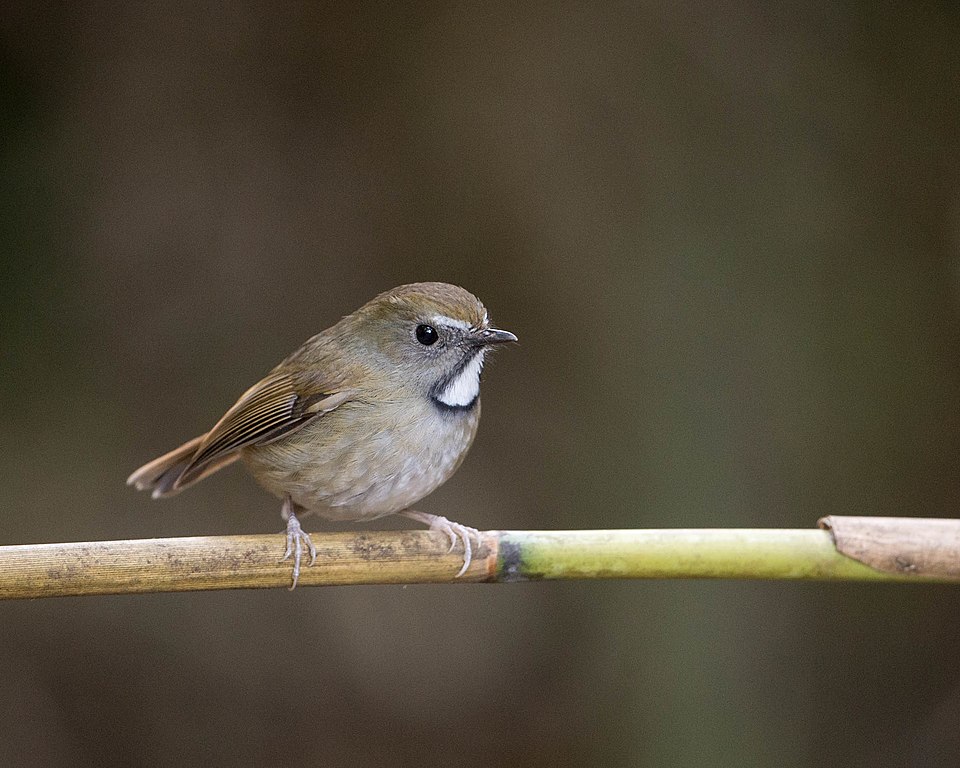
The Lesser Shortwing is a small bird, measuring around 12 to 14 cm in length. Its plumage is primarily a rich brown with a slightly paler underbelly, making it well-camouflaged within its forest habitat. The adult males typically exhibit a darker, more uniform brown compared to females, who have a slightly lighter tone and may present a subtle, mottled pattern on the breast. Juveniles resemble adults but can be distinguished by their more pronounced mottling and duller coloration. The bird's short wings are a notable feature, contributing to its name, and they give it a distinctive silhouette when perched.
When observing the Lesser Shortwing in the field, note its short tail and rounded wings, which are adaptations for its terrestrial lifestyle. Its legs are relatively long, aiding in its ground-foraging habits. Unlike other forest species, it does not typically exhibit bright colors, which can lead to confusion with other small brown birds, though its melodious song is a key differentiator.
In flight, the Lesser Shortwing tends to be rather inconspicuous, often staying low to the ground and moving in short, quick bursts. Its perching posture is typically upright, and it often flicks its tail, a behavior that can help in identification despite its cryptic coloration.
Having trouble telling birds apart? Upload a photo to our bird identification tool for an instant species match.
Lesser Shortwing Habitat and Range
Preferred Habitat
The Lesser Shortwing inhabits subtropical and tropical montane forests, thriving in dense undergrowth where it forages for insects. These birds are typically found at elevations between 600 and 3,000 meters, often preferring areas with high humidity and thick vegetation. They are most commonly associated with the forest floors of the Himalayas, as well as regions like Thailand, Malaysia, and Indonesia.
During the breeding season, they may move to higher elevations to find optimal nesting sites and abundant food resources. In non-breeding seasons, some populations descend to slightly lower elevations to escape colder temperatures. Unlike some other forest birds, the Lesser Shortwing is rarely found in urban settings, as it relies heavily on undisturbed, natural habitats. Its presence in rural areas is largely limited to forested regions, and it does not typically venture into open areas or fields.
Geographic Range
The range of the Lesser Shortwing spans across several countries in Asia, primarily within the Himalayan region and Southeast Asia. It is a resident breeder in the forests of Nepal, Bhutan, and northern India, where it occupies various elevation zones. In Southeast Asia, it can be found throughout Thailand, Malaysia, and parts of Indonesia, including Sumatra and Java.
While the Lesser Shortwing is not considered a long-distance migratory species, it does exhibit altitudinal migration, moving to different elevation zones seasonally to take advantage of favorable climatic conditions. During breeding months, it typically remains at higher elevations, retreating to slightly lower altitudes as temperatures drop.
Population density hotspots for this species are often found in protected forest reserves and national parks, where human impact is minimized. However, its presence can be patchy, dependent on the availability of suitable forest habitat.
Want to know which birds visit your area? Browse our backyard birds by location guides for region-specific species lists.
What Does the Lesser Shortwing Eat?
The diet of the Lesser Shortwing primarily consists of insects and other small invertebrates, which it skillfully hunts on the forest floor. This bird forages by hopping and flipping over leaf litter, using its beak to probe for hidden prey. It favors beetles, ants, spiders, and caterpillars, adjusting its diet based on seasonal availability.
During the breeding season, the demand for protein increases, and the Lesser Shortwing may expand its diet to include a wider variety of insects. In some regions, it has been observed consuming small fruits and seeds, although this is generally a secondary food source. The bird's feeding schedule aligns with its diurnal activity pattern, with peak foraging occurring during the cooler morning and late afternoon hours.
Foraging techniques include sallying from low perches to catch flying insects, although this is less common. The bird’s reliance on a diverse insect diet underscores its role in maintaining ecological balance by controlling insect populations.
Lesser Shortwing Behavior and Social Structure
The Lesser Shortwing displays solitary or paired behavior, with individuals often seen quietly foraging near the ground. Territoriality plays a significant role during the breeding season when males sing to establish and defend their territories. The song is a key part of their courtship displays, which involves males singing from concealed perches within dense foliage.
Courtship includes a variety of visual displays, such as wing flicking and tail fanning, to attract females. Once paired, they remain monogamous throughout the breeding season. Outside the breeding period, Lesser Shortwings are less territorial and may tolerate proximity to other individuals, although they do not typically form large flocks.
In terms of daily activity, these birds are most active in the early morning and late afternoon, avoiding the heat of midday. When threatened by predators, such as small mammals or larger birds, the Lesser Shortwing utilizes its cryptic coloration to blend into the undergrowth and avoid detection, often freezing motionless until danger passes.
Lesser Shortwing Nesting and Reproduction
The Lesser Shortwing constructs its nest close to the ground, often in a sheltered location such as a crevice, under a fallen log, or within dense shrubbery. The nest is cup-shaped, crafted from a variety of forest materials including moss, leaves, and twigs, providing camouflage and protection.
Typically, the clutch consists of 2 to 4 eggs, which are incubated by the female. The incubation period lasts about 14 to 16 days. Both parents participate in feeding the chicks, which fledge approximately 12 to 15 days after hatching. The parental roles are well-defined, with both male and female contributing to feeding and protection of the young.
Lesser Shortwings may raise one or two broods per year, depending on environmental conditions and food availability. Their choice of nesting sites reflects a preference for undisturbed habitats, which is critical for the survival of the offspring.
Lesser Shortwing Sounds and Vocalizations
The Lesser Shortwing is renowned for its rich, melodious song, which consists of a series of clear, fluted notes that rise and fall in pitch. The rhythm is steady and can carry through the dense forest, often heard before the bird is seen. These songs play a crucial role in territory establishment and courtship.
In addition to their primary song, Lesser Shortwings produce a variety of call notes, including sharp, metallic 'tik' sounds used for communication between pairs and to signal alarm. During dawn, their songs are particularly prominent, forming part of the forest's dawn chorus, which can be compared to the song of a thrush in terms of its musical quality.
Alarm calls are generally harsher and more abrupt, providing a stark contrast to their otherwise melodious singing. These calls are used to alert mates and signal the presence of predators.
Interesting Facts About the Lesser Shortwing
- 1The Lesser Shortwing has notably short wings, an adaptation to its terrestrial lifestyle that allows for better maneuverability in dense undergrowth.
- 2Despite its secretive nature, the Lesser Shortwing’s song is one of the most beautiful in its range, often compared to the song of a nightingale.
- 3The bird's preference for dense, humid environments makes it a key indicator of forest health, as it is sensitive to habitat degradation.
- 4Lesser Shortwings have a unique way of foraging, using their beaks to flip over leaves and debris on the forest floor to uncover insects.
- 5The species exhibits altitudinal migration, moving to different elevations based on seasonal temperature changes, ensuring suitable habitat year-round.
- 6Their nests are often well-hidden and creatively constructed to blend into the forest floor, providing camouflage from predators.
- 7The Lesser Shortwing's cryptic coloration helps it remain unseen, but its distinctive song gives away its presence to attentive birders.
Lesser Shortwing Conservation Status
The Lesser Shortwing is currently listed as Least Concern by the IUCN, with stable population trends across its range. However, habitat destruction poses a significant threat, particularly deforestation due to logging and agricultural expansion. Conservation efforts focus on habitat preservation, with several populations residing in protected areas and national parks. Historically, these birds have shown resilience in the face of moderate habitat changes, although continued deforestation could lead to declines. Efforts to preserve montane forests and enforce strict protection measures are crucial for the long-term survival of the Lesser Shortwing. Public awareness campaigns and habitat restoration projects also play a role in conservation strategies.
Other Muscicapidae Species


Birds Similar to the Lesser Shortwing
These species are often confused with the Lesser Shortwing due to similar appearance or overlapping range.

