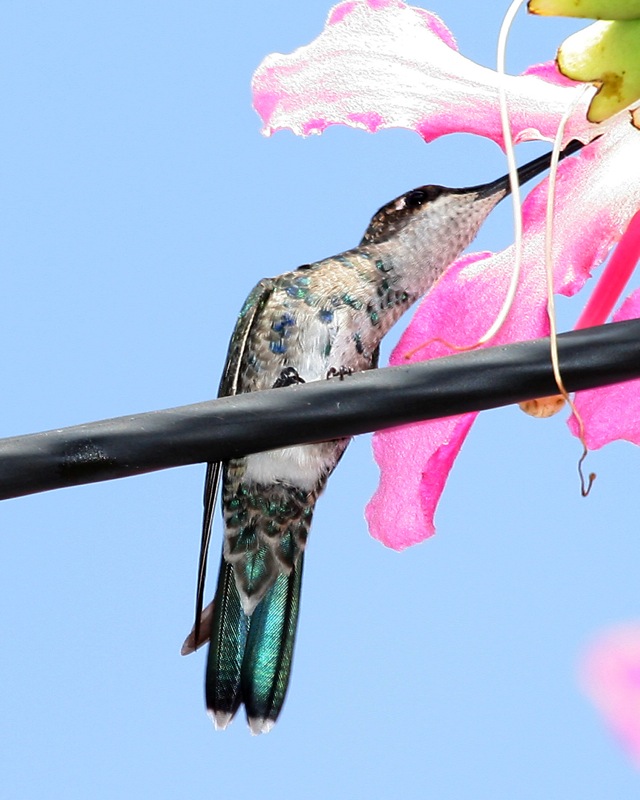
Long-billed Starthroat
Heliomaster longirostris
Order: Apodiformes / Family: Trochilidae

Wikimedia Commons
About the Long-billed Starthroat
The Long-billed Starthroat, scientifically known as Heliomaster longirostris, is a medium-sized hummingbird celebrated for its dazzling plumage and distinctive long bill. This species inhabits a range of environments across Central and South America, notably thriving in tropical and subtropical regions. Its presence extends from the lowland rainforests of the Amazon Basin to the montane forests of the Andes. The Long-billed Starthroat plays a crucial role in pollination, visiting a variety of flowering plants to feed on nectar. This activity facilitates the cross-pollination of many plant species, highlighting its ecological significance. During the breeding season, this hummingbird is particularly active, engaging in frequent feeding bouts and territorial displays. Seasonal variations in behavior are evident; for instance, during the dry season, it may be found at lower elevations where flowering plants are more abundant, while in the wet season, it ascends to higher altitudes following the blooming cycle. The Long-billed Starthroat's adaptability to diverse habitats underscores its resilience, yet it faces challenges such as habitat loss due to deforestation and urban expansion. Nevertheless, it remains a vital component of its ecosystem, particularly in forested areas where its pollination activities support both plant diversity and ecosystem health.
The Long-billed Starthroat belongs to the family Trochilidae, within the order Apodiformes. These birds typically live average 4-6 years, with a maximum recorded of 8 years..
How to Identify a Long-billed Starthroat
The Long-billed Starthroat exhibits a distinctive appearance that aids in its identification. Adult males possess an iridescent purple throat patch, which can appear black in poor lighting, complemented by a metallic green back and crown. Females, while similar, tend to display a less vibrant throat coloration, often leaning more towards greenish hues. Both sexes feature a notably long, straight bill, perfectly adapted for accessing deep flowers. Juveniles resemble females but lack the full development of the iridescent throat. The bird's underparts are predominantly grayish-white, providing a stark contrast to its more colorful upperparts. In flight, the Long-billed Starthroat exhibits rapid wingbeats typical of hummingbirds, with a silhouette characterized by a slightly forked tail and streamlined body. Perching birds often present an upright posture, with their elongated bills pointing slightly downward. Though similar species like the Sparkling Violetear may cause confusion, the Long-billed Starthroat's longer bill and specific throat coloration are distinguishing features.
Having trouble telling birds apart? Upload a photo to our bird identification tool for an instant species match.
Long-billed Starthroat Habitat and Range
Preferred Habitat
The Long-billed Starthroat thrives in a variety of habitats across its range. It is commonly found in tropical and subtropical forests, often preferring the edges of forests where flowering plants are abundant. It is equally at home in open woodlands, gardens, and plantations, showcasing a degree of adaptability to human-altered landscapes. The species is found from sea level up to elevations of around 1500 meters, with occasional records at higher altitudes during specific seasonal movements. Seasonal shifts are evident as the bird follows the availability of flowering plants, moving between different forest strata or between forest and open areas depending on plant phenology. While the Long-billed Starthroat is more frequently observed in rural settings, it can adapt to urban environments where gardens provide adequate nectar sources.
Geographic Range
The Long-billed Starthroat has a wide distribution across Central and South America. Its breeding range encompasses parts of Mexico, extending south through Central America into Colombia, Venezuela, and down into the Amazon Basin. The bird is also found in the Guianas and throughout much of Brazil, reaching as far south as northern Argentina. During the non-breeding season, populations may shift slightly, with some individuals moving to lower elevations or more favorable microhabitats in response to food availability. The species is relatively common in suitable habitats, although local population densities can vary significantly depending on factors such as habitat quality and nectar availability. Migration, if present, is generally altitudinal rather than latitudinal, with birds moving to exploit flowering cycles in different areas.
Want to know which birds visit your area? Browse our backyard birds by location guides for region-specific species lists.
What Does the Long-billed Starthroat Eat?
The Long-billed Starthroat primarily feeds on nectar, which it obtains from a variety of flowering plants. This diet is supplemented with small insects and spiders, which provide essential proteins. The hummingbird's long bill and specialized tongue allow it to access nectar from deep, tubular flowers that other pollinators might find challenging. Seasonal changes in diet occur, with the bird adjusting its foraging techniques and plant preferences based on the availability of resources. During times of nectar scarcity, it may rely more heavily on insect prey, employing agile aerial maneuvers to catch small flying insects. Feeding typically occurs throughout the day, with peaks in activity during the early morning and late afternoon when flower nectar is most abundant.
Want to attract Long-billed Starthroats to your yard? See our recommended feeders and seed types for the best results.
Long-billed Starthroat Behavior and Social Structure
The Long-billed Starthroat exhibits fascinating behaviors, especially in its social and territorial dynamics. Adult males are highly territorial, often engaging in aggressive displays to defend prime feeding areas from intruders. These displays can include aerial chases and vocalizations to establish dominance. During courtship, males perform elaborate display flights that showcase their iridescent throat patches to attract females. This hummingbird is generally solitary, except during the breeding season when pairs form temporary bonds. The Long-billed Starthroat responds to predators with swift, evasive maneuvers and can issue sharp alarm calls to alert nearby individuals. Daily activity patterns involve alternating periods of intense feeding with rest, often in shaded perches where the bird can conserve energy.
Long-billed Starthroat Nesting and Reproduction
The Long-billed Starthroat constructs small, cup-shaped nests typically located on horizontal branches or in the forks of trees. These nests are crafted using soft plant fibers, spider silk, and lichen, providing camouflage and structural integrity. Nests are often positioned several meters above the ground to minimize predation risk. A typical clutch consists of two eggs, which the female incubates alone for about 14 to 16 days. After hatching, chicks remain in the nest for approximately 20 to 24 days, during which the female provides all necessary care, including feeding them regurgitated nectar and insects. The species usually raises two broods per year, contingent on food availability and environmental conditions.
Long-billed Starthroat Sounds and Vocalizations
The Long-billed Starthroat's vocalizations include a series of high-pitched, metallic chips that serve various functions, from territory defense to mating calls. Its primary song consists of rapid, repetitive notes delivered in a rhythmic pattern, often described as a musical trill. Alarm calls are sharper and more insistent, designed to alert conspecifics to potential threats. During the dawn chorus, males are particularly vocal, using their songs to establish territory and attract mates. These vocalizations, although not as complex as those of some songbirds, are distinctive and serve critical communication roles.
Interesting Facts About the Long-billed Starthroat
- 1The Long-billed Starthroat can beat its wings up to 80 times per second, allowing for incredible maneuverability.
- 2This species has a metabolic rate that is among the highest of any vertebrate, requiring frequent feeding to sustain its energy levels.
- 3The Long-billed Starthroat's long bill and specialized tongue make it an excellent pollinator, capable of reaching deep into flowers.
- 4Female Long-billed Starthroats are solely responsible for all nesting duties, from incubation to feeding fledglings.
- 5Despite their small size, Long-billed Starthroats can travel considerable distances to find suitable feeding grounds.
Long-billed Starthroat Conservation Status
The IUCN currently lists the Long-billed Starthroat as a species of Least Concern, reflecting its relatively stable population. Despite this status, it faces ongoing threats from habitat destruction due to deforestation and urbanization. Climate change also poses potential risks by altering flowering patterns and nectar availability. Conservation efforts focus on habitat preservation and restoration, particularly in key breeding and feeding areas. Historical data suggest population fluctuations in response to habitat changes, but the species has shown resilience in adapting to new environments when necessary.
Attracting Long-billed Starthroats to Your Feeder
The Long-billed Starthroat is a regular visitor to backyard bird feeders across its range. At the Eye On The Fly feeding station, we observe Long-billed Starthroats regularly and capture footage with our feeder cameras.
Other Trochilidae Species


Birds Similar to the Long-billed Starthroat
These species are often confused with the Long-billed Starthroat due to similar appearance or overlapping range.