
Blue-tufted Starthroat
Heliomaster furcifer
Order: Apodiformes / Family: Trochilidae
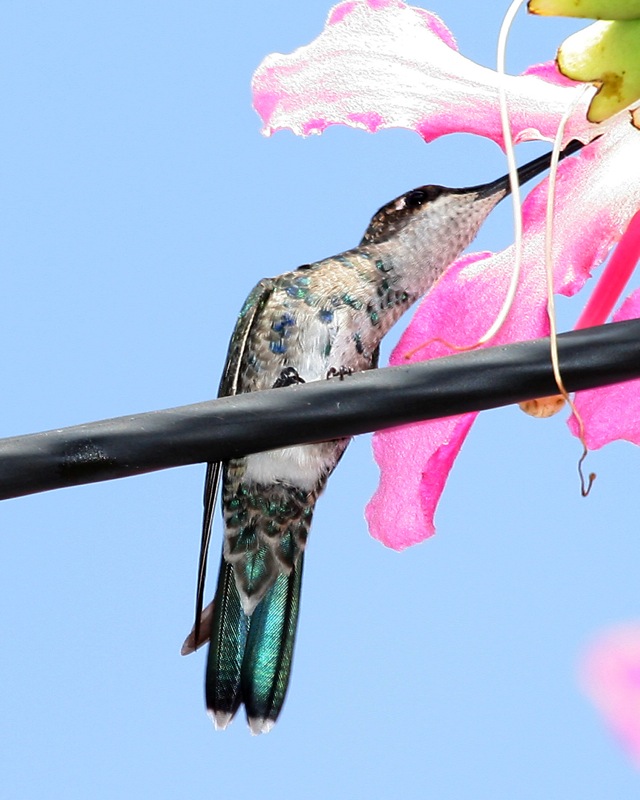
Wikimedia Commons
About the Blue-tufted Starthroat
The Blue-tufted Starthroat, known scientifically as Heliomaster furcifer, is a striking member of the hummingbird family, Trochilidae. This species is notable for its iridescent blue throat, a feature that sets it apart from many other hummingbirds. Predominantly found in South America, the Blue-tufted Starthroat inhabits countries such as Brazil, Paraguay, Argentina, and Bolivia. This bird thrives in a variety of habitats, including tropical and subtropical forests, savannas, and even semi-arid regions. Its adaptability to different environments illustrates its ecological significance and resilience.
Ecologically, the Blue-tufted Starthroat plays a critical role as a pollinator. As it feeds on nectar from flowers, it inadvertently transfers pollen, facilitating plant reproduction. This mutualistic relationship benefits both the bird and the plant communities within its range. The starthroat's presence in diverse habitats underscores its role as a keystone species in maintaining ecological balance.
Seasonal behaviors of the Blue-tufted Starthroat include subtle shifts in habitat use as it follows flowering plants' blooming cycles. During the rainy season, when flowers are abundant, this hummingbird may expand its range to areas with higher floral density. Conversely, in drier periods, it might retreat to regions where water sources are more reliable. The bird's migratory patterns within its range are not fully understood, though local movements in response to resource availability are documented.
The Blue-tufted Starthroat's significance extends beyond its ecological contributions. It serves as an important subject for ornithologists studying pollination biology and avian ecology. Moreover, birdwatchers and nature enthusiasts prize sightings of this hummingbird for its vibrant plumage and dynamic flight displays. As such, it also contributes to ecotourism in regions where it is commonly found, further highlighting its multifaceted importance.
The Blue-tufted Starthroat belongs to the family Trochilidae, within the order Apodiformes. These birds typically live average 4-6 years, with a maximum recorded of 9 years..
How to Identify a Blue-tufted Starthroat
The Blue-tufted Starthroat is easily recognized by its iridescent blue throat, a feature that is most prominent in males. Adult males also exhibit a metallic green upper body and a white belly, creating a striking contrast with their colorful throats. Females and juveniles, while less vibrantly colored, still share the overall green upperparts and white underparts, though their throats are speckled rather than fully blue.
The male Blue-tufted Starthroat's elongated tail feathers and forked tail are distinguishing features that aid in identification. Females have shorter, less pronounced tails with a slightly rounded shape. In flight, the starthroat demonstrates agile maneuvers, often hovering near flowers or darting swiftly between feeding sites. Its perching posture is typically upright, with a slight tilt as it surveys its surroundings.
This species could be confused with other hummingbirds in the region, such as the Glittering-bellied Emerald. However, the Blue-tufted Starthroat's larger size and distinctive blue throat patch are reliable differentiators. Observers should note the bird's flight silhouette, which is characterized by rapid wingbeats and graceful, sweeping arcs.
Having trouble telling birds apart? Upload a photo to our bird identification tool for an instant species match.
Blue-tufted Starthroat Habitat and Range
Preferred Habitat
The Blue-tufted Starthroat inhabits a variety of ecosystems, predominantly within tropical and subtropical regions. These include dense forests, open woodlands, and savannas. The bird often frequents areas with abundant flowering plants, which provide essential nectar sources.
This hummingbird is typically found at elevations ranging from sea level to around 1,800 meters, though it primarily occupies lowland areas where flowers are most plentiful. Seasonal shifts in habitat occur as the bird follows flowering cycles, moving to higher elevations or wetter areas during dry periods to find adequate food resources.
While the Blue-tufted Starthroat is more commonly associated with rural and natural environments, it occasionally ventures into suburban gardens and urban parks, especially where ornamental flowering plants are present. This adaptability to human-altered landscapes demonstrates its versatility in habitat selection.
Geographic Range
The Blue-tufted Starthroat's range is largely confined to South America. Its breeding grounds include regions within Brazil, particularly in the states of Mato Grosso, Minas Gerais, and São Paulo. It also breeds in eastern Paraguay, northeast Argentina, and parts of Bolivia.
During winter, the Blue-tufted Starthroat may undertake local movements in response to changes in flower availability, though it is not considered a long-distance migrant. These movements often occur within its established range, with some populations venturing slightly north or south depending on resource distribution.
Population density is highest in areas with a high concentration of flowering plants, such as the Cerrado's savannas and the Atlantic Forest's edges. These hotspots provide both the nectar and insect prey crucial to the bird's diet, supporting relatively stable populations in these regions.
Want to know which birds visit your area? Browse our backyard birds by location guides for region-specific species lists.
What Does the Blue-tufted Starthroat Eat?
The Blue-tufted Starthroat primarily feeds on nectar, which it extracts from flowers using its specialized, slender bill. It shows a preference for tubular flowers that match the length of its bill, enabling efficient nectar extraction. This hummingbird plays a crucial role in pollinating native plant species, as it transfers pollen on its head and bill while feeding.
During periods when nectar is scarce, the starthroat supplements its diet with small insects and spiders, which provide essential proteins and nutrients. These prey are typically captured through hawking or gleaning from foliage. The bird exhibits a flexible foraging schedule, often feeding during the cooler parts of the day when flower nectar is most concentrated.
Seasonal changes in diet correspond with fluctuations in flower availability. In the wet season, when flowers are abundant, nectar constitutes the bulk of the diet. In contrast, dry seasons see an increased reliance on insects and alternative food sources.
Want to attract Blue-tufted Starthroats to your yard? See our recommended feeders and seed types for the best results.
Blue-tufted Starthroat Behavior and Social Structure
The Blue-tufted Starthroat exhibits solitary behavior for most of the year, except during the breeding season. Males establish territories with abundant floral resources, defending them aggressively against intruders. Displays of aerial acrobatics and vocalizations serve as both courtship and territorial signals.
Courtship involves dynamic displays where males perform rapid ascents and dives, showcasing their iridescent throat patches to attract females. Once paired, the birds may engage in mutual preening, reinforcing pair bonds.
In response to predators, the Blue-tufted Starthroat relies on its agility and speed. It can evade threats through rapid, erratic flight patterns or by seeking cover among dense foliage. This hummingbird is most active during dawn and dusk when floral nectar is freshest, though it remains vigilant throughout the day.
Blue-tufted Starthroat Nesting and Reproduction
The female Blue-tufted Starthroat constructs a small, cup-shaped nest using plant fibers, spider webs, and lichens, typically securing it on a branch or fork in a tree. This structure provides camouflage and stability against the elements.
Clutch size generally consists of two white eggs. The female alone is responsible for incubating the eggs, a process that lasts approximately 14-16 days. During this time, she remains near the nest, leaving only briefly to forage and defend the territory.
After hatching, the chicks are altricial, requiring intensive care and feeding by the female. They fledge roughly 20-24 days post-hatching, although they continue to rely on the mother for food and protection for several weeks. The Blue-tufted Starthroat typically raises one to two broods per year, depending on environmental conditions and resource availability.
Blue-tufted Starthroat Sounds and Vocalizations
The Blue-tufted Starthroat produces a high-pitched, rapid series of notes that form its primary song. These notes are delivered in a rhythmic pattern, often described as a tinkling or metallic sound, which carries well across its territory.
Call notes are shorter and sharper, serving as communication signals between individuals. Alarm calls, triggered by potential threats, are more urgent and staccato, effectively alerting nearby birds to danger.
During the early morning hours, the Blue-tufted Starthroat engages in a dawn chorus, combining vocalizations with wing-whirring sounds that add a mechanical quality to its song. These auditory displays are crucial in maintaining territory and attracting mates.
Interesting Facts About the Blue-tufted Starthroat
- 1The Blue-tufted Starthroat can beat its wings up to 70 times per second, an impressive feat that allows it to hover in place.
- 2Unlike many hummingbirds, the Blue-tufted Starthroat exhibits a more pronounced sexual dimorphism, with males displaying a vivid blue throat patch.
- 3This species has been observed making seasonal movements within its range, though it does not undertake long-distance migrations.
- 4Blue-tufted Starthroat nests are often adorned with lichen, providing excellent camouflage against predators and the elements.
- 5These hummingbirds are known for their territorial nature, often engaging in aerial skirmishes to defend prime feeding grounds.
- 6The Blue-tufted Starthroat's diet consists of up to 70% nectar, supplemented by small insects and arachnids for protein.
- 7Males use their iridescent throat feathers not only for courtship but also to intimidate rivals during territorial disputes.
Blue-tufted Starthroat Conservation Status
The Blue-tufted Starthroat is currently listed as Least Concern by the IUCN, with stable population trends across its range. Primary threats include habitat loss due to deforestation and agricultural expansion, which can reduce available nesting sites and food resources. Conservation efforts focus on preserving natural habitats, particularly in areas with high biodiversity such as the Atlantic Forest and Cerrado. Protected areas and national parks play a vital role in safeguarding populations and maintaining ecological corridors. Historically, population levels have fluctuated with habitat changes, but recent efforts to curb deforestation and promote sustainable land use offer hope for the continued stability of Blue-tufted Starthroat populations.
Attracting Blue-tufted Starthroats to Your Feeder
The Blue-tufted Starthroat is a regular visitor to backyard bird feeders across its range. At the Eye On The Fly feeding station, we observe Blue-tufted Starthroats regularly and capture footage with our feeder cameras.
Other Trochilidae Species


Birds Similar to the Blue-tufted Starthroat
These species are often confused with the Blue-tufted Starthroat due to similar appearance or overlapping range.

