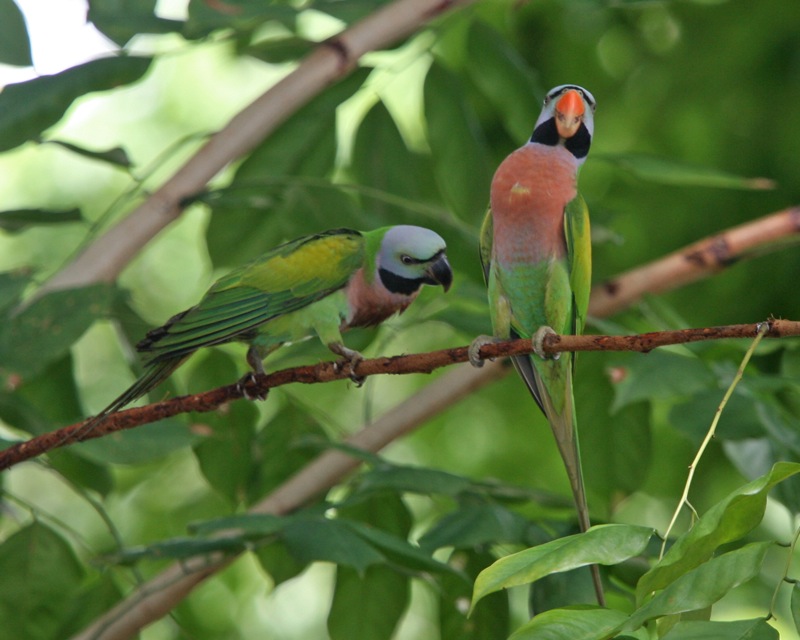
Long-tailed Parakeet
Psittacula longicauda
Order: Psittaciformes / Family: Psittacidae

Wikimedia Commons
About the Long-tailed Parakeet
The Long-tailed Parakeet (Psittacula longicauda) is an extraordinary avian species, notable for its vivid green plumage and the long, elegant tail from which it derives its name. This parakeet is particularly abundant in Southeast Asia, found predominantly in countries such as Malaysia, Indonesia, and southern Thailand. Within these regions, it inhabits the lush, tropical lowland forests, often seen flitting between trees in search of food or in playful interaction with its conspecifics. The species plays a vital ecological role as a seed disperser, aiding in the maintenance of forest biodiversity by facilitating the spread of various plant species as it forages for seeds and fruits.
In terms of ecological significance, the Long-tailed Parakeet contributes to the dynamics of forest ecosystems as both a consumer and a pollinator. The bird's preference for fruits and nectar means it often frequents flowering trees, inadvertently transferring pollen between blossoms. This activity supports the reproductive cycles of many tropical plants, making the parakeet an integral component of its native habitat. Moreover, the bird's social nature and tendency to form large flocks during certain seasons enhance its visibility in the ecosystem, making it an important subject of study for ornithologists and ecological researchers.
Seasonally, the Long-tailed Parakeet exhibits behaviors aligned with resource availability. During fruiting seasons, the parakeet's activity centers around fruit-laden trees, where its presence becomes more conspicuous. Outside these periods, the parakeet may shift its focus to seeds, demonstrating a level of dietary flexibility that underscores its adaptability within diverse ecological contexts. Despite its adaptability, the species faces threats from habitat loss due to deforestation and land conversion, underscoring the need for conservation efforts to ensure its survival.
The Long-tailed Parakeet belongs to the family Psittacidae, within the order Psittaciformes. These birds typically live average 20 years with a maximum recorded of 30 years..
How to Identify a Long-tailed Parakeet
The Long-tailed Parakeet is easily identified by its striking coloration and distinctive physical traits. Adults boast a vivid green plumage that provides excellent camouflage among the leafy canopies of its forest habitat. A distinguishing feature is the bird's elongated tail, which can measure nearly as long as its body, adding elegance to its appearance. The tail feathers are often tinged with blue, particularly noticeable in flight. In terms of sexual dimorphism, males and females are similar, but males typically exhibit a slightly brighter coloration. Juveniles resemble adults but may have shorter tails and a less vibrant plumage, which develops with maturity.
When observing the Long-tailed Parakeet, birders should note its robust red bill and a subtle rose-pink patch on the throat, more pronounced in adult males. The cheeks and forehead display a soft bluish hue, contrasting with the overall green body. In flight, this parakeet's silhouette is unmistakable due to its long tail and sharp, pointed wings, which provide agility and speed as it maneuvers through the forest.
While similar in appearance to other Psittacula species, the Long-tailed Parakeet's combination of a long tail and specific coloration patterns help distinguish it from others. However, in regions where multiple parakeet species coexist, keen observation of these specific field marks is essential for accurate identification.
Having trouble telling birds apart? Upload a photo to our bird identification tool for an instant species match.
Long-tailed Parakeet Habitat and Range
Preferred Habitat
The Long-tailed Parakeet predominantly inhabits tropical and subtropical lowland forests, where it thrives amidst dense foliage and abundant food sources. It prefers primary forests but can also be found in secondary growth and plantations, demonstrating a degree of adaptability to human-modified landscapes. The bird typically occupies areas up to 1,000 meters in elevation, although it is more commonly seen at lower altitudes where forest density is greatest.
During the breeding season, the parakeet shows a preference for the interiors of tall trees, which provide both nesting sites and protection from predators. Outside of the breeding season, the Long-tailed Parakeet may venture into more open areas, including agricultural lands and urban green spaces, in search of food. However, it is less frequently seen in heavily urbanized environments, where habitat alteration has reduced its natural foraging and nesting opportunities.
Seasonal shifts in habitat preference are closely linked to food availability. In regions where deforestation has occurred, the parakeet's presence may become more sporadic, highlighting the importance of habitat conservation efforts in ensuring the species' continued presence across its natural range.
Geographic Range
The Long-tailed Parakeet's range is centered in Southeast Asia, with populations primarily distributed across the Malay Peninsula, Sumatra, Borneo, and adjacent islands. In Malaysia, both Peninsular and East Malaysia support significant populations, reflecting the species' adaptability to various forest types within these regions. Indonesia hosts a considerable number of Long-tailed Parakeets, particularly in Sumatra and Kalimantan, where expansive forest habitats provide ideal living conditions.
The bird's range extends into southern Thailand, although populations there are less dense compared to the core regions of Malaysia and Indonesia. The Long-tailed Parakeet is not known for extensive migratory behavior, but it does exhibit local movements in response to food availability and breeding requirements. These movements are more pronounced in areas where seasonal variations affect resource distribution.
Populations of the Long-tailed Parakeet are densest in regions of intact primary rainforest with minimal human disturbance. However, habitat fragmentation and deforestation have led to localized declines, necessitating targeted conservation efforts to preserve critical habitats and ensure population stability.
Want to know which birds visit your area? Browse our backyard birds by location guides for region-specific species lists.
What Does the Long-tailed Parakeet Eat?
The Long-tailed Parakeet's diet primarily consists of fruits and seeds, which provide essential nutrients and energy. Figs, guavas, and berries are staple components of its diet, with the bird often seen foraging in fruit-laden trees. The parakeet uses its strong, curved bill to skillfully extract seeds from fruit, displaying remarkable dexterity and precision.
During certain seasons, the Long-tailed Parakeet may supplement its diet with nectar and flowers, taking advantage of the abundant floral resources available in tropical forests. This dietary flexibility allows the parakeet to adapt to changes in food availability, a critical factor in its survival across diverse habitats.
Foraging activity typically occurs during the early morning and late afternoon when the parakeet is most active. The bird often feeds in flocks, which can number anywhere from a few individuals to several dozen, depending on resource availability and social dynamics. While foraging, the Long-tailed Parakeet employs a combination of visual and auditory cues to locate food, often responding to the calls of conspecifics to identify fruitful feeding sites.
Long-tailed Parakeet Behavior and Social Structure
The Long-tailed Parakeet is a highly social bird, often observed in flocks that range from small family groups to larger aggregations during non-breeding seasons. This flocking behavior serves multiple purposes, including foraging efficiency, predator avoidance, and social interaction. Within these groups, the parakeet exhibits a complex social structure characterized by vocal communication and coordinated movements.
Courtship displays are a notable aspect of the Long-tailed Parakeet's behavior, with males engaging in elaborate flight displays and vocalizations to attract mates. These displays often involve aerial acrobatics and the presentation of food offerings, which play a crucial role in pair-bond formation and mate selection.
In terms of territoriality, the Long-tailed Parakeet is relatively non-aggressive, often tolerating the presence of other parakeets within its home range. However, it may defend feeding sites and nesting territories during the breeding season to ensure resource availability for its offspring. The parakeet's response to predators is characterized by high-pitched alarm calls and swift, evasive flight, often retreating to the safety of dense foliage.
Daily activity patterns include periods of intense foraging interspersed with rest and preening. The parakeet often seeks sheltered locations for midday rest, taking advantage of the forest canopy's natural protection to conserve energy and avoid the heat of the day.
Long-tailed Parakeet Nesting and Reproduction
Long-tailed Parakeets typically nest in tree cavities, often selecting sites that provide optimal protection from predators and environmental elements. These birds favor tall trees in mature forests, where natural cavities offer secure nesting opportunities. Occasionally, the parakeet may adapt and nest in artificial structures, such as wooden posts, when natural sites are scarce.
The female Long-tailed Parakeet lays a clutch of 2-4 eggs, which she incubates for approximately 21-24 days. During this period, the male assists by providing food and defending the nesting territory. Once hatched, the fledglings remain in the nest for about 6-8 weeks, during which both parents share feeding and care responsibilities.
The species typically raises one brood per year, although favorable conditions may sometimes permit a second. The timing of breeding and nesting aligns with peak food availability, ensuring that young have access to abundant resources as they develop. Parental roles are well-defined, with both male and female contributing to the success of the offspring through cooperative care and protection.
Long-tailed Parakeet Sounds and Vocalizations
The Long-tailed Parakeet's vocalizations are varied and complex, featuring a range of high-pitched calls and chattering notes. Its primary song consists of rapid, repetitive phrases, characterized by a rhythmic series of chirps that can carry over long distances. These calls serve multiple purposes, including mate attraction and territory defense.
In addition to its song, the parakeet uses specific call notes for communication within flocks, often characterized by a sharp, metallic quality. Alarm calls are distinct, featuring urgent, shrill notes that alert other birds to the presence of potential threats. These vocalizations are particularly evident during the dawn chorus, when the parakeet's activity is at its peak, filling the forest with its lively and energetic sounds.
Interesting Facts About the Long-tailed Parakeet
- 1The Long-tailed Parakeet's tail can be nearly as long as its body, making up about 50% of its total length.
- 2This parakeet is a highly social bird, often forming flocks of up to 60 individuals outside the breeding season.
- 3Long-tailed Parakeets are known to travel up to 20 kilometers in a day in search of food, showcasing their impressive endurance.
- 4Despite their vibrant colors, these parakeets are masters of camouflage, blending seamlessly into the green foliage of the forest canopy.
- 5The species' vocalizations are not only for communication; they also play a role in maintaining flock cohesion and coordinating movements.
- 6Long-tailed Parakeets have a unique foraging method, often hanging upside-down from branches to access hard-to-reach fruits and seeds.
- 7These birds have been observed using tools, such as sticks, to extract insects from crevices, highlighting their intelligence and problem-solving abilities.
Long-tailed Parakeet Conservation Status
The Long-tailed Parakeet currently holds a conservation status of Near Threatened, as assessed by the IUCN. While still relatively common within its core range, the species faces significant threats from habitat loss due to deforestation and agricultural expansion. These activities have led to a decline in suitable nesting and foraging habitats, impacting overall population numbers. Conservation efforts focus on habitat protection and reforestation initiatives, aiming to preserve the remaining tracts of primary forest crucial for the species' survival. Additionally, there is an emphasis on raising public awareness about the ecological importance of the Long-tailed Parakeet and the need to maintain its natural environment. Historical population changes reflect a decrease in regions heavily affected by land-use change, highlighting the urgency for effective conservation measures.
Other Psittacidae Species


Birds Similar to the Long-tailed Parakeet
These species are often confused with the Long-tailed Parakeet due to similar appearance or overlapping range.