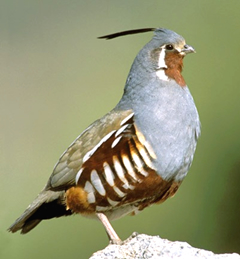
Long-tailed Wood-Partridge
Dendrortyx macroura
Order: Galliformes / Family: Odontophoridae

Wikimedia Commons
About the Long-tailed Wood-Partridge
The Long-tailed Wood-Partridge (Dendrortyx macroura) is a striking bird native to the montane forests of Mexico. This bird is particularly significant due to its restricted range and specialized habitat preferences. Found primarily in the Sierra Madre Occidental and the Sierra Madre Oriental, the Long-tailed Wood-Partridge plays a crucial ecological role as a ground-foraging bird. Its presence often indicates a healthy forest ecosystem. Measuring between 29 to 34 cm in length, this partridge exhibits a distinctive combination of rich brown and gray plumage, complemented by its long tail, which is particularly eye-catching as it moves through the underbrush.
The bird is primarily sedentary, with seasonal movements that are more altitudinal than geographical. In the summer months, it may ascend to higher elevations, while in winter, it descends to avoid the harshest climates. This altitudinal migration is crucial for its survival, as it seeks out areas with abundant food and cover. The Long-tailed Wood-Partridge is an essential seed disperser, consuming a variety of seeds and fruits, which it helps to propagate through its droppings. This ecological role underscores its importance in maintaining the biodiversity of its native forests.
Conservationists regard the Long-tailed Wood-Partridge as a species of concern. While it is not currently classified as endangered, habitat loss and fragmentation pose significant threats. The preservation of its montane forest habitat is critical for its continued survival. The bird's presence is an indicator of forest health, making it a valuable species for ecological monitoring. Its adaptability within its specific habitat is noteworthy, allowing it to adjust to varying conditions throughout the year. The Long-tailed Wood-Partridge remains a testament to the rich avian diversity of the Mexican highlands.
The Long-tailed Wood-Partridge belongs to the family Odontophoridae, within the order Galliformes. These birds typically live average 3-5 years with a max recorded of 8 years.
How to Identify a Long-tailed Wood-Partridge
The Long-tailed Wood-Partridge is most easily recognized by its elongated tail and vibrant plumage. Adults display a blend of rich chestnut and gray tones, with intricate patterns that offer excellent camouflage among the forest floor detritus. The face is marked with contrasting black and white, with a subtle crest that can be raised or lowered. In flight, the tail's distinctive length becomes apparent, setting it apart from many other partridge species.
Juvenile Long-tailed Wood-Partridges resemble adults but have slightly duller plumage and shorter tails, a feature that gradually lengthens as they mature. Males and females are similar in appearance, though males may exhibit slightly brighter coloration, particularly around the face and neck.
Comparisons with other species can lead to confusion, particularly with the Crested Guan (Penelope purpurascens) or the West Mexican Chachalaca (Ortalis poliocephala), both of which share habitat ranges. However, the Long-tailed Wood-Partridge's smaller size, distinctive tail, and ground-hugging posture help differentiate it. Its characteristic foraging behavior involves walking with a low, deliberate gait, often flicking its long tail as it moves through dense undergrowth.
Having trouble telling birds apart? Upload a photo to our bird identification tool for an instant species match.
Long-tailed Wood-Partridge Habitat and Range
Preferred Habitat
The Long-tailed Wood-Partridge inhabits montane forests, specifically favoring oak and pine forests interspersed with dense underbrush. It thrives at elevations ranging from 1,200 to 3,500 meters, often found in the Sierra Madre Occidental and Sierra Madre Oriental. These forests provide the dense cover necessary for nesting and foraging.
Seasonal habitat shifts are subtle, generally involving altitudinal movements rather than long-distance migrations. In summer, the partridges frequent higher, cooler elevations, while they retreat to lower, more sheltered areas during the colder months. Unlike some avian species, the Long-tailed Wood-Partridge shows little affinity for urban or suburban environments, preferring the solitude and resources of undisturbed forests.
Geographic Range
The Long-tailed Wood-Partridge is found exclusively in Mexico, with a range that stretches across the Sierra Madre Occidental and Sierra Madre Oriental. It is a non-migratory bird, residing year-round within this limited geographic range. Despite its restricted distribution, the bird's population is relatively stable, though its presence is more concentrated in regions with intact forest cover.
Population density is highest in areas where old-growth forests remain, particularly in states such as Durango, Michoacán, and Oaxaca. The bird's preference for montane forests means that its range is largely dictated by the presence of these habitats. Conservation efforts focus on preserving these critical areas to maintain viable populations.
Want to know which birds visit your area? Browse our backyard birds by location guides for region-specific species lists.
What Does the Long-tailed Wood-Partridge Eat?
The diet of the Long-tailed Wood-Partridge is largely composed of seeds, fruits, and insects, reflecting its role as a ground forager. In the warmer months, its diet expands to include a variety of berries and fruits, such as those from the madrone and oak trees, which are abundant in its highland habitats.
During the colder months, when fruits are scarcer, the partridge relies more heavily on seeds and insects, which it scratches from the forest floor. Its strong legs and sharp claws are well-adapted for this type of foraging. The partridge typically feeds in the early morning and late afternoon, taking advantage of cooler temperatures and increased food availability.
Insects, though a smaller component of its diet, provide essential protein, particularly during the breeding season. The bird's foraging behavior involves short bursts of activity interspersed with periods of rest, allowing it to remain vigilant for predators while feeding.
Long-tailed Wood-Partridge Behavior and Social Structure
The Long-tailed Wood-Partridge exhibits a complex social structure, often seen in small family groups or pairs. These birds are territorial, with males establishing and defending territories through vocalizations and displays. Their calls serve not only as territorial markers but also as a means of maintaining group cohesion.
Courtship displays are subtle yet intricate, involving vocal duets and mutual preening. Such behaviors strengthen pair bonds, which are often long-lasting. While primarily ground-dwelling, the Long-tailed Wood-Partridge is capable of short, explosive flights when threatened, using its long tail for balance and maneuverability.
Flocking behavior is minimal, though during the non-breeding season, small groups may come together to forage. The partridge's response to predators involves rapid, low-flying escapes to dense cover, where it relies on its cryptic plumage for concealment. Daily activity patterns revolve around foraging and resting, with heightened activity during the cooler parts of the day.
Long-tailed Wood-Partridge Nesting and Reproduction
The Long-tailed Wood-Partridge nests on the ground, typically in well-concealed locations beneath dense shrubbery or fallen logs. The nest itself is a shallow depression lined with leaves and grass, providing insulation and camouflage.
Clutch sizes range from 6 to 10 eggs, with an incubation period of approximately 24 days. While both parents participate in incubation, the female typically assumes the primary role. Once hatched, chicks are precocial, leaving the nest within hours and following their parents, who guide them to foraging sites.
Fledging occurs between 2 to 3 weeks of age, with young birds remaining with the family group until the next breeding season. The Long-tailed Wood-Partridge generally raises one brood per year, though favorable conditions may occasionally allow for a second.
Long-tailed Wood-Partridge Sounds and Vocalizations
The vocalizations of the Long-tailed Wood-Partridge are distinctive and serve critical communicative functions. Its primary song consists of a series of rhythmic, whistling notes that rise and fall in pitch. These calls are most often heard during the early morning and late afternoon, coinciding with peak activity periods.
Alarm calls are sharp and staccato, designed to alert family members to potential threats. These calls differ markedly from the softer, more musical contact calls used within family groups. The dawn chorus of the Long-tailed Wood-Partridge is a complex affair, often involving a variety of whistles and chirps that establish territory and strengthen social bonds.
In comparison to other forest-dwelling birds, the Long-tailed Wood-Partridge's calls are relatively low in volume, reflecting its preference for dense, enclosed habitats where sound does not need to travel far.
Interesting Facts About the Long-tailed Wood-Partridge
- 1The Long-tailed Wood-Partridge's tail comprises nearly half its total body length, aiding in balance and maneuverability.
- 2This species is one of the few partridges that exhibits altitudinal migration, adjusting its elevation seasonally.
- 3Long-tailed Wood-Partridges can be heard more often than seen, owing to their elusive nature and camouflaged plumage.
- 4Despite its limited range, the Long-tailed Wood-Partridge has adapted to a variety of montane forest types within Mexico.
- 5The bird's diet shifts seasonally, with a notable increase in fruit consumption during summer months.
- 6Long-tailed Wood-Partridges form monogamous pair bonds, often remaining with the same partner for several breeding seasons.
- 7The species' vocal repertoire is complex, with different calls for alarm, territory defense, and social interactions.
Long-tailed Wood-Partridge Conservation Status
The Long-tailed Wood-Partridge is currently listed as Near Threatened by the IUCN, with its population considered stable but vulnerable to habitat destruction. The primary threats include deforestation and habitat fragmentation due to agriculture and urban development. Conservation efforts focus on preserving remaining tracts of montane forest, with some success in establishing protected areas. Historical population declines have been mitigated through these initiatives, although ongoing monitoring is essential to ensure long-term viability. The bird's restricted range and specialized habitat requirements make it particularly sensitive to environmental changes, necessitating targeted conservation strategies that address both habitat protection and broader ecological impacts.