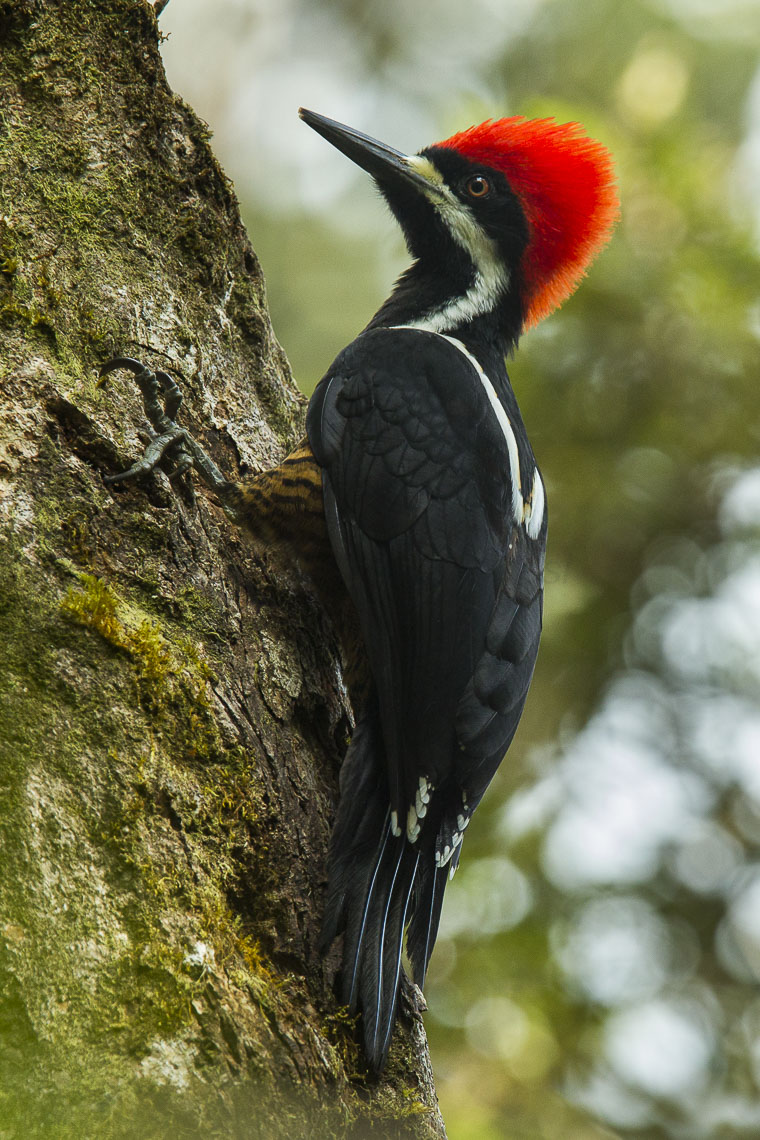
Magellanic Woodpecker
Campephilus magellanicus
Order: Piciformes / Family: Picidae

Wikimedia Commons
About the Magellanic Woodpecker
The Magellanic Woodpecker (Campephilus magellanicus) is one of the most visually striking members of the Picidae family, primarily inhabiting the temperate forests of southern South America. This remarkable bird is the largest woodpecker found in South America, a testament to its adaptability and ecological significance. With a body length of about 36 to 45 centimeters and a wingspan reaching up to 70 centimeters, its presence is both commanding and unmistakable. It is especially notable for the male's brilliant red head, which starkly contrasts with its black body. Females, while similar in size, possess a black head with a subtle red mark on the crown, differentiating the sexes with elegance.
The ecological role of the Magellanic Woodpecker extends beyond its striking appearance. As a keystone species, it plays a critical role in maintaining the health of its forest ecosystem. By excavating large cavities in trees, it provides essential nesting sites for a variety of secondary cavity-nesters, including birds, mammals, and insects. These cavities are particularly important in the ancient, Nothofagus-dominated forests of Chile and Argentina. With its powerful beak, the Magellanic Woodpecker also helps control insect populations, primarily preying on wood-boring beetle larvae that can damage trees if left unchecked.
Seasonally, the Magellanic Woodpecker exhibits fascinating behaviors. During the breeding season, which begins in late southern spring, pairs engage in conspicuous displays of courtship and territorial defense. Their loud drumming reverberates through the forest, asserting their presence and warding off rivals. In winter, while they remain largely sedentary, their feeding habits shift slightly as they exploit available food sources, demonstrating their adaptability to seasonal changes. Their presence in the forests of Tierra del Fuego and Los Glaciares National Park underscores their adaptability to diverse environments, from lowland temperate rainforests to sub-Antarctic woodlands.
The Magellanic Woodpecker belongs to the family Picidae, within the order Piciformes. These birds typically live average 10-15 years with a maximum recorded of 20 years..
How to Identify a Magellanic Woodpecker
Identifying the Magellanic Woodpecker is relatively straightforward due to its distinctive features. Adult males boast a vivid red head and crest, which contrasts sharply with their glossy black body. The females are similarly sized but exhibit a black head with a small patch of red on the crown. Both sexes have white wing patches, visible during flight, and a robust, chisel-like bill, which is pale in color. Juveniles resemble adults but have a slightly duller plumage, with males showing a patchy red on the head until they mature.
Unlike many other woodpecker species, the Magellanic Woodpecker's size serves as a key distinguishing feature, significantly larger than the sympatric White-barred Piculet or the Chilean Flicker. When in flight, it displays a strong, undulating flight pattern typical of woodpeckers, with its large size and wing patches being prominent identifiers. Perched, it often maintains an upright posture, using its stiff tail feathers for support against tree trunks.
Observers might confuse the Magellanic Woodpecker with the Andean Flicker due to their overlapping ranges in some areas. However, the latter is considerably smaller and has a distinct overall coloration, characterized by a brownish body and barred patterning, which differs from the bold, contrasting colors of the Magellanic Woodpecker.
Having trouble telling birds apart? Upload a photo to our bird identification tool for an instant species match.
Magellanic Woodpecker Habitat and Range
Preferred Habitat
The Magellanic Woodpecker predominantly inhabits mature temperate forests, particularly those dominated by southern beech (Nothofagus) species. These forests, located in the southern Andes of Chile and Argentina, provide the essential old-growth trees necessary for nesting and foraging. The species is typically found at elevations ranging from sea level up to about 2,000 meters, with a preference for habitats that offer a mix of dead and decaying trees.
In regions like the forests of Tierra del Fuego and Los Glaciares National Park, the Magellanic Woodpecker finds both the food resources and nesting sites it requires. While it is predominantly a forest bird, it may occasionally venture into nearby open areas if food resources necessitate. Unlike many woodpecker species that might adapt to urban environments, the Magellanic Woodpecker remains closely tied to forested areas, underlining its reliance on pristine habitats.
Seasonal habitat shifts are minimal, as the species remains in its forest home year-round. However, within this range, it may move slightly in response to variations in food availability, often favoring areas with higher concentrations of deadwood and insect activity.
Geographic Range
The range of the Magellanic Woodpecker extends across the temperate forests of southern South America. It is primarily found in Chile and Argentina, from the latitudes of approximately 35°S to 56°S, which includes the southern beech forests of the Andean region. Notable locations within its range include the Alerce Andino National Park, the Nahuel Huapi National Park, and the forests of Tierra del Fuego.
The species is non-migratory, remaining within its established territories throughout the year. It does not engage in long-distance migrations, unlike some other woodpecker species, due to the stable climate and consistent food availability within its range. Local movements may occur as it searches for suitable nesting sites or responds to changes in food distribution.
Population density hotspots include areas with extensive old-growth forests, where the availability of large, decaying trees provides ideal conditions for nesting and foraging. Despite its relatively limited distribution, the Magellanic Woodpecker is a vital component of the forest ecosystems within its range, contributing to biodiversity and forest health.
Want to know which birds visit your area? Browse our backyard birds by location guides for region-specific species lists.
What Does the Magellanic Woodpecker Eat?
The Magellanic Woodpecker's diet primarily consists of insects, particularly the larvae of wood-boring beetles. These insects represent a critical food source, providing the high protein content necessary for the bird's energy-intensive lifestyle. The woodpecker uses its powerful bill to excavate deep into tree bark and wood, extracting insects from within.
Seasonal changes in diet reflect the availability of prey. During the spring and summer months, when insect activity is at its peak, the woodpecker focuses heavily on beetle larvae. In the winter, when insect activity diminishes, the bird may supplement its diet with plant materials such as fruits and nuts, although these form a smaller portion of its intake.
The Magellanic Woodpecker employs a distinctive foraging technique, characterized by strong, deliberate pecking and the use of its long tongue to probe deep into crevices. This method allows it to access prey residing in hard-to-reach places, making it an efficient predator of forest pests. Foraging activity generally peaks in the early morning and late afternoon, aligning with periods of increased insect activity.
Magellanic Woodpecker Behavior and Social Structure
The Magellanic Woodpecker exhibits fascinating social and territorial behaviors. It typically lives in monogamous pairs or small family groups, maintaining territories that range from 10 to 20 hectares. These territories are vigorously defended against intruders, with both males and females participating in displays of aggression and drumming to assert dominance.
Courtship displays are an integral part of the breeding season. Males perform elaborate drumming sequences, sometimes accompanied by vocalizations, to attract females and strengthen pair bonds. The drumming, which resonates through the forest, also serves as a means of communication between mates and family members.
In response to predators, such as hawks or owls, the Magellanic Woodpecker relies on its keen senses and agility. It may use evasive maneuvers, including rapid flight and darting into the dense forest canopy, to escape danger. During the day, the woodpecker remains active, foraging and engaging in territorial maintenance, with peak activity occurring during the cooler hours of the morning and late afternoon.
Magellanic Woodpecker Nesting and Reproduction
The nesting habits of the Magellanic Woodpecker reflect its dependence on mature forests. It excavates large cavities in the trunks of old trees, often at heights between 5 and 15 meters. These cavities serve as secure sites for raising young, providing protection from predators and harsh weather conditions.
A typical clutch consists of one to three eggs, which are incubated by both parents for a period of approximately 17 to 19 days. The shared responsibility continues after hatching, with both the male and female participating in feeding the chicks. Fledging occurs about 28 to 30 days after hatching, with young remaining close to their parents for several months as they learn essential survival skills.
The Magellanic Woodpecker typically raises one brood per year, reflecting the challenging environmental conditions of its habitat. The availability of suitable nesting sites can be a limiting factor for the population, emphasizing the importance of conservation efforts to protect old-growth forests.
Magellanic Woodpecker Sounds and Vocalizations
The primary vocalization of the Magellanic Woodpecker is a loud, resonant drumming, used for both communication and territorial defense. This drumming has a rapid, rhythmic pattern, often lasting several seconds.
In addition to drumming, the woodpecker produces a series of sharp, high-pitched calls, which serve as contact calls between mates and family members. Alarm calls are more abrupt and harsh, signaling the presence of potential predators or intruders.
During the dawn chorus, the Magellanic Woodpecker's drumming and calls blend with those of other forest species, creating a vibrant soundscape. Its vocal repertoire, while not as extensive as that of many songbirds, is nonetheless a crucial component of its behavioral ecology.
Interesting Facts About the Magellanic Woodpecker
- 1The Magellanic Woodpecker is the largest woodpecker in South America, reaching lengths of up to 45 centimeters.
- 2Despite their size, Magellanic Woodpeckers are adept at navigating dense forest canopies, moving with surprising agility.
- 3These woodpeckers are critical to their ecosystem, as their cavities provide nesting sites for other species, such as owls and small mammals.
- 4The powerful drumming of the Magellanic Woodpecker can be heard over half a kilometer away, making it a dominant sound in its habitat.
- 5Magellanic Woodpeckers have a specialized tongue that can extend well beyond their beak to extract insects from deep within tree bark.
- 6Unlike many woodpecker species, the Magellanic Woodpecker does not migrate, staying within its forest home year-round.
- 7The Magellanic Woodpecker's drumming serves not only for communication but also to gauge the quality of potential nesting sites.
Magellanic Woodpecker Conservation Status
The Magellanic Woodpecker is currently classified as Near Threatened on the IUCN Red List, with population trends indicating a gradual decline. Primary threats include habitat loss due to logging and conversion of forests to agriculture. Conservation efforts focus on protecting remaining old-growth forests and establishing protected areas to ensure the survival of existing populations. Historical population changes reflect significant loss of habitat over the past century, underscoring the urgency of these efforts. Strategies for conservation include enforcing logging restrictions and promoting sustainable forestry practices that preserve critical habitats. Continued research and monitoring are essential to assess population health and inform future conservation initiatives.
Other Picidae Species


Birds Similar to the Magellanic Woodpecker
These species are often confused with the Magellanic Woodpecker due to similar appearance or overlapping range.