
Powerful Woodpecker
Campephilus pollens
Order: Piciformes / Family: Picidae
Wikimedia Commons
About the Powerful Woodpecker
The Powerful Woodpecker, scientifically known as Campephilus pollens, is a remarkable avian species native to the montane forests of South America. This woodpecker is particularly significant due to its size, making it one of the largest woodpeckers inhabiting the Andean regions. Its presence serves as a crucial indicator of forest health, as it thrives in mature, undisturbed forests rich in insect prey. Found primarily in Colombia, Ecuador, and Peru, the Powerful Woodpecker inhabits cloud forests and subtropical montane forests, often at elevations ranging from 1,200 to 3,100 meters. These environments offer the dense canopy and abundant dead wood essential for their survival and nesting. The woodpecker plays an important ecological role by controlling insect populations, particularly beetle larvae, thereby contributing to the forest's natural pest control. Seasonally, the Powerful Woodpecker might exhibit slight altitudinal movements, descending to lower elevations during harsher weather conditions. Its presence and behaviors during different seasons provide valuable insights into the forest dynamics and the health of its ecosystems. The woodpecker's ecological role emphasizes the interconnectedness of species within these forest habitats, highlighting the need for conservation efforts to maintain these critical environments. The Powerful Woodpecker's unique behaviors, such as its strong drumming and distinctive vocalizations, make it an important subject of study for ornithologists and birdwatchers alike.
The Powerful Woodpecker belongs to the family Picidae, within the order Piciformes. These birds typically live average 8-12 years with a maximum recorded of 14 years..
How to Identify a Powerful Woodpecker
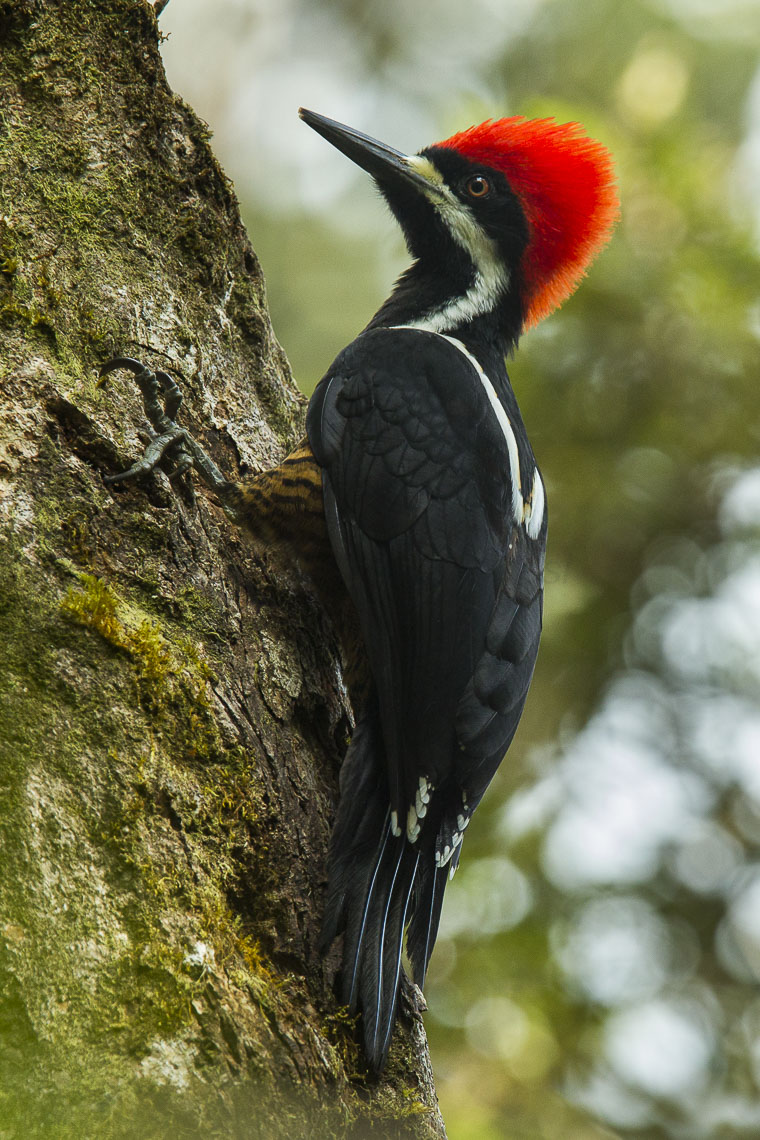
Adult Powerful Woodpeckers are distinguished by their predominantly black plumage, contrasted by striking white stripes extending from their shoulders down to their flanks. Their head features a bold red crown, more pronounced in males, making them visually striking. Females can be distinguished by their black crowns, which lack the red hue. Juvenile Powerful Woodpeckers resemble adults but tend to have duller plumage and less defined markings. They lack the pronounced red crown seen in adult males. In flight, the Powerful Woodpecker's large wings and strong, direct flight pattern are noticeable, with white patches visible on the wings. When perched, their robust body and strong, slightly curved bill are distinctive features. Despite their size, they can be confused with the Lineated Woodpecker (Dryocopus lineatus), but the latter lacks the extensive white striping on the back that is characteristic of the Powerful Woodpecker.
Having trouble telling birds apart? Upload a photo to our bird identification tool for an instant species match.
Powerful Woodpecker Habitat and Range
Preferred Habitat
The Powerful Woodpecker inhabits montane and cloud forests in the Andes of South America, thriving in elevations between 1,200 and 3,100 meters. These forests provide the dense canopy and abundant dead wood necessary for foraging and nesting. While primarily found in remote, undisturbed regions, these woodpeckers may occasionally venture into adjacent secondary forests. However, they are less common in urban or heavily disturbed areas, where their habitat requirements are not met. Seasonal shifts in habitat are minimal, with the woodpecker remaining within highland regions year-round, though some altitudinal movement may occur during inclement weather.
Geographic Range
The Powerful Woodpecker's range spans the Andean regions of Colombia, Ecuador, and Peru. It is predominantly a resident species, with no significant long-distance migration patterns observed. In Colombia, it is found in the central and eastern Andes, while in Ecuador, it inhabits the western and eastern slopes of the Andes. In Peru, its presence is noted in the central and northern regions. Population density tends to be higher in well-preserved montane forests, where food sources and nesting sites are abundant. The woodpecker's distribution is closely tied to these forested corridors, which provide the essential resources for its survival.
Want to know which birds visit your area? Browse our backyard birds by location guides for region-specific species lists.
What Does the Powerful Woodpecker Eat?
The Powerful Woodpecker's diet mainly consists of insects, particularly beetle larvae, which it extracts from dead or decaying wood. This preference for larval insects highlights its role as a natural pest control agent within its ecosystem. The woodpecker employs a powerful drumming technique to access its prey, using its strong bill to chisel into wood. Seasonal changes in diet are minimal, although it may consume additional insect species or small invertebrates when available. Its foraging activity typically peaks during early morning and late afternoon, coinciding with periods of increased insect activity.
Powerful Woodpecker Behavior and Social Structure
The Powerful Woodpecker is primarily solitary, displaying territorial behavior particularly during the breeding season. Males are known for their vigorous drumming, a behavior used to establish territory and attract mates. Courtship involves aerial displays and mutual feeding between pairs. When faced with potential threats, the woodpecker's response involves remaining motionless against tree trunks or emitting alarm calls to warn others. Daily activity patterns include early morning and late afternoon foraging sessions, with midday periods often spent resting or preening. The woodpecker's strong territorial instincts and predictable activity patterns make it a fascinating subject for behavioral studies.
Powerful Woodpecker Nesting and Reproduction
Powerful Woodpeckers excavate nests in large, dead trees, choosing sites with soft wood that facilitate excavation. The nests are located at varying heights, though often high enough to avoid ground predators. Clutch sizes range from two to three eggs, with both parents sharing incubation duties over a period of approximately two weeks. Once hatched, the young remain in the nest for about a month before fledging. Both parents participate in feeding the chicks, showcasing a strong pair bond and cooperative parenting strategy. Typically, the Powerful Woodpecker raises one brood per year.
Powerful Woodpecker Sounds and Vocalizations
The Powerful Woodpecker's vocalizations include a series of sharp, resonant drumming patterns, used primarily for communication and territorial defense. Its calls are loud and distinctive, often described as a rapid series of 'kik-kik-kik' notes. Alarm calls are sharper and more abrupt, designed to alert others of potential dangers. During the dawn chorus, the woodpecker's vocalizations blend with the sounds of the forest, creating a symphony of natural noise. These vocal patterns are crucial for maintaining social structures and marking territory.
Interesting Facts About the Powerful Woodpecker
- 1The Powerful Woodpecker's bill strikes can exert a force over 1,000 times that of gravity, showcasing its specialized adaptation for drilling into wood.
- 2Despite its large size, the Powerful Woodpecker's drumming is notably precise and rhythmic, capable of being heard over considerable distances in its forest habitat.
- 3The Powerful Woodpecker's nesting cavities are often reused by other birds, making it a keystone species within its ecosystem.
- 4Unlike many smaller woodpeckers, the Powerful Woodpecker's diet is predominantly larval insects, highlighting its role in natural pest control within montane forests.
- 5The species name 'pollens' refers to its powerful build, with 'pollens' meaning strong or mighty in Latin, aptly describing this robust woodpecker.
Powerful Woodpecker Conservation Status
The IUCN currently lists the Powerful Woodpecker as a species of Least Concern, although its populations are affected by habitat loss due to deforestation. Ongoing conservation efforts focus on preserving montane forest habitats and mitigating the impact of human encroachment. While the overall population trend remains stable, localized declines have been reported in heavily deforested areas. Conservationists emphasize the importance of protecting large tracts of forest to ensure the woodpecker's continued survival and ecological function.
Other Picidae Species


Birds Similar to the Powerful Woodpecker
These species are often confused with the Powerful Woodpecker due to similar appearance or overlapping range.

