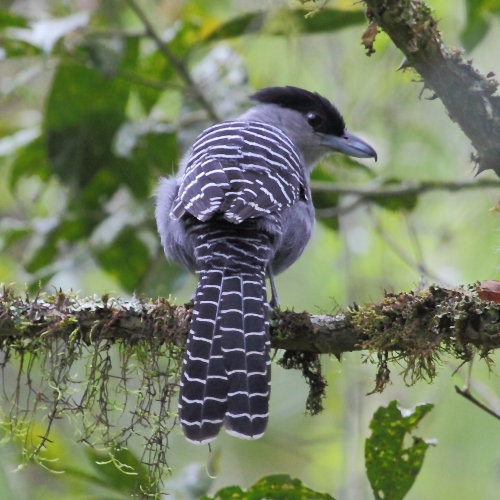
Manu Antbird
Cercomacra manu
Order: Passeriformes / Family: Thamnophilidae

Wikimedia Commons
About the Manu Antbird
The Manu Antbird, scientifically known as Cercomacra manu, is a captivating species within the Thamnophilidae family. This bird inhabits the dense undergrowth of tropical rainforests, primarily in the Amazon Basin. Known for its elusive nature, the Manu Antbird is often heard rather than seen, as it thrives in the shadows of Peru's and Bolivia's rich forests. This bird plays a significant role in the ecosystem by controlling insect populations, a crucial task in the biodiversity-rich environments it inhabits.
The Manu Antbird holds ecological importance due to its insectivorous diet. It helps maintain a balance within its habitat by preying on various arthropods, which are abundant in the rainforest. As a member of the antbird family, it is adapted to foraging near army ant swarms, capturing insects that are flushed out by the ants' movement. This symbiotic relationship is an excellent example of the interconnectedness within tropical ecosystems.
Seasonally, the Manu Antbird remains relatively stable in its preferred habitat, showing minimal migratory behavior. Its adaptability to the changing conditions of the rainforest, such as variations in rainfall and food availability, showcases its resilience. The bird's presence in both primary and secondary forests highlights its ability to survive in diverse environmental settings. However, habitat degradation poses a threat to its continued survival, emphasizing the need for conservation efforts in the regions it inhabits.
The Manu Antbird belongs to the family Thamnophilidae, within the order Passeriformes. These birds typically live average 4 years with a max recorded of 6 years.
How to Identify a Manu Antbird
The Manu Antbird is a small songbird, measuring approximately 14 centimeters in length. Adult males display striking black plumage with conspicuous white wing bars, which contrast sharply with their otherwise dark feathers. Females, on the other hand, exhibit a more subdued coloration with brownish tones replacing the males' black, though they share the white wing bars.
Juveniles resemble females but often display more mottled and less defined plumage. This bird's overall appearance, particularly the wing bars, assists in distinguishing it from similar species within the dense forest understory. The Manu Antbird's silhouette is compact, with a slightly curved bill adapted to insect consumption.
In flight, the Manu Antbird appears agile but prefers to stay low to the ground, rarely venturing far from dense cover. When perched, it often maintains a horizontal posture on low branches or vines, staying alert to the movement of potential prey. Its preference for shadowy environments can make visual identification challenging, with its distinctive call often providing the first clue to its presence.
Having trouble telling birds apart? Upload a photo to our bird identification tool for an instant species match.
Manu Antbird Habitat and Range
Preferred Habitat
The Manu Antbird is primarily found in the tropical rainforest habitats of the Amazon Basin. It thrives in dense undergrowth and is commonly associated with humid lowland environments. The bird favors areas with ample leaf litter and fallen debris, providing a rich hunting ground for insects.
This species typically resides at elevations ranging from 200 to 800 meters above sea level, although it might ascend higher in regions where suitable habitat persists. Unlike some bird species, the Manu Antbird exhibits little seasonal habitat shift, remaining within forested areas year-round.
While the Manu Antbird is predominantly a forest dweller, it can sometimes be found in secondary growth areas, showing a degree of adaptability to altered landscapes. It rarely ventures into urban areas, maintaining a preference for secluded, less disturbed habitats.
Geographic Range
The Manu Antbird's range is largely confined to South America, specifically within the Amazon Basin. Its principal habitats are in southeastern Peru and northern Bolivia, with isolated populations potentially existing in adjacent regions of Brazil.
This bird is non-migratory, residing in its preferred habitats throughout the year. The Manu Antbird does not exhibit significant migratory patterns, focusing instead on small local movements in search of food or suitable nesting sites.
Population density is highest in areas with dense forest cover, particularly within protected reserves such as Peru's Manú National Park, from which the bird derives its common name. Conservation areas play a critical role in sustaining its populations, given the ongoing threats of deforestation and habitat fragmentation.
Want to know which birds visit your area? Browse our backyard birds by location guides for region-specific species lists.
What Does the Manu Antbird Eat?
The Manu Antbird's diet consists primarily of insects and other arthropods. It is an adept hunter of ants, beetles, spiders, and other small invertebrates found in the leaf litter of the forest floor.
Foraging behavior includes following army ant swarms, a common trait among antbirds. As the ants move, they flush out various prey, which the Manu Antbird skillfully captures. This bird employs a perch-and-pounce technique, often moving quietly from one low perch to another before darting to snatch its prey.
Dietary shifts are minimal due to the consistent availability of insects in its habitat. However, during periods of high rainfall, when insect activity increases, the Manu Antbird may expand its diet slightly to include a wider array of invertebrates. Feeding is most active during the early morning and late afternoon, coinciding with peak insect activity.
Manu Antbird Behavior and Social Structure
The Manu Antbird is generally solitary or found in pairs. It exhibits strong territorial behavior, with males often defending their chosen area vigorously from intruders.
Courtship involves a series of displays and vocalizations, with the male showcasing his plumage and engaging in a dance to attract a mate. Once paired, the bond remains strong throughout the breeding season.
Flocking behavior is uncommon except during feeding around ant swarms, where it may temporarily join mixed-species flocks. In terms of daily activity, the Manu Antbird is most active during dawn and dusk, taking advantage of the cooler temperatures and increased insect movement at these times.
When threatened by predators, the Manu Antbird employs a strategy of remaining motionless or retreating into denser cover, relying on its cryptic plumage for protection.
Manu Antbird Nesting and Reproduction
The Manu Antbird nests in the dense, tangled undergrowth of the forest. Nests are typically constructed within low shrubs or vine tangles, where they are well-concealed from predators.
The nest itself is a small cup made of leaves, twigs, and other plant materials, intricately woven to ensure stability. The clutch usually consists of two eggs, which are pale with fine speckles.
Both parents participate in incubation, which lasts about 14 days. After hatching, the chicks remain in the nest for approximately 12 to 15 days before fledging. The Manu Antbird may raise one or two broods per year, depending on environmental conditions and food availability.
Parental care extends beyond fledging, with adults continuing to feed and protect their young until they are fully independent.
Manu Antbird Sounds and Vocalizations
The Manu Antbird's primary song is a series of clear, melodious whistles that increase in tempo, resembling a descending scale. This song serves both territorial and courtship purposes.
Call notes are short and sharp, often described as 'tic-tic' sounds, used primarily for communication between mates or when alarmed. Alarm calls are louder and more insistent, serving to alert mates or signal distress.
During the dawn chorus, the Manu Antbird contributes its voice to the symphony of the forest, its song recognizable among the many other avian calls. Its calls can be compared to a distant flute, providing an auditory marker for birders tracking this elusive species.
Interesting Facts About the Manu Antbird
- 1The Manu Antbird is named after Peru's Manú National Park, a biodiversity hotspot where it is commonly found.
- 2Unlike many birds, the Manu Antbird often forages by following army ant swarms, capturing prey disturbed by the ants.
- 3Despite its small size, the Manu Antbird plays a crucial role in controlling insect populations in the Amazon rainforest.
- 4The species exhibits strong sexual dimorphism, with males in striking black and white, whereas females are brown and white.
- 5The Manu Antbird rarely ventures into open spaces, preferring the cover of dense forest understory and undergrowth.
- 6Their song, a series of clear whistles, is often one of the first indicators of their presence to keen birders.
- 7The Manu Antbird's nest is a well-camouflaged structure built low in shrubs, making it hard to spot even when close.
Manu Antbird Conservation Status
The Manu Antbird is currently listed as Least Concern on the IUCN Red List, although its population trend is decreasing due to habitat loss. Deforestation for agriculture and logging poses significant threats to its habitat. Conservation efforts focus on habitat preservation, particularly within protected areas such as national parks and reserves. These efforts are crucial, as the bird's survival depends heavily on intact forest ecosystems. Historically, the Manu Antbird's population was more widespread, but ongoing habitat destruction has led to local declines. Continued conservation initiatives are essential to prevent further population decreases.