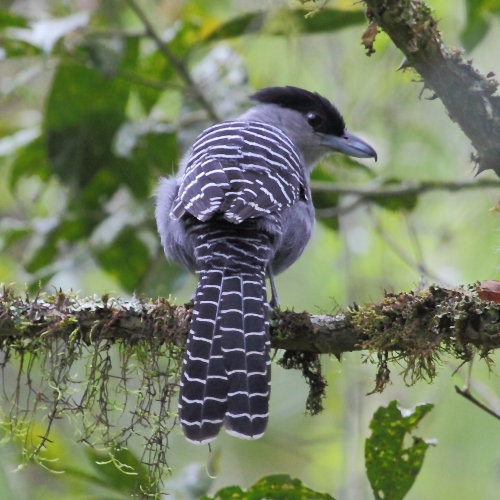
Mato Grosso Antbird
Cercomacra melanaria
Order: Passeriformes / Family: Thamnophilidae

Wikimedia Commons
About the Mato Grosso Antbird
The Mato Grosso Antbird, Cercomacra melanaria, is a fascinating member of the Thamnophilidae family, known for its adaptability and ecological importance in the ecosystems it inhabits. This bird is primarily found in the Pantanal region, which spans parts of Brazil, Paraguay, and Bolivia. The Pantanal is the world's largest tropical wetland area, providing the Mato Grosso Antbird with abundant resources and habitat diversity. The bird plays a crucial ecological role as an insectivore, controlling the populations of insects and contributing to the balance of the food web.
The Mato Grosso Antbird is notable for its preference for dense, shrubby undergrowth, often near water bodies. This habitat choice underscores its dependency on the complex wetland ecosystems of its range. The bird's presence in these habitats is a positive indicator of the health of these environments, as it requires a well-structured habitat to thrive. Seasonal flooding in the Pantanal significantly influences the bird's habitat availability, and the Mato Grosso Antbird has adapted to these changes by shifting its foraging and nesting strategies accordingly.
During the breeding season, which coincides with the wet season from October to March, the Mato Grosso Antbird increases its territorial behavior and vocal activity. This period is critical for mating and raising offspring, and the lush environment provides abundant food for the growing young. As the dry season approaches, the bird's behavior and habitat use may shift slightly, but it remains predominantly within its established territory. The Mato Grosso Antbird's resilience in adapting to seasonal changes highlights its evolutionary success in one of the most dynamic ecosystems on the planet.
The Mato Grosso Antbird belongs to the family Thamnophilidae, within the order Passeriformes. These birds typically live average 5 years with a max recorded of 8 years.
How to Identify a Mato Grosso Antbird
The Mato Grosso Antbird is a small, striking bird primarily characterized by its dark plumage. Adult males are predominantly black with subtle grayish tones on the wings and tail, which helps in distinguishing them from similarly sized and colored species. Females, on the other hand, have a more muted coloration, with brownish tones interspersed with black, particularly on the head and upper body. This sexual dimorphism aids birders in identifying gender from a distance.
Juvenile Mato Grosso Antbirds differ from adults as they exhibit more of a mottled pattern, which gradually changes as they mature. Their initial plumage lacks the stark contrast seen in adults, making them slightly harder to identify. However, their behavior and habitat choice often provide additional clues.
In flight, the Mato Grosso Antbird displays a rapid, darting flight pattern typical of thamnophilids, with a short tail and rounded wings that are well-suited for navigating dense undergrowth. When perching, the bird often holds a horizontal posture, which, combined with its preference for low branches and thickets, helps birders spot them despite their cryptic coloration. This posture, coupled with their vocalizations, often provides the best opportunity for identification in the field.
Having trouble telling birds apart? Upload a photo to our bird identification tool for an instant species match.
Mato Grosso Antbird Habitat and Range
Preferred Habitat
The Mato Grosso Antbird primarily inhabits the dense undergrowth of tropical wetlands, a characteristic feature of the Pantanal region. These wetlands offer a rich tapestry of habitat types, from seasonally flooded grasslands to more permanent swampy areas. The bird favors areas with thick shrubbery and proximity to water, which provide shelter and ample foraging opportunities.
This species' habitat preference includes elevations ranging from near sea level to moderate uplands, typically not exceeding 500 meters. It thrives in areas where seasonal fluctuations in water levels create a dynamic environment conducive to a rich insect population.
While the Mato Grosso Antbird is predominantly found in rural and natural wetland areas, it can occasionally be spotted in the outskirts of small towns or villages that border these ecosystems. However, urbanization poses threats to its preferred habitat, as development can lead to habitat fragmentation and degradation.
Geographic Range
The Mato Grosso Antbird has a relatively restricted range, primarily confined to the expansive Pantanal wetlands, which cover parts of western Brazil, eastern Bolivia, and northern Paraguay. These wetlands serve as both its breeding and non-breeding grounds, making the species a year-round resident rather than a migratory bird.
The bird's range corresponds closely with the distribution of suitable wetland habitats, which offer the dense undergrowth and water sources it requires. Within this range, the Mato Grosso Antbird tends to be more densely populated in areas with less human disturbance, particularly in less-accessible parts of the Pantanal.
Despite its limited range, the Mato Grosso Antbird is considered relatively common within its preferred habitats. However, specific population density hotspots can be found in undisturbed sections of the Pantanal, where the habitat remains most intact and offers optimal conditions for feeding and nesting.
Want to know which birds visit your area? Browse our backyard birds by location guides for region-specific species lists.
What Does the Mato Grosso Antbird Eat?
The Mato Grosso Antbird's diet primarily consists of insects and other arthropods, which it skillfully hunts within the dense undergrowth of its wetland habitat. Beetles, ants, and spiders form a significant portion of its diet, with prey size ranging from small insects to medium-sized arthropods that can be easily managed.
The bird employs a foraging technique known as 'gleaning', where it picks insects off foliage or the forest floor with precision. This technique is particularly effective in its preferred habitat, where dense shrubbery offers both prey and cover. During the wet season, when insect populations peak, the Mato Grosso Antbird may consume a broader range of prey, including caterpillars and other soft-bodied insects.
Feeding primarily occurs during the cooler parts of the day, such as early morning and late afternoon, when insect activity is high. This schedule helps the bird avoid the heat of the day while taking advantage of active prey.
Mato Grosso Antbird Behavior and Social Structure
The Mato Grosso Antbird exhibits fascinating social and territorial behaviors. It is primarily a solitary or paired bird, with individuals often maintaining and defending territories, especially during the breeding season. Territorial disputes are common and involve vocal displays and posturing rather than physical altercations.
Courtship displays are subtle, often involving mutual preening and soft vocalizations between mates. These displays reinforce pair bonds and ensure successful mating. Unlike some other species, the Mato Grosso Antbird does not typically form large flocks, but it may join mixed-species foraging groups outside the breeding season.
The bird's response to predators involves both vocal alarms and evasive maneuvers. When threatened, it will emit a sharp call to alert nearby birds and may perform distraction displays to lead predators away from nests or young. The Mato Grosso Antbird is most active during daylight hours, with activity peaking during the cooler morning and late afternoon periods, aligning with its feeding schedule.
Mato Grosso Antbird Nesting and Reproduction
The Mato Grosso Antbird constructs cup-shaped nests, often placed low in dense shrubbery or among reeds. The choice of nest location reflects its need for concealment from predators. Nest materials typically include twigs, leaves, and plant fibers, woven together to create a secure structure.
Clutch size generally ranges from two to three eggs, which are incubated by both parents. The incubation period lasts approximately 14 to 16 days, during which time the parents take turns keeping the eggs warm and guarding the nest.
Once the eggs hatch, both parents participate in feeding and caring for the young. The fledging period is brief, usually around 10 to 12 days, after which the chicks leave the nest but remain dependent on parental care for a short time. The Mato Grosso Antbird typically raises one to two broods per year, depending on environmental conditions and food availability.
Mato Grosso Antbird Sounds and Vocalizations
The Mato Grosso Antbird's song is a series of rapid, repetitive notes with a slightly metallic quality, often described as 'tik-tik-tik'. This song is more frequently heard during the breeding season, serving both to establish territory and to attract mates. The rhythm is steady, and the pitch is relatively high, cutting through the dense undergrowth effectively.
In addition to its primary song, the bird produces various call notes, including short, sharp 'chip' sounds used for communication between mates or as alarm calls. When predators are near, the alarm calls become more frequent and urgent, alerting other birds in the vicinity.
During the dawn chorus, the Mato Grosso Antbird's voice blends with the calls of other wetland birds, contributing to the vibrant soundscape of its habitat. The bird's vocalizations are distinctive, serving as a reliable tool for identification in the field.
Interesting Facts About the Mato Grosso Antbird
- 1The Mato Grosso Antbird is named after the Brazilian state of Mato Grosso, a key part of its range in the Pantanal.
- 2Despite its name, the Mato Grosso Antbird rarely follows ant swarms, unlike some other antbird species.
- 3The Pantanal, where the Mato Grosso Antbird lives, is estimated to be 20 times the size of the Everglades.
- 4This bird's song can carry up to 100 meters through dense vegetation, aiding in territory establishment.
- 5The Mato Grosso Antbird is one of over 200 species in the antbird family, Thamnophilidae.
- 6Its diet helps control insect populations, playing a crucial role in its wetland ecosystem.
- 7The Mato Grosso Antbird's nesting success is closely tied to the water levels in its wetland habitat.
Mato Grosso Antbird Conservation Status
The Mato Grosso Antbird is currently classified as Least Concern by the IUCN, reflecting its stable population trend. However, ongoing threats such as habitat destruction and fragmentation due to agricultural expansion and urbanization pose significant risks to its habitat. Conservation efforts in the Pantanal aim to protect wetland habitats through sustainable land use practices and the establishment of protected areas. These measures help mitigate habitat loss and ensure the long-term survival of species like the Mato Grosso Antbird. Historically, the population of the Mato Grosso Antbird has fluctuated in response to changes in wetland management and land use in the region. Continued monitoring and habitat preservation are essential to maintain its current status and prevent future declines.