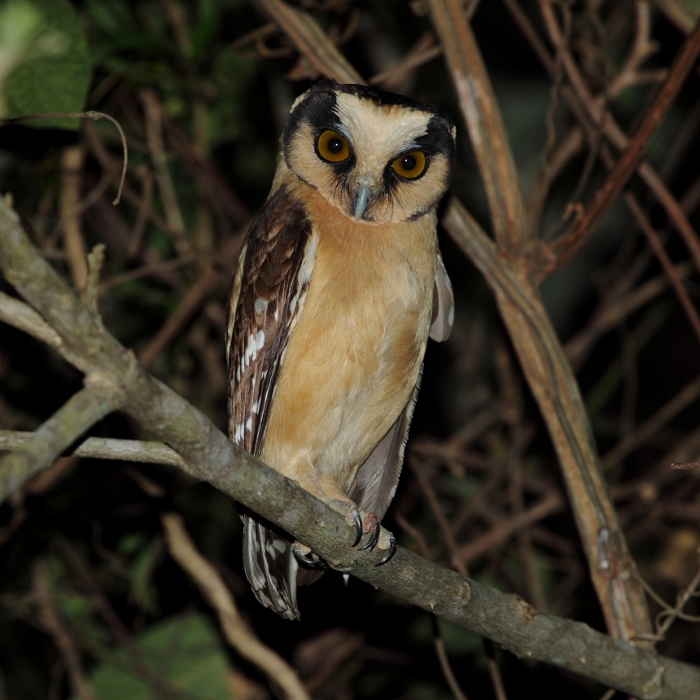
Alagoas Screech-Owl
Megascops alagoensis
Order: Strigiformes / Family: Strigidae

Wikimedia Commons
About the Alagoas Screech-Owl
The Alagoas Screech-Owl (Megascops alagoensis) is an elusive and critically endangered bird endemic to northeastern Brazil, particularly the state of Alagoas. This small owl, belonging to the Strigidae family, plays a crucial role in its ecosystem as a nocturnal predator, helping to control insect and small vertebrate populations. It occupies dense, humid forest habitats, primarily within the Atlantic Forest biome, which is one of the most biodiverse yet threatened regions on Earth. This owl's presence is an indicator of forest health, as it requires intact forest canopies for roosting and nesting. The species faces significant threats from habitat destruction due to logging, agriculture, and urban expansion, which have reduced its habitat to small, fragmented patches. As deforestation continues, the Alagoas Screech-Owl's survival becomes increasingly precarious. Conservationists have prioritized this species due to its restricted range and declining population, highlighting the necessity to preserve and restore its natural habitats. The ecological role of the Alagoas Screech-Owl extends beyond predation, as it participates in seed dispersal indirectly through its prey. During the breeding season, which coincides with the rainy season, the owl becomes more vocal and territorial, using its calls to establish dominance and locate mates. These seasonal behaviors are vital for maintaining its place within the forest ecosystem. As a nocturnal bird, it contributes to the nighttime soundscape of the forest, its calls echoing through the trees, a reminder of the rich biodiversity that the Atlantic Forest supports. Despite its small size, the Alagoas Screech-Owl holds significant ecological value. Its conservation status serves as a barometer for the health of its environment. Efforts to protect and restore the Atlantic Forest are not only critical for this species but for countless others relying on this unique and irreplaceable habitat.
The Alagoas Screech-Owl belongs to the family Strigidae, within the order Strigiformes. These birds typically live estimated to be around 5-10 years in the wild..
How to Identify a Alagoas Screech-Owl
The Alagoas Screech-Owl is a small owl, measuring around 21-23 centimeters in length. It exhibits a mottled gray-brown plumage that provides excellent camouflage against the bark of trees. The facial disk is defined with darker borders, and the eyes are large and yellow, characteristic of the species. Juveniles resemble adults but tend to have slightly fluffier plumage and lack the defined facial disk of mature birds. Males and females appear similar in plumage, though females are often marginally larger. In flight, this owl displays broad, rounded wings and a short tail, creating a stocky silhouette. When perched, it sits upright, often motionless against tree trunks or within dense foliage. Confusion with other screech-owls, such as the Tawny-browed Owl, can occur, but the Alagoas Screech-Owl's distinct vocal patterns and specific range help differentiate it from similar species. Its relatively small size and unique vocalizations are key identifiers for experienced birders.
Having trouble telling birds apart? Upload a photo to our bird identification tool for an instant species match.
Alagoas Screech-Owl Habitat and Range
Preferred Habitat
Alagoas Screech-Owls inhabit the dense, humid forests of the Atlantic Forest in northeastern Brazil, primarily within Alagoas state. These owls favor lowland and montane forest regions, generally below 1,000 meters in elevation. They prefer areas with dense canopy cover, which provide ample roosting and nesting sites. Seasonal habitat shifts may occur as these owls adapt to changes in prey availability and environmental conditions. Unlike some owl species, the Alagoas Screech-Owl does not typically venture into urban areas, preferring the seclusion of forest interiors. This preference makes it particularly vulnerable to habitat fragmentation, as it relies on contiguous forest tracts for survival.
Geographic Range
The Alagoas Screech-Owl's range is highly restricted to northeastern Brazil, with its primary stronghold in the state of Alagoas. It occupies a limited range within the Atlantic Forest, one of the most fragmented and endangered ecosystems in the world. The breeding range does not extend far beyond this region, and there is no evidence of long-distance migration. Instead, the species may move locally within its limited range to exploit seasonal food resources. Population density hotspots occur in areas with remaining intact forest habitat, but these are dwindling rapidly. Conservation efforts must focus on protecting these critical habitats to ensure the species' survival.
Want to know which birds visit your area? Browse our backyard birds by location guides for region-specific species lists.
What Does the Alagoas Screech-Owl Eat?
The diet of the Alagoas Screech-Owl consists mainly of insects and small vertebrates, including rodents and small birds. During different seasons, its diet may shift depending on prey availability, but it primarily remains an insectivore. The owl employs a sit-and-wait hunting strategy, often perching silently before swooping down to capture prey with its talons. This nocturnal hunter operates under the cover of darkness, using its acute hearing and sharp eyesight to detect prey. The size of prey typically ranges from small insects to vertebrates no larger than a small rodent, enabling the owl to maintain its energy needs throughout the year.
Alagoas Screech-Owl Behavior and Social Structure
Alagoas Screech-Owls are primarily solitary and territorial, especially during the breeding season, when males establish territories with vocal displays. These owls are nocturnal, becoming active at dusk to begin their hunting activities, which continue throughout the night. During the day, they roost in tree cavities or dense foliage to hide from predators. When threatened, they rely on their camouflaged plumage to blend into their surroundings. In response to predators, they may exhibit distraction displays or rely on their silent flight to escape. Courtship involves complex vocalizations, with males calling to attract females. Once paired, the owls maintain close contact through mutual preening and duet calls. Unlike some owl species, the Alagoas Screech-Owl rarely forms flocks, maintaining a solitary lifestyle outside of the breeding season.
Alagoas Screech-Owl Nesting and Reproduction
The Alagoas Screech-Owl nests in natural tree cavities, often selecting sites that offer protection from the elements and predators. Nest materials include leaves and small twigs, though the owl does not construct a nest in the traditional sense. The clutch size typically ranges from two to three eggs, with incubation lasting around 26 to 30 days. Both parents share in the incubation duties, although the female primarily incubates while the male provides food. After hatching, the young remain in the nest for several weeks before fledging, usually around 30 to 35 days post-hatching. Parental care continues for a short period after the young leave the nest, as they learn to hunt and fend for themselves. The species generally produces one brood per year, coinciding with the rainy season when food is most abundant.
Alagoas Screech-Owl Sounds and Vocalizations
The primary song of the Alagoas Screech-Owl is a series of short, soft hoots delivered in a rhythmic pattern. These calls serve as territorial warnings and mating displays. In addition to the primary song, the owl produces a variety of call notes, including sharp barks and trills, used in communication with mates or young. Alarm calls are louder and more urgent, designed to deter predators or alert others to danger. During the dawn chorus, the owl's calls are more frequent, marking its territory at a time when many nocturnal creatures retreat to rest. These vocalizations, though subtle, play a vital role in the owl's social structure and communication.
Interesting Facts About the Alagoas Screech-Owl
- 1The Alagoas Screech-Owl measures just 21-23 centimeters, making it a small yet vocal predator.
- 2Its habitat, the Atlantic Forest, is one of the most biodiverse regions on Earth, with many endemic species.
- 3Despite its small range, the Alagoas Screech-Owl plays a crucial role in controlling insect populations.
- 4This owl's vocalizations are key to its social interactions, especially during the breeding season.
- 5The Alagoas Screech-Owl relies heavily on the dense forest canopy for both roosting and nesting.
- 6The owl's camouflage is so effective that it often remains undetected, even by experienced birders.
- 7Conservation efforts for this owl also benefit numerous other species within the same habitat.
Alagoas Screech-Owl Conservation Status
The Alagoas Screech-Owl is currently listed as Critically Endangered on the IUCN Red List, with its population trend decreasing due to ongoing habitat loss. Primary threats include deforestation for agriculture, logging, and urban development, which have led to severe habitat fragmentation. Conservation efforts focus on protecting the remaining patches of Atlantic Forest, with initiatives aimed at habitat restoration and legal protection of critical areas. Historically, the population has declined sharply, mirroring the loss of its forest habitat. Successful conservation will require coordinated efforts to halt deforestation and promote reforestation in affected regions.
Other Strigidae Species


Birds Similar to the Alagoas Screech-Owl
These species are often confused with the Alagoas Screech-Owl due to similar appearance or overlapping range.