
Moss-backed Sparrow
Arremon dorbignii
Order: Passeriformes / Family: Passerellidae
Wikimedia Commons
About the Moss-backed Sparrow
The Moss-backed Sparrow, scientifically known as Arremon dorbignii, is a striking member of the Passerellidae family, celebrated for its distinctive moss-green plumage. This bird thrives in the subtropical and tropical forests ranging from Bolivia to Argentina. Preferring the dense undergrowth of montane forests, the Moss-backed Sparrow plays a crucial role in the ecosystem by participating in seed dispersal. Its presence indicates a healthy forest understory, as it often inhabits areas rich in shrubbery and leaf litter. The ecological role of this species extends beyond its immediate habitat, as its foraging habits help control insect populations, contributing to the overall health of the forest ecosystem.
In the regions where it resides, the Moss-backed Sparrow is an important component of the avian community. Its behavior and adaptations are finely tuned to its environment. During the breeding season, which coincides with the rainy months, these sparrows exhibit increased territoriality and vocal activity. This seasonality ensures that the young hatch during periods of abundant food supply, primarily insects.
The sparrow's contribution to the ecosystem is significant. By controlling insect numbers and aiding in seed dispersal, it helps maintain the biodiversity of its habitat. Researchers and bird enthusiasts alike value the Moss-backed Sparrow for its role as an environmental indicator species. Its presence often suggests an intact and thriving forest environment, making it a subject of interest for conservationists aiming to preserve its natural habitat.
The Moss-backed Sparrow belongs to the family Passerellidae, within the order Passeriformes. These birds typically live typically around 5-7 years, with a maximum recorded of 12 years..
How to Identify a Moss-backed Sparrow
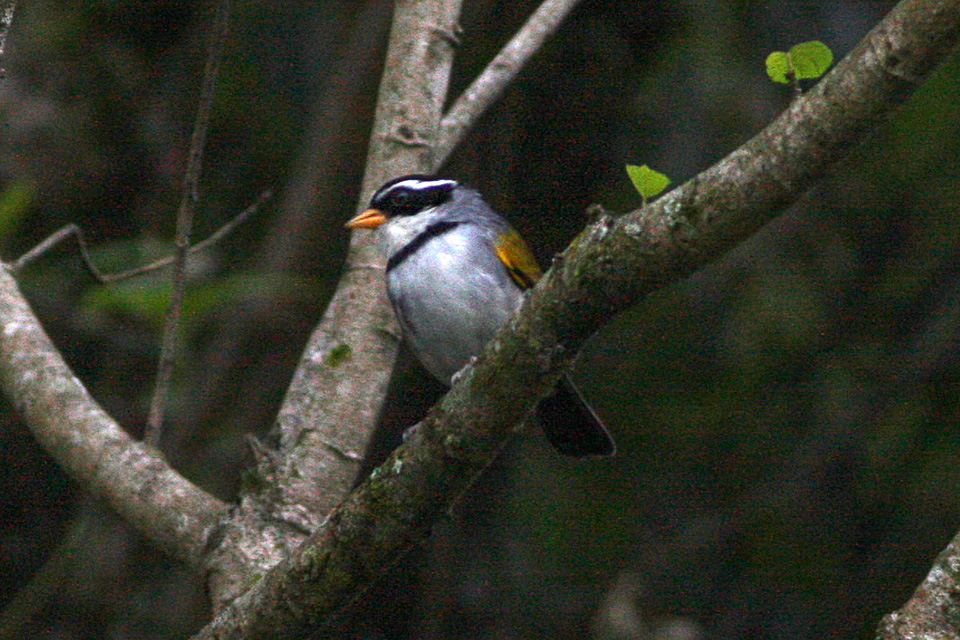
Moss-backed Sparrows are medium-sized birds, measuring about 14 centimeters in length. Adults display a vibrant moss-green back, which contrasts sharply with their black head and white throat. The underparts are generally a soft gray, providing additional contrast. Juvenile Moss-backed Sparrows are slightly duller, with a more muted green on their back and a less pronounced black head. Males and females exhibit similar plumage, making them difficult to distinguish in the field based on appearance alone.
When observing these sparrows, note their distinctive perching posture, often upright with a slight forward lean. Their rounded wings and medium-length tails are visible in flight, which is typically a short burst followed by a glide. This flight pattern, combined with their unique coloration, helps mitigate confusion with similar species such as the Black-striped Sparrow. The Moss-backed Sparrow's call is another identification aid, a series of short, sharp notes distinct from those of similar sparrows.
In terms of behavior, the Moss-backed Sparrow is often seen foraging on the ground, where its coloration provides excellent camouflage among the foliage. Observers should look for the characteristic flick of the tail, a common behavior among ground-foraging sparrows.
Having trouble telling birds apart? Upload a photo to our bird identification tool for an instant species match.
Moss-backed Sparrow Habitat and Range
Preferred Habitat
The Moss-backed Sparrow favors subtropical and tropical moist montane forests. It thrives at elevations ranging from 1,000 to 2,500 meters, where dense understory and ample leaf litter are prevalent. These sparrows are typically found in forested areas with complex vertical structures, providing ample foraging opportunities and nesting sites. Seasonal habitat shifts are minimal, as this species is largely sedentary, remaining within its preferred habitat year-round.
While primarily forest dwellers, Moss-backed Sparrows occasionally venture into adjacent scrublands and secondary forests, particularly in search of food. Their presence in urban areas is rare, as they avoid heavily developed regions. Instead, they find refuge in protected areas and reserves where their habitat remains undisturbed by human activity.
Geographic Range
The range of the Moss-backed Sparrow includes parts of Bolivia, Peru, and northwestern Argentina. Within these countries, it is primarily found in the Andean regions, with populations concentrated in areas such as the Yungas forest of Bolivia and the cloud forests of northern Argentina. These regions offer the ideal combination of elevation, humidity, and vegetation density that the species requires.
The Moss-backed Sparrow is non-migratory, residing within its range throughout the year. Breeding territories are established within this range, with some local movement possibly occurring in response to food availability. Despite its relatively restricted range, the sparrow can be locally abundant where suitable habitat exists, forming dense populations in areas with optimal conditions.
Want to know which birds visit your area? Browse our backyard birds by location guides for region-specific species lists.
What Does the Moss-backed Sparrow Eat?
The diet of the Moss-backed Sparrow primarily consists of insects, seeds, and small fruits. Insect consumption is particularly high during the breeding season, providing essential protein for nestlings. This sparrow employs a foraging technique known as 'ground gleaning,' where it searches for food on the forest floor, flipping leaves and debris with its beak to uncover hidden prey.
Seeds and fruits become more prominent in the sparrow's diet during the non-breeding season, reflecting the seasonal availability of food resources. The sparrow's flexible diet allows it to adapt to varying food supplies throughout the year. This adaptability is crucial for survival in the fluctuating conditions of its forest habitat.
The size of prey items typically includes small beetles and caterpillars, reflecting the sparrow's ability to exploit a range of food sources. Feeding occurs primarily in the early morning and late afternoon, coinciding with periods of increased insect activity.
Moss-backed Sparrow Behavior and Social Structure
The social structure of the Moss-backed Sparrow is largely solitary, although pairs form during the breeding season. Territorial behavior is pronounced, especially during this time, with males engaging in vocal displays to defend their nesting area. Courtship involves a series of calls and displays, often accompanied by mutual preening between pairs.
Flocking behavior outside of the breeding season is minimal, as individuals maintain separate foraging territories. However, loose associations may form when food resources are abundant. In response to predators, such as hawks, the sparrow exhibits a 'freezing' behavior, relying on its cryptic plumage for camouflage.
Daily activity patterns show that Moss-backed Sparrows are most active during dawn and dusk, aligning with peak insect activity. This pattern allows them to maximize food intake while minimizing exposure to potential predators.
Moss-backed Sparrow Nesting and Reproduction
Moss-backed Sparrows build cup-shaped nests, primarily using twigs, grasses, and leaves. These nests are typically located on or near the ground, often concealed in dense undergrowth to protect against predators. The choice of nest site is crucial for survival, as it offers camouflage and shelter.
Clutch sizes range from two to four eggs, with an incubation period of approximately 14 days. Both parents participate in feeding the chicks, although the female primarily handles incubation. Fledging occurs about 12 to 15 days after hatching, with the young remaining dependent on parental care for several weeks.
The Moss-backed Sparrow generally raises one brood per year, although a second brood may occur if environmental conditions allow. The relatively lengthy care period ensures that fledglings have a high chance of survival, allowing them to develop the necessary skills for independent life.
Moss-backed Sparrow Sounds and Vocalizations
The primary song of the Moss-backed Sparrow is a series of clear, melodious whistles, each phrase rising slightly in pitch. This song is often delivered from a concealed perch within the forest understory. Call notes are short and sharp, used primarily for communication between mates or as an alarm signal. When alarmed, the sparrow emits a rapid series of harsh notes, alerting others to potential danger.
The dawn chorus showcases the sparrow's vocal repertoire, with males singing more frequently to establish territory and attract mates. The song's quality has been compared to that of a flute, clear and resonant within the dense forest. Observers often note the contrast between the sparrow's distinct vocalizations and the more complex songs of other forest birds.
Interesting Facts About the Moss-backed Sparrow
- 1The Moss-backed Sparrow often forages in mixed-species flocks, benefiting from the increased vigilance provided by the group.
- 2Despite its vibrant plumage, the Moss-backed Sparrow's cryptic behavior makes it challenging to spot in its dense forest habitat.
- 3The sparrow's song can carry over long distances, helping to establish territory boundaries within the crowded forest.
- 4During courtship, males perform a unique display involving a series of short hops and wing flicks to attract females.
- 5The Moss-backed Sparrow's nest-building skills are so intricate that the structures can sometimes be mistaken for those of larger birds.
- 6This species is a vital component of the Andean montane forest ecosystem, serving as both predator and prey within its food web.
- 7Rainforest expeditions often seek out the Moss-backed Sparrow as an indicator species of healthy forest environments.
Moss-backed Sparrow Conservation Status
The Moss-backed Sparrow currently holds a conservation status of Least Concern, with populations considered stable. However, habitat loss due to deforestation poses a significant threat, particularly in regions where forest conversion for agriculture is prevalent. Conservation efforts focus on protecting critical habitats within national parks and reserves. Historical population changes have been minimal, but ongoing habitat fragmentation could impact future stability. Conservationists advocate for sustainable land-use practices and the establishment of ecological corridors to support this species. Continued monitoring is essential to ensure that population trends remain positive and that habitat preservation efforts are effective.
Other Passerellidae Species


Birds Similar to the Moss-backed Sparrow
These species are often confused with the Moss-backed Sparrow due to similar appearance or overlapping range.

