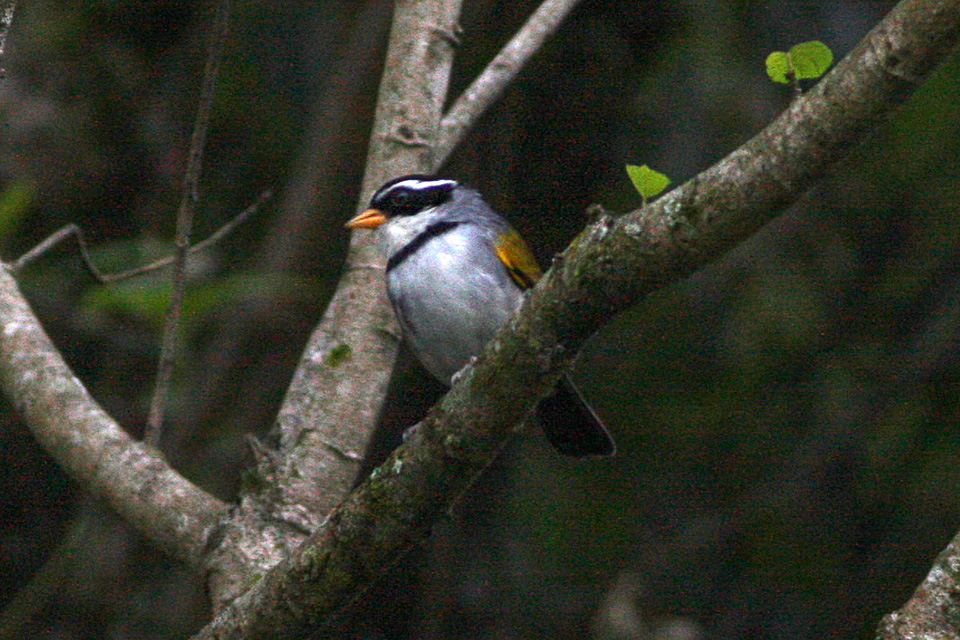
Sooty-faced Finch
Arremon crassirostris
Order: Passeriformes / Family: Passerellidae

Wikimedia Commons
About the Sooty-faced Finch
The Sooty-faced Finch (Arremon crassirostris) stands out as a key avian resident of the dense, humid forests of Central America. Found primarily in the countries of Costa Rica and Panama, this bird thrives in the undergrowth of tropical and subtropical forests. Its presence contributes significantly to the ecological dynamics of these ecosystems, as it participates actively in seed dispersion and insect population control. The Sooty-faced Finch is a year-round resident of its habitat, adapting to the seasonal variations of the tropical climate. During the wet season, the finch often engages in more intensive foraging to take advantage of the abundance of insects and fruits. In the dry season, its diet shifts slightly, with a greater reliance on seeds. This adaptability in feeding helps maintain its population even as environmental conditions fluctuate. The Sooty-faced Finch plays a role as both a predator and prey within its ecosystem. While it consumes a variety of seeds and insects, it also falls prey to larger birds of prey and some forest mammals. This dual role underscores its importance in maintaining the delicate balance within its habitat. The species' presence also acts as an indicator of forest health, as its survival depends on rich, uninterrupted forest cover.
The Sooty-faced Finch belongs to the family Passerellidae, within the order Passeriformes. These birds typically live around 4-6 years on average, with a maximum recorded of 9 years..
How to Identify a Sooty-faced Finch
Adult Sooty-faced Finches exhibit a striking appearance with their predominantly olive-green back and wings, contrasted by a grayish-white belly. The most distinctive feature is their sooty-black face, which extends from the beak to behind the eyes, giving the bird its name. The robust, conical bill is well-suited for seed consumption, a key aspect of its diet. Juvenile finches display muted versions of the adult coloration, with browner tones and less pronounced facial markings. Males and females are similar in appearance, making visual differentiation challenging without closer inspection. In flight, the Sooty-faced Finch maintains a low, direct path through the underbrush, rarely venturing into open spaces. Its perching posture is upright, often accompanied by constant head movements as it scans for food or potential threats. Confusion with similar species such as the Black-striped Sparrow can occur, but the Sooty-faced Finch's darker facial plumage and stout bill are reliable distinguishing features.
Having trouble telling birds apart? Upload a photo to our bird identification tool for an instant species match.
Sooty-faced Finch Habitat and Range
Preferred Habitat
The Sooty-faced Finch inhabits the dense, humid understory of tropical and subtropical forests, primarily within elevations ranging from 600 to 1,500 meters. This bird favors regions where dense foliage provides ample cover and foraging opportunities. In Costa Rica, it is commonly found in the Pacific slope's mid-elevation forests, such as those in the Osa Peninsula. During times of environmental stress, such as prolonged dry periods, the finch may venture into adjacent secondary growth areas where food sources may be more abundant. Unlike some other species, the Sooty-faced Finch rarely ventures into urban areas, preferring the secluded, lush environments that tropical forests provide.
Geographic Range
The Sooty-faced Finch is primarily found in the countries of Costa Rica and Panama. It occupies a relatively narrow geographical range, restricted to the humid slopes of the Pacific and Caribbean sides of these countries. Within this range, the species is considered a resident bird, showing little to no long-distance migratory behavior. Occasionally, it may perform altitudinal migrations in response to seasonal food availability, moving to slightly higher elevations during certain times of the year. Population densities are generally higher in regions where primary forest cover is intact, such as the Monteverde Cloud Forest in Costa Rica.
Want to know which birds visit your area? Browse our backyard birds by location guides for region-specific species lists.
What Does the Sooty-faced Finch Eat?
The Sooty-faced Finch's diet consists mainly of seeds and insects, with occasional consumption of fruits and berries. During the wet season, the abundance of insects like beetles and caterpillars provides a rich protein source, which the finch actively seeks out by foraging through leaf litter and low shrubs. In contrast, the dry season sees a shift towards more seed consumption, with the bird utilizing its strong bill to crack open various seed types. The finch's foraging technique is methodical, often involving careful examination of the forest floor and low vegetation. It forages primarily during the early morning and late afternoon, taking advantage of cooler temperatures and reduced predator activity.
Sooty-faced Finch Behavior and Social Structure
The Sooty-faced Finch is generally solitary or found in pairs, exhibiting territorial behavior particularly during the breeding season. Males are known to engage in song bouts to establish territory and attract mates, although these displays are less pronounced than in some other passerines. The finch demonstrates a cautious nature, often remaining in dense cover and rarely exposing itself to open areas. When predators approach, it emits sharp alarm calls and seeks refuge in thicker foliage. Social interactions are limited outside of the breeding season, but small loose flocks may form during foraging. The finch's daily activity is bimodal, with peaks in the early morning and late afternoon.
Sooty-faced Finch Nesting and Reproduction
Sooty-faced Finches construct cup-shaped nests using a variety of materials including grasses, leaves, and fine twigs. These nests are typically located close to the ground, nestled within dense shrubbery or low trees to provide protection from predators. The typical clutch size ranges from two to four eggs, with both parents sharing incubation duties over a period of approximately two weeks. After hatching, the young finches remain in the nest for another two weeks before fledging. Both parents engage in feeding the chicks, ensuring a balanced diet of insects and seeds. The species usually raises one or two broods per year, depending on environmental conditions.
Sooty-faced Finch Sounds and Vocalizations
The Sooty-faced Finch's song is a series of rapid, metallic chips and whistles, somewhat reminiscent of a sparrow's song but with a harsher quality. These calls serve both territorial and mate attraction purposes, primarily during the early morning hours. Its call notes include sharp, single 'tsip' sounds used for general communication. In the presence of danger, the finch produces a frantic series of alarm calls, alerting nearby birds to potential threats. This vocal repertoire enables effective communication within the dense forest environment.
Interesting Facts About the Sooty-faced Finch
- 1The Sooty-faced Finch's robust bill is perfectly adapted for crushing hard seeds, which form a large part of its diet.
- 2Despite its striking plumage, the Sooty-faced Finch often remains hidden in dense vegetation, making it a challenge to spot.
- 3The Sooty-faced Finch is most active during the cooler hours of the day, avoiding the midday heat typical of its tropical habitat.
- 4This finch is a year-round resident of its habitat, showing little migratory behavior in contrast to many other bird species.
- 5The Sooty-faced Finch contributes to forest health by dispersing seeds of various plant species as it forages.
- 6Its distinctive sooty face not only gives the bird its name but also aids in identification amid the forest's dense foliage.
- 7The bird's song, though less melodious than some, plays a crucial role in maintaining its territory and finding mates.
Sooty-faced Finch Conservation Status
The Sooty-faced Finch is currently classified as Least Concern by the IUCN, with populations considered stable. However, habitat destruction due to deforestation poses a significant threat, as it leads to fragmentation of the bird's required forest environment. Conservation efforts in Costa Rica and Panama focus on protecting remaining forest areas and promoting reforestation. Historically, the finch has experienced fluctuations in local population sizes, largely dependent on the extent of forest cover. Continued monitoring and habitat protection are crucial for maintaining its stable population trend.
Other Passerellidae Species


Birds Similar to the Sooty-faced Finch
These species are often confused with the Sooty-faced Finch due to similar appearance or overlapping range.