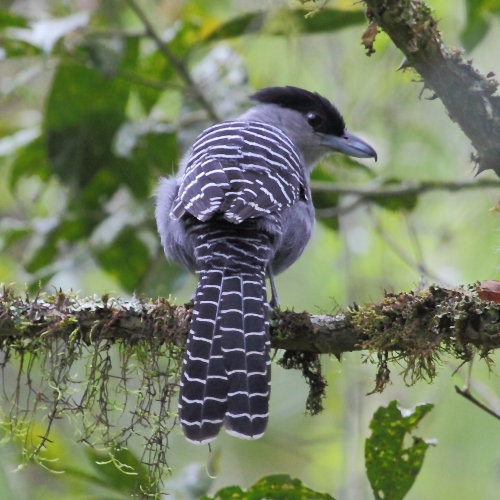
Myrmornis arada
Myrmornis arada
Order: Passeriformes / Family: Thamnophilidae

Wikimedia Commons
About the Myrmornis arada
The Myrmornis arada, commonly known as the Wing-banded Antbird, inhabits the dense tropical forests of South America, particularly in countries such as Brazil, Venezuela, and the Guianas. This antbird is a member of the Thamnophilidae family, which comprises a variety of insectivorous birds adapted to understory life. The Wing-banded Antbird plays a crucial ecological role as a predator of insects, helping to maintain the balance of the forest ecosystem. They are particularly associated with army ant swarms, following these insects to capture fleeing prey. Their presence often indicates a healthy, biodiverse forest environment.
The significance of the Myrmornis arada extends beyond its ecological role. It serves as an indicator species for the health of tropical forest ecosystems, thriving in undisturbed, mature forest habitats. Its behavior offers insights into the complex interactions among species in these environments. Seasonally, the Wing-banded Antbird does not undertake long migrations but may exhibit local movements in response to food availability and habitat changes.
The Myrmornis arada's elusive nature contributes to its intrigue among birders and researchers alike. Its preference for shaded understory and dense foliage makes it a challenging bird to observe, yet this secretive lifestyle aids in its survival by providing protection from predators. Despite its relative rarity and habitat specificity, the Wing-banded Antbird remains a captivating subject for studies on avian adaptation to tropical forest life.
The Myrmornis arada belongs to the family Thamnophilidae, within the order Passeriformes. These birds typically live average 6-9 years with a maximum recorded of 12 years..
How to Identify a Myrmornis arada
The adult Myrmornis arada displays a distinctive appearance with its prominent wing bands, which are white and contrast sharply against its otherwise dark plumage. The bird's upperparts are predominantly black with a subtle sheen, while the underparts are more subdued, featuring a mix of gray and black. Both males and females share similar plumage, although males might show slightly more vivid contrast in their wing pattern.
Juvenile Wing-banded Antbirds are generally duller, lacking the crisp wing bands found in adults. As they mature, the juvenile plumage transitions to the adult pattern over several molts. This bird can be confused with other antbirds, but the unique wing bands and the combination of black and gray plumage make it distinguishable.
In flight, the Myrmornis arada shows a compact silhouette, with rapid wingbeats typical of forest-dwelling passerines. When perching, it often adopts a low, horizontal posture, making use of its cryptic coloration to blend into the shadowy understory.
Having trouble telling birds apart? Upload a photo to our bird identification tool for an instant species match.
Myrmornis arada Habitat and Range
Preferred Habitat
The Myrmornis arada thrives in lowland tropical forests, particularly favoring regions with dense understory vegetation. These birds are primarily found at elevations ranging from sea level to around 1,000 meters. They are most commonly associated with primary forests, where the structure and biodiversity offer ample foraging opportunities.
Though occasionally found in secondary forests, the presence of the Wing-banded Antbird in such areas usually indicates regions of regrowth with substantial underbrush. Unlike some forest birds, this species rarely ventures into urban or suburban areas, maintaining a preference for undisturbed forest habitats. The seasonal shifts in habitat usage are minimal, with movements within forest layers in response to prey abundance rather than altitudinal migration.
Geographic Range
The Myrmornis arada is distributed across northern South America, with a presence in countries such as Brazil, Venezuela, French Guiana, Suriname, and Guyana. Its range is largely restricted to the Amazon basin and the Guiana Shield, where dense forest habitats abound. Within these countries, the population densities can vary, with hotspots in areas of rich biodiversity and minimal human disturbance.
The Wing-banded Antbird does not engage in long-distance migrations. Instead, it exhibits more localized movements, occasionally shifting within its range in response to ecological factors such as prey availability. The bird's preference for mature forests limits its range expansion but ensures its presence in areas that remain ecologically intact.
Want to know which birds visit your area? Browse our backyard birds by location guides for region-specific species lists.
What Does the Myrmornis arada Eat?
The diet of the Myrmornis arada is predominantly insectivorous, focusing on the abundant arthropods found in its tropical forest habitat. It primarily feeds on ants, beetles, and other small insects, often following army ant swarms to capture prey disturbed by the ants' movement.
Seasonally, the diet may shift slightly to incorporate other available invertebrates, such as spiders and small caterpillars, especially when ant activity is low. The Wing-banded Antbird employs a foraging technique that involves quick, darting movements to catch insects flushed from the leaf litter. Its feeding schedule is largely diurnal, aligning with the activity patterns of its prey.
Myrmornis arada Behavior and Social Structure
The Myrmornis arada exhibits a solitary lifestyle, with individuals typically foraging alone or in pairs. Territorial behavior is less pronounced than in other antbirds, but males may defend a small area with vocalizations, especially during the breeding season.
Courtship displays are subtle, often involving synchronized movements or gentle vocal exchanges rather than elaborate displays. Flocking behavior is uncommon, with the Wing-banded Antbird preferring to remain concealed within the forest understory, avoiding open areas.
In response to predators, the Myrmornis arada relies on its cryptic plumage and stealthy movements rather than aggressive defense strategies. Daily activity peaks during the early morning and late afternoon, coinciding with the cooler parts of the day and the increased activity of prey species.
Myrmornis arada Nesting and Reproduction
The nesting behavior of the Myrmornis arada involves constructing a cup-shaped nest from fine plant materials such as leaves and fibers. These nests are typically placed low in the understory, often in dense thickets or against the trunk of a tree, providing camouflage from predators.
A typical clutch consists of two eggs, with both parents sharing incubation duties over a period of approximately two weeks. After hatching, the nestlings remain in the nest for another two to three weeks before fledging. Parental care continues for some time post-fledging, as the young are guided in foraging and gradually learn to be independent. The Wing-banded Antbird generally produces one brood per year, focusing its reproductive efforts on the most favorable seasons.
Myrmornis arada Sounds and Vocalizations
The Myrmornis arada's primary song is a series of short, melodious whistles delivered in a rhythmic pattern. The pitch is moderate, with a clear, resonant quality that carries well through the dense forest.
In addition to its territorial song, the Wing-banded Antbird emits various call notes, including a sharp, alerting chip sound used in response to disturbances. Alarm calls are harsher and more rapid, serving to warn mates and signal the presence of potential threats. During the dawn chorus, the bird's song becomes more pronounced, marking its territory and attracting mates.
Interesting Facts About the Myrmornis arada
- 1The Wing-banded Antbird's name comes from its distinct white wing bands, a rare feature among antbirds.
- 2Myrmornis arada is often found near army ant swarms, taking advantage of insects flushed by the ants.
- 3This species is part of a family known for its specialized insect-hunting techniques in dense forests.
- 4Despite its name, the Wing-banded Antbird does not solely feed on ants but a variety of forest insects.
- 5The bird's elusive nature makes it a prized sighting among birdwatchers visiting South American forests.
- 6Wing-banded Antbirds are often indicators of healthy, undisturbed forest ecosystems.
- 7Myrmornis arada's territorial song is most frequently heard during the early morning hours.
Myrmornis arada Conservation Status
The Myrmornis arada currently holds a status of Least Concern according to the IUCN, with a stable population trend across its range. However, habitat loss due to deforestation poses a significant long-term threat to its populations. Conservation efforts focus on preserving primary forest habitats and promoting sustainable land-use practices. Historically, the Wing-banded Antbird has maintained stable numbers in areas where forest conservation measures are effective. Continued efforts to curb habitat destruction and implement protected areas are vital for ensuring the species' future stability.