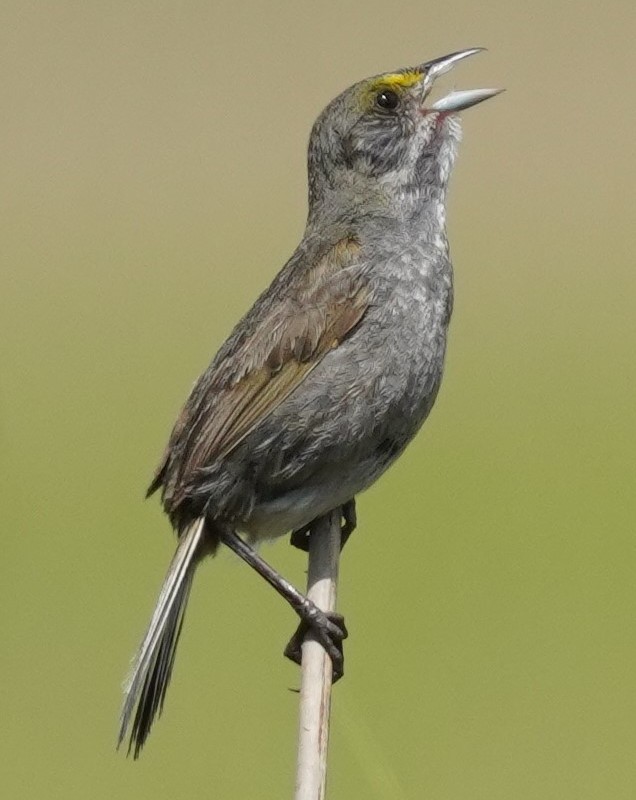
Nelson's Sparrow
Ammospiza nelsoni
Order: Passeriformes / Family: Passerellidae

Wikimedia Commons
About the Nelson's Sparrow
The Nelson's Sparrow, scientifically known as Ammospiza nelsoni, is a small passerine bird belonging to the family Passerellidae. This bird is notable for its vibrant orange face and distinct streaking along its flanks, making it a favorite subject among bird watchers. Primarily found in North America's coastal marshes and wet meadows, the Nelson's Sparrow has adapted to an array of wetland environments.
During the breeding season, which spans from June to August, this sparrow inhabits the northern Great Plains, from southern Canada down to the northern United States. Its ecological role is significant as it helps control insect populations and supports plant pollination processes. In winter, Nelson's Sparrows migrate to the southeastern United States, particularly the Gulf Coast, where they inhabit saltwater marshes and brackish estuaries.
The bird's ecology is tightly linked to wetland habitats, making it a valuable indicator species for environmental health. The Nelson's Sparrow's diet primarily consists of insects, small crustaceans, and seeds, which it diligently forages from the ground and among marsh vegetation. Its seasonal behaviors include intricate migration patterns, breeding displays, and territorial defense.
The Nelson's Sparrow plays a critical role in the food web within its wetland ecosystems, serving as both predator and prey. Its presence helps maintain the balance of aquatic invertebrate populations and provides food for higher trophic levels such as raptors and larger mammals. As wetlands face threats from climate change and human encroachment, the conservation of this species becomes increasingly vital.
The Nelson's Sparrow belongs to the family Passerellidae, within the order Passeriformes. These birds typically live average lifespan is about 4-5 years, with a maximum recorded age of 9 years..
How to Identify a Nelson's Sparrow
Nelson's Sparrows are small birds, measuring about 11-13 cm in length with a wingspan of 18-20 cm. Adults display a striking orange face and breast, with grayish napes and crowns. The flanks exhibit brown streaks against a buff background, aiding in their camouflage among the reeds. The plumage of juveniles is similar, though slightly duller, lacking the full intensity of the adult's orange facial coloring.
Sexual dimorphism is minimal in Nelson's Sparrows, with males and females appearing similar in size and coloration. However, males may sometimes exhibit brighter and more defined plumage during the breeding season. In flight, their short, rounded wings and rapid wingbeats are distinctive. When perched, they often sit upright in a conspicuous manner, showcasing their streaky sides and orange face.
Confusion with similar species such as the Saltmarsh Sparrow can occur. However, the Nelson's Sparrow can be differentiated by its more vivid orange face and the absence of the Saltmarsh Sparrow's more pronounced breast streaking. Observing these field marks carefully aids in accurate identification.
Having trouble telling birds apart? Upload a photo to our bird identification tool for an instant species match.
Nelson's Sparrow Habitat and Range
Preferred Habitat
Nelson's Sparrows inhabit a range of wetland environments, from tidal salt marshes along the Atlantic Coast to freshwater prairie wetlands. They favor habitats with dense vegetation, including grasses and sedges, which provide cover and foraging opportunities. These sparrows are typically found at low elevations, as their preferred habitats are primarily at sea level.
In breeding season, they occupy the wet meadows and marshes of the northern Great Plains and parts of southern Canada. As winter approaches, they shift to coastal marshes of the southeastern United States. Urban presence is minimal, as they are highly adapted to natural wetland ecosystems.
Seasonal habitat shifts are dictated by temperature and food availability, with Nelson's Sparrows remaining in more temperate coastal regions during winter months. This adaptation ensures access to unfrozen wetlands and continued foraging opportunities.
Geographic Range
The breeding range of Nelson's Sparrows stretches across the northern Great Plains, from southeastern Alberta and Saskatchewan to the Dakotas and Minnesota. They also breed in regions of southern Manitoba and northwestern Ontario.
During migration, these sparrows follow corridors through the Midwest and eastern United States, arriving at their wintering grounds along the Atlantic and Gulf coasts, from North Carolina to Texas. They are particularly abundant in coastal marshes of Louisiana and Texas during winter.
Population density hotspots include the expansive marshes of the upper Midwest during the breeding season and the Gulf Coast marshes in winter. Their presence is less frequent in inland regions outside migration periods, emphasizing their reliance on specific wetland habitats.
Want to know which birds visit your area? Browse our backyard birds by location guides for region-specific species lists.
What Does the Nelson's Sparrow Eat?
The diet of Nelson's Sparrows primarily consists of insects and small invertebrates, making them effective insectivores. Beetles, flies, and spiders form a significant portion of their diet during the breeding season, when protein demands are high.
In winter, their diet shifts slightly to include more seeds from marsh plants and grains washed into coastal areas. Their foraging technique involves probing through muddy surfaces and dense vegetation to extract prey. They exhibit a feeding schedule that peaks during early morning and late afternoon, aligning with the activity of their prey.
Prey size varies but generally includes small insects and crustaceans. This diet supports their energetic needs throughout the year and plays a role in controlling insect populations in their habitats.
Nelson's Sparrow Behavior and Social Structure
Nelson's Sparrows exhibit fascinating social structures and behaviors. During the breeding season, males establish territories through song and visual displays, positioning themselves prominently within marsh vegetation to attract females.
Their courtship displays include a series of short, flitting flights accompanied by song. Once paired, they defend their territory aggressively against intruders. Outside of breeding, Nelson's Sparrows tend to be solitary or found in loose flocks, particularly during migration and winter.
In response to predators, they employ a 'freeze and flush' tactic, staying motionless until the last moment before darting into dense cover. Their daily activity patterns include foraging during cooler parts of the day and resting in shaded areas during peak temperatures.
Nelson's Sparrow Nesting and Reproduction
Nelson's Sparrows construct nests near or on the ground, often concealed by dense marsh vegetation. The nest, typically a cup-shaped structure, is built using grasses, sedges, and sometimes lined with finer materials.
Preferred nesting locations are within thick reed beds or low-growing shrubs, providing protection from predators and harsh weather. The clutch size usually ranges from 3 to 5 eggs, with an incubation period of approximately 11-13 days.
Both parents participate in feeding the nestlings, which fledge about 10-12 days after hatching. The number of broods per year is typically one, although some pairs may attempt a second if conditions allow.
Nelson's Sparrow Sounds and Vocalizations
The primary song of the Nelson's Sparrow is a series of short, buzzy notes that are best described as a 'tick-tick-bzzzz.' The rhythm is consistent, and the pitch remains moderately high with a nasal quality.
Call notes include a sharp, staccato 'chip' that serves as an alarm call or a contact note between individuals. During the dawn chorus, their song can be heard echoing across marshlands, often blending with the calls of other wetland species.
Their vocalizations, while not as melodious as some other sparrows, are crucial for communication and territory establishment.
Interesting Facts About the Nelson's Sparrow
- 1Nelson's Sparrows can be found nesting in distinct wetland habitats as far west as the Dakotas and as far east as the Atlantic coast.
- 2These sparrows exhibit an unusual 'freeze' behavior when threatened, remaining motionless to avoid detection.
- 3During flight, Nelson's Sparrows display a characteristic rapid wingbeat, which helps differentiate them from other sparrow species.
- 4Their migration can cover over 1,500 miles, showcasing their resilience and adaptability across seasons.
- 5Nelson's Sparrows contribute to the ecological health of wetlands by controlling insect populations and aiding in seed dispersal.
- 6Despite their small size, these sparrows have a robust and varied diet that includes both animal and plant matter.
- 7Their distinctive 'tick-tick-bzzzz' song often echoes through the marshes during breeding season, serving as a territorial marker.
Nelson's Sparrow Conservation Status
The Nelson's Sparrow is currently classified as Least Concern by the IUCN, although habitat loss poses a significant threat. Population trends have shown slight declines, primarily due to wetland drainage and climate change impacts on coastal habitats. Conservation efforts focus on preserving and restoring wetland areas, particularly along migration routes and wintering grounds. Protecting these habitats ensures the survival of Nelson's Sparrows and other marsh-dependent species. Historically, the population has fluctuated with the availability of suitable habitat, highlighting the importance of ongoing conservation initiatives.
Other Passerellidae Species


Birds Similar to the Nelson's Sparrow
These species are often confused with the Nelson's Sparrow due to similar appearance or overlapping range.