
Seaside Sparrow
Ammospiza maritima
Order: Passeriformes / Family: Passerellidae
Wikimedia Commons
About the Seaside Sparrow
The Seaside Sparrow, scientifically known as Ammospiza maritima, is a small, inconspicuous bird predominantly found in the salt marshes of the eastern United States. Adapted to a life among the coastal grasses, this sparrow plays a crucial role in the ecosystem, primarily as an insectivore, controlling pest populations. Its presence indicates a healthy marsh environment, where it contributes to the balance of the ecosystem. Seaside Sparrows are a year-round resident in coastal regions, though some populations exhibit short-distance migrations. The bird's range stretches from the Gulf Coast of Texas through the Atlantic Coast up to New England. These marshes provide both breeding and wintering habitats, with some northern populations moving southward during colder months. The Seaside Sparrow's ecological role extends to serving as prey for larger birds and mammals, thus integrating it into the broader food web. Its specialized habitat preferences make it a species of interest among conservationists, as its survival directly reflects the health of salt marsh ecosystems. The bird's presence or absence can indicate significant changes in the environment, such as pollution or habitat loss, making it a key species for monitoring coastal ecosystem health.
The Seaside Sparrow belongs to the family Passerellidae, within the order Passeriformes. These birds typically live average lifespan is around 3-5 years with a maximum recorded age of 10 years..
How to Identify a Seaside Sparrow
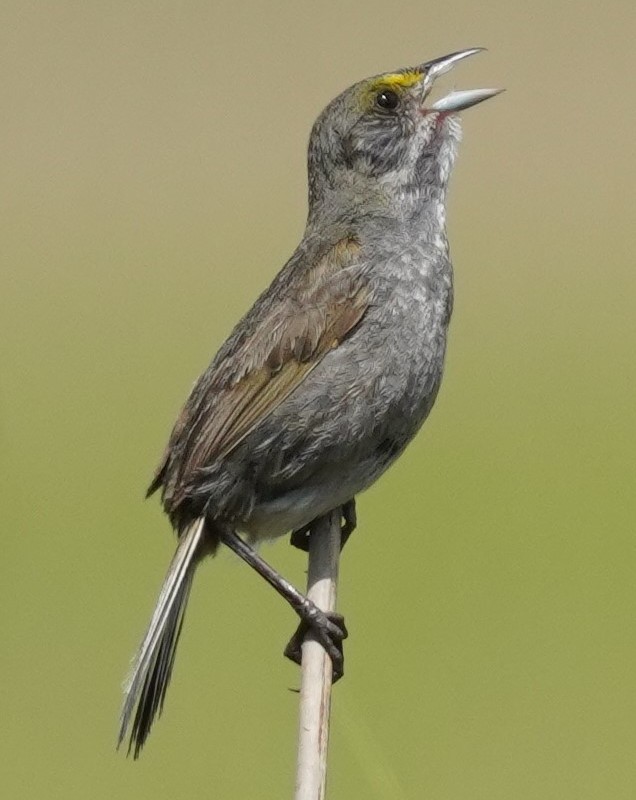
Identifying the Seaside Sparrow involves noting several key characteristics. Adults possess a generally muted coloration, with a grayish-brown back and streaked underparts. A distinctive yellowish streak above the eye can help in differentiating it from similar species. Juveniles appear similar to adults but may exhibit slightly duller plumage. Males and females show little sexual dimorphism, making them hard to distinguish through plumage alone. The bird's small size, typically around 14 cm in length, also aids in identification. While in flight, the Seaside Sparrow shows a relatively short tail and rounded wings, giving it a compact silhouette. When perched, it often adopts a hunched posture, which can be seen as it navigates through its marshy habitat. Potential confusion with the Nelson's Sparrow and Saltmarsh Sparrow can occur, but these species often inhabit slightly different areas or display variations in plumage and song.
Having trouble telling birds apart? Upload a photo to our bird identification tool for an instant species match.
Seaside Sparrow Habitat and Range
Preferred Habitat
The Seaside Sparrow thrives in coastal salt marshes, a habitat characterized by tidal waters and dense grasses. These environments are found at sea level, mainly along the eastern seaboard. The sparrow prefers areas with abundant Spartina grasses, which provide both food and cover. While they are predominantly found in rural wetland areas, they can occasionally be seen near urban coastal developments if suitable marshland exists. Seasonal habitat shifts may occur in response to tidal changes, but the sparrow largely remains within the coastal marshes year-round. Unlike many other sparrows, the Seaside Sparrow is rarely found in inland or upland areas, reflecting its specialization for life at the water's edge.
Geographic Range
The Seaside Sparrow's range is primarily confined to the coastal regions of the southeastern United States. It breeds along the Gulf Coast from Texas through Florida and up the Atlantic Coast to southern New England. During winter, some northern populations migrate to more southerly locations, including Florida and the Gulf Coast. The bird's presence is most concentrated in areas like the Florida Everglades and the salt marshes of Georgia and South Carolina, which serve as population density hotspots. Migration corridors are relatively narrow, as this sparrow does not undertake long-distance migrations like some of its relatives.
Want to know which birds visit your area? Browse our backyard birds by location guides for region-specific species lists.
What Does the Seaside Sparrow Eat?
The diet of the Seaside Sparrow consists predominantly of insects and other invertebrates, which it gleans from the marsh grasses and mudflats. During the breeding season, it focuses on insects such as beetles and caterpillars, providing essential protein for growing chicks. In winter, the diet broadens to include seeds and small crustaceans. Foraging behavior involves walking or hopping through the vegetation, rarely venturing into open water. The sparrow typically feeds during daylight hours, with a peak in activity during the early morning and late afternoon. Prey items are relatively small, matching the bird's diminutive size, and are often captured directly from the plant surfaces or the ground.
Seaside Sparrow Behavior and Social Structure
Seaside Sparrows exhibit a fairly solitary lifestyle outside of the breeding season, though they may form loose flocks in winter. Their territorial behavior becomes pronounced during the breeding season, when males sing from prominent perches to establish and defend their territories. Courtship displays include aerial chases and vocalizations. When threatened by predators, such as birds of prey, the sparrows rely on their cryptic plumage to blend into the marsh vegetation. They are primarily diurnal, with most activity occurring during daylight hours, particularly feeding and territorial singing. At night, they roost low in the grass to avoid detection by nocturnal predators.
Seaside Sparrow Nesting and Reproduction
The Seaside Sparrow constructs its nest in dense marsh vegetation, often choosing locations elevated slightly above the high tide line to avoid flooding. The nest is a cup-shaped structure made from grasses and lined with finer plant materials. Clutch size typically ranges from three to five eggs, with an incubation period of about 12 to 14 days. Both parents participate in feeding the young, which fledge approximately 10 to 12 days after hatching. The sparrow may have two broods per year, particularly in its southern range, where the breeding season is longer.
Seaside Sparrow Sounds and Vocalizations
The primary song of the Seaside Sparrow is a series of buzzy notes, often described as a raspy 'tsip-tsip-zeeeeee,' with the final note drawn out. This song serves to establish territory and attract mates, particularly during the dawn chorus when activity peaks. Call notes are typically short and metallic, used for communication between individuals. Alarm calls, which are harsher and more urgent, are given in response to perceived threats. These vocalizations are less melodious than some other sparrows, reflecting the species' adaptation to noisy, windswept marsh environments.
Interesting Facts About the Seaside Sparrow
- 1Seaside Sparrows are one of the few bird species almost entirely restricted to salt marsh habitats.
- 2They have a remarkable ability to survive tidal flooding by building their nests just above the high tide line.
- 3During high tides, Seaside Sparrows often retreat to higher marsh areas to avoid the rising water.
- 4Unlike many sparrows, Seaside Sparrows show little sexual dimorphism, making males and females difficult to distinguish.
- 5Seaside Sparrows have a relatively small range, confined to the coastal margins of the southeastern United States.
- 6Despite their drab appearance, Seaside Sparrows play a crucial role in controlling insect populations in salt marshes.
- 7The song of the Seaside Sparrow is less complex than many other sparrows, adapted to carry over the windy marshes.
Seaside Sparrow Conservation Status
The Seaside Sparrow is currently listed as a species of Least Concern by the IUCN, but its populations are subject to pressures from habitat destruction and climate change. Rising sea levels and coastal development pose significant threats to its salt marsh habitat. Conservation efforts focus on preserving and restoring these crucial environments, with some success seen in areas where marshland has been protected or rehabilitated. Historical population declines have been noted in regions where marshes have been degraded, but concerted conservation work has led to stability or increases in some locales.
Other Passerellidae Species


Birds Similar to the Seaside Sparrow
These species are often confused with the Seaside Sparrow due to similar appearance or overlapping range.


