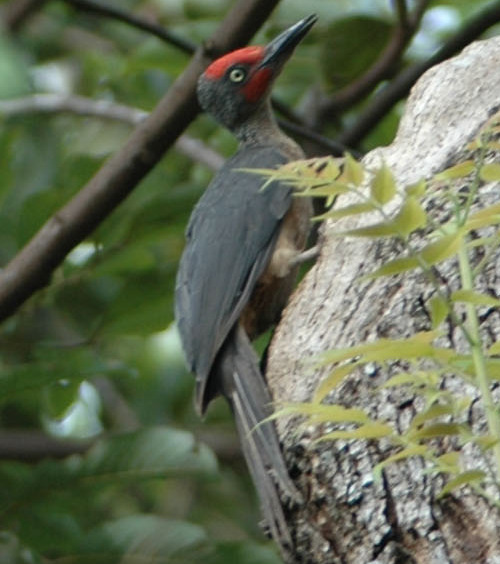
Northern Sooty-Woodpecker
Mulleripicus funebris
Order: Piciformes / Family: Picidae

Wikimedia Commons
About the Northern Sooty-Woodpecker
The Northern Sooty-Woodpecker, scientifically named Mulleripicus funebris, is a large woodpecker endemic to the Philippines. This bird is a member of the Picidae family, which encompasses various woodpecker species known for their drumming behavior. Unlike many woodpeckers that exhibit colorful plumage, the Northern Sooty-Woodpecker stands out with its distinctive dark appearance, which provides excellent camouflage within its preferred forest habitats.
This species is primarily found in the lowland and montane forests of Luzon, Mindoro, and other islands in the Philippines. It plays a critical ecological role in these regions by controlling insect populations and aiding in the dispersal of tree seeds. Its presence indicates a healthy forest ecosystem as it requires large tracts of undisturbed forest to thrive.
The Northern Sooty-Woodpecker exhibits interesting seasonal behaviors, particularly during the breeding season when it becomes more vocal and active. Unlike some migratory woodpeckers, this species remains within its territory year-round. During the rainy season, food availability increases, leading to heightened foraging activity. The woodpecker's drumming patterns also intensify during this time, serving as both a mating call and a territorial signal.
The Northern Sooty-Woodpecker belongs to the family Picidae, within the order Piciformes. These birds typically live average 6-10 years with records up to 14 years..
How to Identify a Northern Sooty-Woodpecker
The Northern Sooty-Woodpecker can be distinguished by its large size and entirely black plumage, which is unusual among its more colorful relatives. Adults display a uniform sooty-black coloration with a slightly glossy sheen, making them a striking presence in the dense canopy. Juveniles resemble adults but may have a slightly duller appearance with some brownish tinges.
Males and females of the species are similar in appearance, although males may exhibit a marginally brighter gloss on their feathers. A key identification feature is the woodpecker's robust bill, which is strong and tapering, adapted for drilling into tough wood to extract insects.
In flight, the Northern Sooty-Woodpecker displays a powerful and direct flight pattern, characterized by rapid wingbeats and a slightly undulating trajectory. When perched, it typically adopts an upright posture, clinging vertically to tree trunks. This posture, combined with its dark coloration, can make it challenging to spot against the bark.
Having trouble telling birds apart? Upload a photo to our bird identification tool for an instant species match.
Northern Sooty-Woodpecker Habitat and Range
Preferred Habitat
The Northern Sooty-Woodpecker resides primarily in lowland and montane forests, preferring areas with mature trees and dense foliage. It is most commonly found at elevations ranging from sea level up to 1500 meters. These habitats provide the necessary resources for foraging and nesting.
During the dry season, the woodpecker may shift slightly within its range to lower elevations where moisture levels and food sources remain more abundant. Despite its preference for forested areas, the Northern Sooty-Woodpecker occasionally ventures into adjacent secondary forests and woodland edges when searching for food.
This bird is not commonly found in urban or highly disturbed areas, as it relies on large, contiguous tracts of forest to sustain its population. The presence of old-growth trees is particularly important for nesting and foraging activities.
Geographic Range
The Northern Sooty-Woodpecker is found exclusively in the Philippines, with its range extending across several islands. Its primary habitats include the islands of Luzon, Mindoro, and parts of Sibuyan and Samar.
As a non-migratory species, the Northern Sooty-Woodpecker does not exhibit long-distance seasonal movements, maintaining territories within these islands throughout the year. However, localized movements may occur within its range, particularly in response to seasonal changes in food availability.
Within its range, population densities can vary significantly depending on habitat quality. The bird tends to be more abundant in undisturbed forest areas, while fragmented habitats may support smaller, isolated populations.
Want to know which birds visit your area? Browse our backyard birds by location guides for region-specific species lists.
What Does the Northern Sooty-Woodpecker Eat?
The Northern Sooty-Woodpecker primarily feeds on insects, with a particular preference for beetle larvae and ants. Its powerful bill allows it to excavate deep into tree bark and wood to access these prey items.
During the rainy season, the abundance of insects increases, providing a critical food source for the woodpecker. In addition to insects, the Northern Sooty-Woodpecker occasionally consumes fruits and seeds, especially during periods when insect prey is scarce. This dietary flexibility helps it survive in varying environmental conditions.
Foraging typically occurs during the early morning and late afternoon, although the bird may be active throughout the day, especially during the breeding season. It employs a methodical approach, moving systematically along tree trunks and branches to locate and extract prey.
Northern Sooty-Woodpecker Behavior and Social Structure
The Northern Sooty-Woodpecker exhibits intriguing social and territorial behaviors. It is generally solitary or found in pairs, particularly during the breeding season. This species is highly territorial, with individuals vigorously defending their home range through vocalizations and drumming.
Courtship displays involve mutual drumming and calling, as well as aerial displays where the birds perform short flights with exaggerated wingbeats. Once paired, the woodpeckers remain together throughout the breeding season, cooperating in nest construction and chick rearing.
In response to predators, the Northern Sooty-Woodpecker relies on its cryptic coloration to remain undetected. When alarmed, it may emit a sharp call that serves as a warning to other birds in the vicinity. Daily activity patterns typically involve early morning and late afternoon foraging, with periods of rest during the heat of the day.
Northern Sooty-Woodpecker Nesting and Reproduction
The Northern Sooty-Woodpecker constructs its nest within cavities excavated in large, mature trees. These cavities are typically located several meters above the ground, providing protection from ground-based predators.
Both the male and female participate in the excavation process, using their strong bills to create a suitable nest chamber. The pair may take several weeks to complete the nest, ensuring it is secure and insulated.
Clutch size generally ranges from two to four eggs, which are incubated for approximately two weeks. Both parents share incubation duties, as well as the feeding of the chicks once they hatch. Fledging occurs about three to four weeks after hatching, with young birds remaining with their parents for a short period before dispersing. This species typically raises one brood per year.
Northern Sooty-Woodpecker Sounds and Vocalizations
The primary vocalization of the Northern Sooty-Woodpecker is a series of sharp, rapid 'pik-pik-pik' notes that carry effectively through the forest. This call serves both as a territorial declaration and a contact call between mates.
In addition to vocal calls, the woodpecker's drumming plays a crucial role in communication. The drumming is a rapid sequence of strikes on a resonant tree trunk, producing a deep, resonant sound that can be heard over considerable distances.
Alarm calls are shorter and more abrupt, signaling potential threats. During the dawn chorus, the Northern Sooty-Woodpecker's calls blend with those of other forest birds, creating a vibrant tapestry of sound.
Interesting Facts About the Northern Sooty-Woodpecker
- 1The Northern Sooty-Woodpecker's drumming can reach up to 19 beats per second, a speed matched by few other woodpeckers.
- 2Despite its large size, the Northern Sooty-Woodpecker can remain virtually invisible against tree bark due to its dark plumage.
- 3This species' powerful bill can exert a force up to 1,200 g, allowing it to chisel through tough wood.
- 4The Northern Sooty-Woodpecker's tongue can extend over 10 cm, enabling it to reach deep into crevices for insects.
- 5It is one of the few woodpeckers that can thrive in the humid, tropical climates of the Philippine lowlands.
- 6Studies have shown that the Northern Sooty-Woodpecker plays a role in controlling pest insect populations in forests.
- 7The bird's territorial calls can be heard up to 500 meters away, making it a dominant auditory presence in its habitat.
Northern Sooty-Woodpecker Conservation Status
The Northern Sooty-Woodpecker is currently listed as Near Threatened by the IUCN. Its population trend is decreasing due to habitat loss from logging, agricultural expansion, and urban development. Conservation efforts focus on preserving and restoring forest habitats, particularly in protected areas and nature reserves. Implementation of sustainable forestry practices is also critical for maintaining suitable environments for this species. Historically, the Northern Sooty-Woodpecker's population has fluctuated in response to changes in forest cover. Continued habitat destruction poses the most significant threat to its survival, underscoring the need for concerted conservation action.
Other Picidae Species


Birds Similar to the Northern Sooty-Woodpecker
These species are often confused with the Northern Sooty-Woodpecker due to similar appearance or overlapping range.