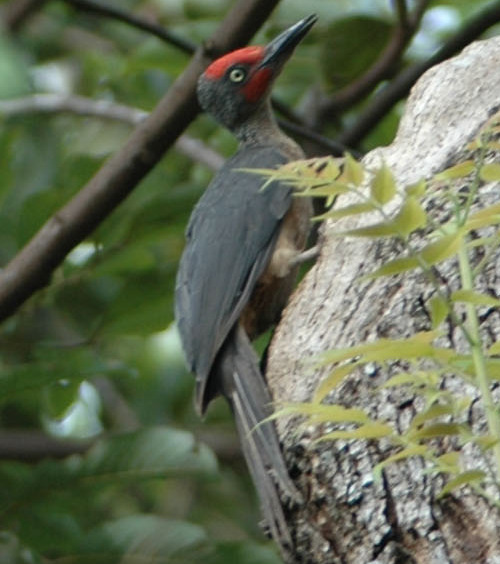
Southern Sooty-Woodpecker
Mulleripicus fuliginosus
Order: Piciformes / Family: Picidae

Wikimedia Commons
About the Southern Sooty-Woodpecker
The Southern Sooty-Woodpecker, scientifically known as Mulleripicus fuliginosus, is a remarkable bird species endemic to the Philippines. This bird belongs to the family Picidae and is primarily found in the lush, dense lowland forests of the islands. Its presence is a testament to the rich biodiversity of these Philippine forests. The Southern Sooty-Woodpecker plays a vital ecological role in its habitat, assisting in the control of insect populations and contributing to the health of the forest ecosystem by facilitating tree growth through its foraging activities. This woodpecker is typically observed in primary and secondary forests, with a preference for areas that provide ample foliage and a diversity of tree species. Seasonal behaviors include noticeable changes during the breeding season when the birds become more vocal and are often seen engaging in territorial drumming. The Southern Sooty-Woodpecker remains active year-round, with no significant migratory behavior, making it an integral part of the forest's dynamic system throughout the year. Its presence in these regions underscores the importance of conservation efforts aimed at preserving the natural habitats that support such specialized and ecologically significant species.
The Southern Sooty-Woodpecker belongs to the family Picidae, within the order Piciformes. These birds typically live average 6-8 years with a maximum recorded up to 12 years..
How to Identify a Southern Sooty-Woodpecker
The Southern Sooty-Woodpecker is a large woodpecker, identifiable by its predominantly sooty black plumage, which gives the bird its name. Adult males typically exhibit a darker, more uniform coloration compared to females, which may have slightly lighter, grayish tones on their underparts. The bird's robust bill and stout neck are also key identifying features, aiding in its powerful pecking behavior. Juvenile individuals resemble adults but often have a less uniform coloration, sometimes displaying mottled patterns as they mature. When observing the bird in flight, its silhouette is notable for broad wings and a relatively long tail, which it uses to skillfully navigate through dense forest canopies. Unlike other woodpeckers that might be confused with the Southern Sooty-Woodpecker, such as the Northern Sooty-Woodpecker, this species lacks any prominent white markings on its wings or back, making it distinct within its range. Perching posture is typically upright, with the bird often seen clinging to large tree trunks or branches as it forages.
Having trouble telling birds apart? Upload a photo to our bird identification tool for an instant species match.
Southern Sooty-Woodpecker Habitat and Range
Preferred Habitat
The Southern Sooty-Woodpecker inhabits primarily lowland and montane forests in the Philippines. These forests are characterized by their dense canopy and rich biodiversity, providing ideal conditions for the woodpecker's foraging and nesting activities. At elevations ranging from sea level up to 1,000 meters, the species thrives in both primary and secondary forests. It shows a marked preference for areas with a high density of large, mature trees that offer abundant foraging opportunities. While the Southern Sooty-Woodpecker is seldom found in urban environments, it occasionally ventures into forest edges and plantations adjacent to its natural habitat. There is little evidence of significant seasonal habitat shifts, as the bird remains largely sedentary throughout the year, relying on the consistent availability of resources within its established territories.
Geographic Range
The Southern Sooty-Woodpecker is endemic to the Philippines, with its range primarily confined to the islands of Luzon, Mindanao, and a few other adjacent islands. It inhabits these regions year-round, with no known long-distance migrations. The bird's breeding range is consistent with its overall distribution, as it utilizes the same forested areas for both nesting and foraging activities. Population density is highest in regions where mature forest tracts remain intact, such as the Sierra Madre on Luzon and the Dipterocarp forests on Mindanao. These areas offer the critical resources needed for its survival, including a rich supply of insects and suitable nesting sites. While some local movements may occur in response to food availability, the Southern Sooty-Woodpecker generally exhibits a strong fidelity to its established territories.
Want to know which birds visit your area? Browse our backyard birds by location guides for region-specific species lists.
What Does the Southern Sooty-Woodpecker Eat?
The diet of the Southern Sooty-Woodpecker primarily consists of insects, with a particular preference for wood-boring beetles and their larvae. These insects are located within the bark and wood of trees, necessitating the woodpecker's specialized foraging techniques. The bird uses its strong bill to peck and excavate into tree trunks, extracting insects with precision. Seasonal variations in diet are minimal, though during certain times of the year, the woodpecker may supplement its diet with fruits and seeds when insects are less abundant. Prey size varies, but the bird typically targets medium to large insects that provide substantial nutritional value. Foraging occurs throughout the day, with peak activity periods during the early morning and late afternoon when the forest is cooler and insect activity is heightened.
Southern Sooty-Woodpecker Behavior and Social Structure
The Southern Sooty-Woodpecker exhibits a social structure that is primarily solitary or found in pairs, especially during the breeding season. Territorial behavior is pronounced, with both vocalizations and drumming used to assert dominance and secure nesting sites. Courtship displays involve complex drumming patterns and calls that serve to attract mates and deter rivals. Flocking behavior is uncommon outside of the breeding season, as these woodpeckers maintain individual territories. In response to predators, the Southern Sooty-Woodpecker relies on its cryptic plumage to blend into the forest environment, often freezing in place against tree trunks to avoid detection. Daily activities cycle between periods of active foraging and quieter rest intervals, with the bird remaining alert to changes in its surroundings.
Southern Sooty-Woodpecker Nesting and Reproduction
The Southern Sooty-Woodpecker constructs its nest in natural cavities or excavates holes in large, decaying trees. Nesting sites are typically located between 3 to 15 meters above the ground, providing protection from ground-based predators. The nest is lined with wood chips and other soft materials, ensuring a comfortable environment for the eggs. Clutch size generally ranges from 2 to 4 eggs, with both parents sharing in the incubation duties over a period of approximately 14 to 16 days. Once hatched, the young are altricial and require considerable parental care. Fledging occurs at around 24 to 28 days post-hatching, with both parents actively involved in feeding and protecting the chicks. The Southern Sooty-Woodpecker typically raises one brood per year, although favorable conditions may occasionally lead to a second clutch.
Southern Sooty-Woodpecker Sounds and Vocalizations
The Southern Sooty-Woodpecker's primary song consists of a rapid series of drumming beats, each lasting about 2 to 3 seconds and characterized by a low, resonant pitch. This drumming serves both as a territorial signal and a courtship display, echoing through the dense forest. Call notes are sharp and distinctive, often described as 'pik' or 'chik,' used for communication between pairs or to signal alarm. Alarm calls are more rapid and intense, alerting other birds to potential threats. During the dawn chorus, the woodpecker's drumming is often more frequent, coinciding with heightened territorial activity and vocal exchanges with neighboring individuals.
Interesting Facts About the Southern Sooty-Woodpecker
- 1The Southern Sooty-Woodpecker can peck at a rate of 20 times per second, a testament to its powerful neck muscles.
- 2This woodpecker's diet primarily consists of insects, but it also consumes fruits during certain seasons.
- 3The Southern Sooty-Woodpecker uses drumming not only for communication but also to excavate insects hiding in wood.
- 4Despite being a solitary bird, the Southern Sooty-Woodpecker exhibits strong pair bonds during the breeding season.
- 5The bird's sooty black plumage provides excellent camouflage against the dark bark of the trees it inhabits.
- 6Southern Sooty-Woodpeckers are one of the few species endemic to the Philippines, highlighting their ecological importance.
- 7Their drumming can be heard from over 500 meters away, making it an effective territorial and mating call.
Southern Sooty-Woodpecker Conservation Status
The Southern Sooty-Woodpecker is currently listed as Near Threatened on the IUCN Red List, with its population trend showing a gradual decline. Habitat loss due to deforestation and land conversion for agriculture are the primary threats to its survival. Despite these challenges, local conservation efforts are underway to protect remaining forest tracts and implement sustainable land-use practices. Historical data indicate that population declines have accelerated in recent decades, emphasizing the urgent need for continued conservation action. Efforts to raise awareness and promote habitat restoration are crucial to ensuring the long-term survival of this unique species.
Other Picidae Species


Birds Similar to the Southern Sooty-Woodpecker
These species are often confused with the Southern Sooty-Woodpecker due to similar appearance or overlapping range.